
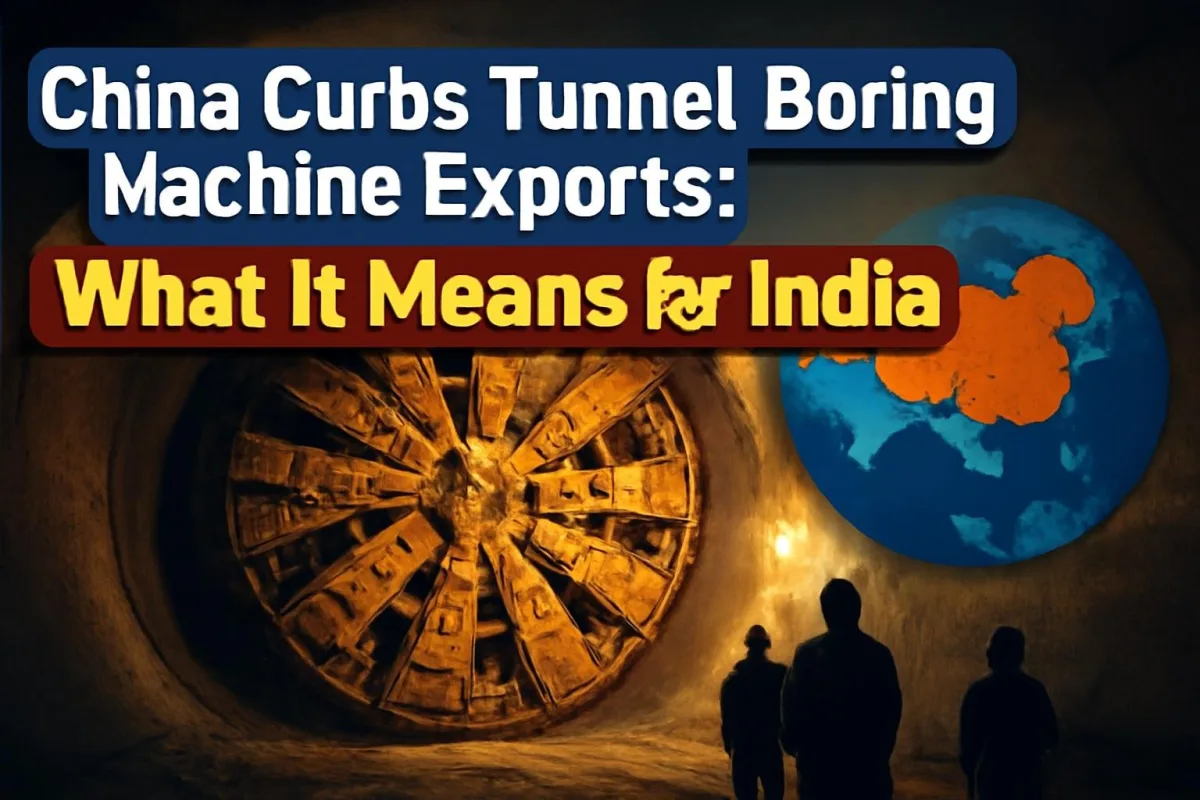
China has placed tunnel boring machines (TBMs), the giant drills used to build metro lines, rail tunnels and highway tunnels, under export controls. The rules, announced on October 19 by China's Ministry of Commerce (MOFCOM) together with its customs administration, take effect on November 18, 2026, and require exporters to obtain licences or register shipments before machines leave the country.
India is not named in the notice, but the move matters here because Chinese-made machines and components are widely used in Indian infrastructure, and Indian officials have complained in the past about TBMs being held up in China.
What China Has Announced
The controls cover earth-pressure-balance and slurry-shield TBMs, specified open, single-shield and double-shield rock-boring machines, and key parts such as cutterheads, screw conveyors, segment erectors and main-drive systems. Some remanufacturing technologies for these machines are also included.
The list goes beyond tunnelling. Walking excavators, plateau-type wet shotcrete machines used at high altitude, and certain large dredger parts such as slurry pumps, impellers, dragheads and cutterheads above specified sizes are also covered. Separately, Beijing said it would adjust export controls on some drone-related items.
Licence, Not a Blanket Ban
Beijing has framed the rules as a dual-use measure, saying the equipment has both civilian and military uses and citing national security and non-proliferation. It is not a blanket ban. Exports to countries and regions in disputes with China will need a licence, while other destinations will need registration and an export certificate. MOFCOM has said applications that meet the requirements will be approved. Exporters must declare controlled items under dual-use codes, and shipments can be held while customs verifies them.
| Key Fact | Details |
|---|---|
| Announced | October 19, 2026, by China's MOFCOM and customs |
| Effective from | November 18, 2026 |
| Main items | Tunnel boring machines and key components |
| Also covered | Walking excavators, high-altitude shotcrete machines, large dredger parts |
| Stated reason | National security, dual-use and non-proliferation |
| China's 2025 exports | About $793 million in tunnelling and rock-cutting machinery (UN Comtrade) |
| India named? | No |
Why India Is Watching
India is in the middle of a tunnelling boom. Metro lines in several cities run underground, the Mumbai-Ahmedabad high-speed rail project has a 21-km underground section of which about 16 km is being bored by TBMs, and the Rishikesh-Karnaprayag railway used a TBM for the first time in Himalayan rock. A twin-tube road-and-rail tunnel under the Brahmaputra in Assam is also in the pipeline.
The issue is not new. In 2024, Commerce Minister Piyush Goyal raised with Germany's then Vice Chancellor Robert Habeck that Beijing was not allowing a German TBM maker's China plant to ship machines to India. Delays in customs clearance have been a recurring complaint for Indian contractors since.
The rules also cover high-altitude equipment, which could matter for road and tunnel work in border regions such as Ladakh and Arunachal Pradesh.
What It Means for Projects and Commuters
For now, there is no confirmed delay to any specific Indian project, and it is not yet clear which machines on Indian sites fall under the new rules. But a licensing step adds paperwork, time and uncertainty. If shipments of new machines or spare cutterheads get stuck, contractors could face delays, and those delays eventually show up as later opening dates for metro lines and tunnels.
India does have options. European and American firms such as Germany's Herrenknecht and the US-based Robbins Company supply TBMs, and Larsen and Toubro has executed large tunnelling projects in India. Building more of the machines and parts domestically is also being discussed as a way to cut dependence.
Quick Explainer: What Is a TBM?
A tunnel boring machine is a huge cylindrical drill that cuts through soil or rock with a rotating cutterhead at the front, while lining the tunnel behind it with concrete segments. It allows tunnels to be built under busy cities with far less disruption than digging open trenches, which is why almost every underground metro line in India relies on them. A single machine can be hundreds of tonnes and is often custom-built for the soil conditions of one project.
What Happens Next
Indian contractors and project agencies will be studying the fine print before November 18 to see which orders are affected. The rules arrive alongside a separate Chinese proposal to restrict exports of several technologies, including some AI, biotech and solar know-how, which suggests Beijing is widening its use of export controls. How New Delhi responds, through talks or by speeding up alternative sourcing, will shape the impact on India's infrastructure timelines.





Comments (0)