
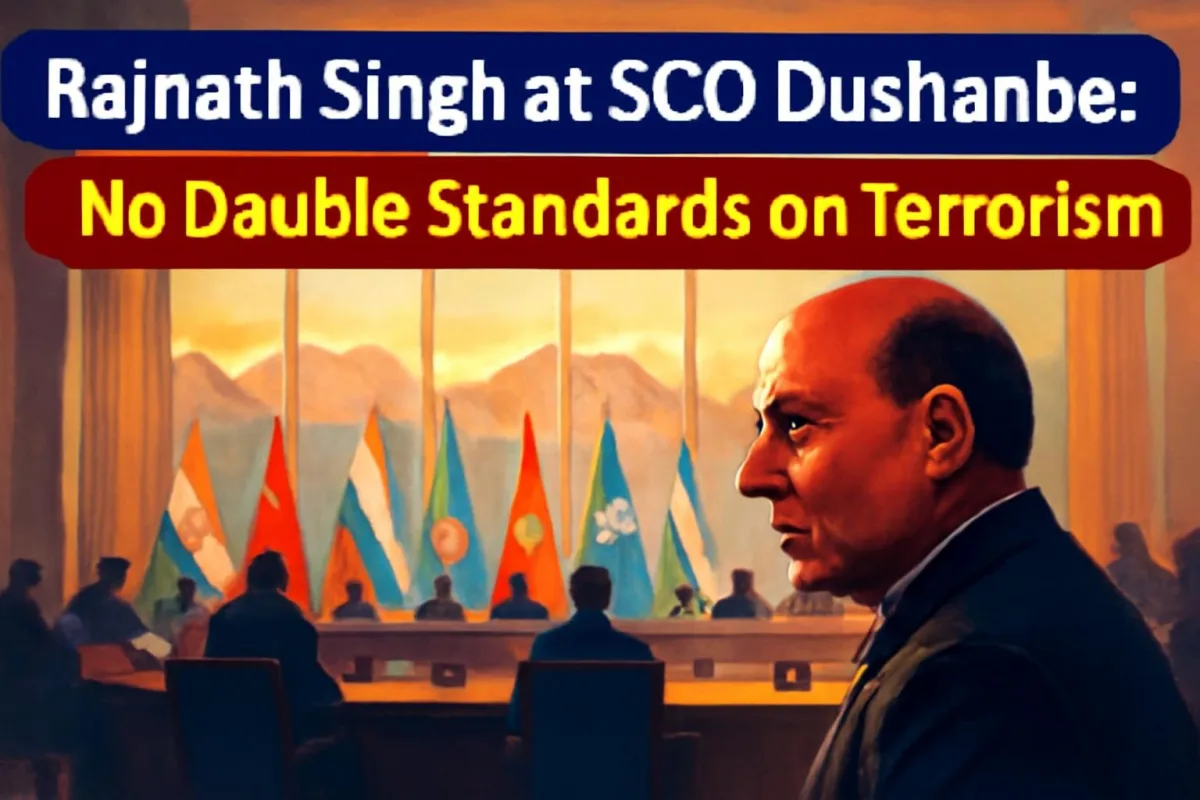
Defence Minister Rajnath Singh used India's seat at the Shanghai Cooperation Organisation (SCO) to deliver a blunt message on terrorism. Speaking at the 25th meeting of the SCO Council of Heads of Government in Dushanbe, Tajikistan, on October 20, he said there can be "no justification for terrorism, no double standards in addressing it", while Pakistan's Deputy Prime Minister and Foreign Minister Ishaq Dar sat across the table.
Singh represented India on a two-day official visit to Tajikistan. Alongside the security message, he pushed for practical economic cooperation, better connectivity and visible benefits for young people across the region.
What Rajnath Singh Said on Terrorism
Singh described terrorism as "one of the gravest threats to development" and said it "radicalises societies and keeps our youth devoid of opportunities that they deserve". He told the gathering: "There can be no space for people who finance and support terrorists or provide them a safe haven," and added that "the entire ecosystem of terrorism should be ended strongly and collectively".
The phrase "ecosystem of terrorism" echoes the language Prime Minister Narendra Modi used at the SCO level in September, when he asked member states to dismantle it. India has long accused Pakistan of backing cross-border terrorism, and relations remain tense after the April 2025 Pahalgam attack, in which 26 people were killed, and India's Operation Sindoor that followed two weeks later.
Ishaq Dar in the Room
The remarks drew attention because Dar was present as Pakistan's representative. Pakistan's foreign ministry posted footage of the session. There were no reports of any bilateral meeting between the two sides on the sidelines.
Economy, Trade and Connectivity
Singh argued that the SCO's success should be judged by results on the ground. "Our success should be measured by the opportunities we create for youth," he said, adding that it should also mean new markets for entrepreneurs and better technology for farmers and small businesses.
India backed the adoption of the SCO's trade and economic cooperation action plan for 2026-2030. The meeting adopted that plan, a joint communique and the SCO budget for 2027. Singh called for resilient supply chains, easier trade and investment, simpler customs procedures, digital documentation and lower costs for business.
On connectivity, he highlighted the International North-South Transport Corridor (INSTC) and Chabahar Port as routes linking Central Asia with global markets, while stressing that connectivity projects must be consultative and respect sovereignty and territorial integrity, a principle India often raises in the context of projects that pass through disputed territory.
| Key Fact | Details |
|---|---|
| Meeting | 25th SCO Council of Heads of Government |
| Date | October 20, 2026 |
| Venue | Dushanbe, Tajikistan |
| India represented by | Defence Minister Rajnath Singh |
| Pakistan represented by | Deputy PM and Foreign Minister Ishaq Dar |
| Documents adopted | Joint communique, SCO budget 2027, 2026-2030 economic action plan |
| Connectivity focus | INSTC and Chabahar Port |
| Upcoming | First SCO Civilisational Dialogue Forum, hosted by India later in 2026 |
India's Pitch: DPI, Start-ups and Green Alliances
Singh presented India's Digital Public Infrastructure, its start-up ecosystem and women-led development as models other members could draw on. He listed India-led initiatives such as the International Solar Alliance, the Coalition for Disaster Resilient Infrastructure, Mission LiFE and the Global Biofuel Alliance.
He welcomed decisions taken at the Bishkek summit to make the Universal Centre in Tashkent and the Anti-Drug Centre in Dushanbe permanent SCO bodies, but cautioned that new institutions should avoid duplication and show measurable results. He also invited members to the first SCO Civilisational Dialogue Forum, which India will host later this year.
What It Means for India
For India, the SCO is one of the few forums where it sits at the same table as both China and Pakistan. Restating a firm line on terrorism there keeps the issue on the regional agenda. At the same time, the push on trade, Chabahar and the INSTC shows New Delhi wants the grouping to deliver economic gains, particularly better access to Central Asian markets that are hard to reach overland.
What Happens Next
India will now prepare to host the SCO Civilisational Dialogue Forum. Implementation of the 2026-2030 economic action plan and progress on connectivity corridors will be the real test of whether the meeting's commitments translate into trade and jobs for member countries.





Comments (0)