
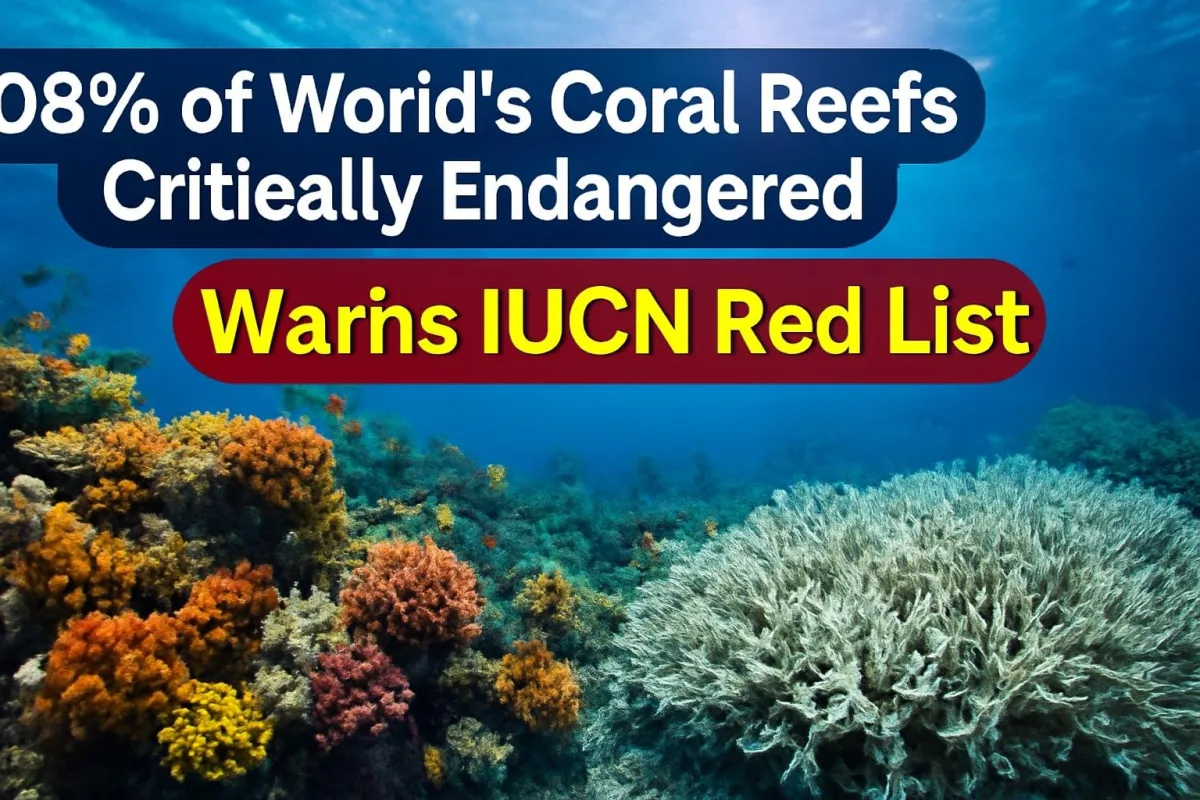
Almost every shallow-water coral reef on the planet is now at an extremely high risk of collapse, the International Union for Conservation of Nature (IUCN) said on October 22. In its first-ever global assessment of coral reef ecosystems under the IUCN Red List of Ecosystems, the body classified 96 per cent of them as Critically Endangered – the highest threat category – and warned that they could collapse by 2075.
The findings were announced at a news conference during the UN's COP17 biodiversity summit in Yerevan, Armenia, and cover famous reef systems from Australia's Great Barrier Reef to the Red Sea.
What the Assessment Found
Scientists assessed warm, shallow-water coral reefs across 127 tropical and subtropical ecoregions, covering 188,362 square kilometres of reef. More than 250 experts contributed, with data on reefs in over 80 countries and territories. The work was coordinated by the IUCN and its Commission on Ecosystem Management along with the University of Melbourne and CORDIO East Africa.
The Great Barrier Reef, the Coral Triangle, the Mesoamerican Barrier Reef System and the Red Sea reefs were all classified as Critically Endangered. Reefs in the Western Galápagos Islands are already considered collapsed, a status dating back to the 1982-83 El Niño. Four ecoregions did not have enough data to be assessed.
| Key Fact | Details |
|---|---|
| Assessed by | IUCN Red List of Ecosystems |
| Announced | October 22, 2026, at COP17 in Yerevan, Armenia |
| Coverage | 127 ecoregions, 188,362 sq km of shallow-water reefs |
| Critically Endangered | 96% of reef ecosystems |
| Collapse risk window | Within 50 years (by 2075) |
| Main driver | Heat stress from climate change |
| Overfishing impact | Threatens 63% of reef ecosystems |
| Experts involved | More than 250, covering 80+ countries and territories |
Heat is the main killer
The assessment found that heat stress caused by climate change is the most consistent driver of reef decline. Corals are extremely sensitive to warm water; when seas heat up, they expel the algae that live in their tissues and turn white – a process called bleaching. Repeated bleaching leaves too little time for recovery, and eventually the hard corals give way to algae, rubble and sponges. At that point the reef can no longer support the fish and other life that depend on it.
The projections are based on the UN climate panel's "middle-of-the-road" scenario, under which the world warms by about 2.7°C by the end of the century. Even looking only at observed changes over the past 50 years, without future projections, about 24 per cent of reef ecosystems would already qualify as Critically Endangered.
Overfishing adds pressure
Climate is not the only problem. Overexploitation of key fish groups such as parrotfish and groupers, which help keep reefs healthy, threatens 63 per cent of reef ecosystems, the IUCN said.
"Not Too Late", Say Scientists
Despite the grim numbers, the scientists behind the study stressed that reefs are not yet lost. "It is not too late to give coral reefs a chance to recover," said IUCN Director General Dr Grethel Aguilar.
Dr Mishal Gudka, the scientific lead of the assessment, noted that "coral reefs have shown a remarkable ability to bounce back from devastating bleaching events" and said pockets of resilient reefs can survive if action is taken to protect them.
The warning comes at a worrying time. A "super" El Niño emerging in 2026 poses an added risk to corals, and a week earlier a separate IUCN study found that about 44 per cent of reef-building coral species are threatened with extinction.
What It Means for India
India has some of Asia's most important reef systems – in the Gulf of Mannar and Palk Bay off Tamil Nadu, the Gulf of Kutch in Gujarat, Lakshadweep and the Andaman and Nicobar Islands. While the IUCN release does not single out Indian reefs, these ecosystems sit in the same warming tropical seas and have suffered repeated bleaching in past heatwaves.
For India, the stakes are practical, not just environmental. Reefs support fisheries that feed coastal families, attract tourists to Lakshadweep and the Andamans, and act as natural breakwaters that soften the impact of storms and erosion. Globally, reefs support about a quarter of all marine species.
What Happens Next
The IUCN wants governments at COP17 to treat the findings as an emergency, with deeper cuts in greenhouse gas emissions, better-managed fisheries and stronger protection for reefs that still show resilience. Countries are also expected to use the Red List data to plan local conservation and restoration.



Comments (0)