
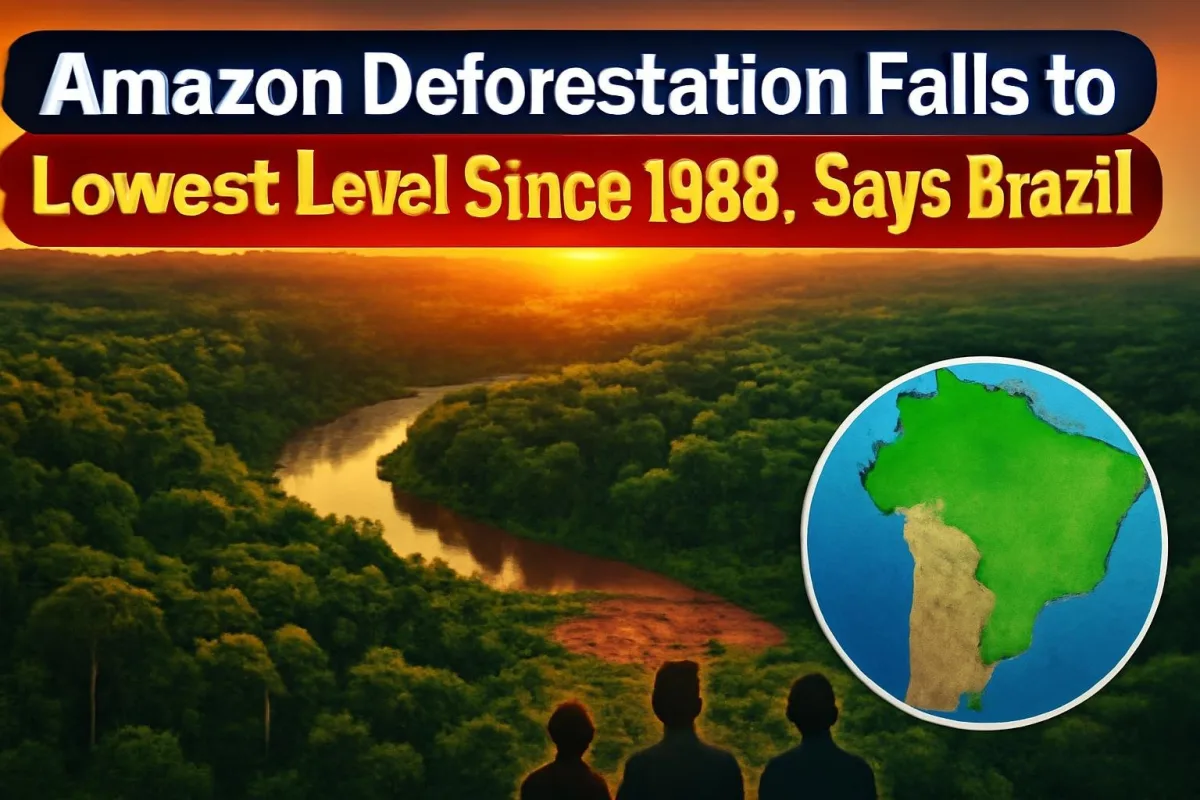
The world's largest rainforest has just recorded its best year in nearly four decades. Brazil's government says deforestation in the Amazon fell to 3,335 square kilometres between August 2025 and July 2026, the lowest figure since satellite monitoring began in 1988. The data, released last week from the PRODES monitoring system run by Brazil's National Institute for Space Research (INPE), lands just days before a presidential runoff that could decide whether the trend continues.
The Numbers Behind the Record Low
The new figure is down about 41.8% from the previous year and roughly 1,236 square kilometres below the earlier record low. That is still a large area, more than twice the size of Delhi, but it marks a dramatic turnaround from a few years ago.
| Indicator | Figure |
|---|---|
| Amazon forest lost (Aug 2025–Jul 2026) | 3,335 sq km |
| Change from previous year | Down about 41.8% |
| Fall since 2023 (government figure) | About 71% |
| Rise during 2019–2022 | About 60%, over 45,000 sq km cleared |
| Largest share by state | Para (33.9%), Mato Grosso (25.5%), Amazonas (15.7%) |
| Cerrado savanna loss | 5,516 sq km, lowest since 2001 |
Para, Mato Grosso and Amazonas, the three states with the most clearing, each saw drops of more than 45%. Roraima was the only state where deforestation rose, and only slightly. The neighbouring Cerrado, a vast savanna that often gets less attention, also recorded its lowest loss since 2001.
What Drove the Decline
Deforestation climbed sharply during the Jair Bolsonaro years from 2019 to 2022. After Luiz Inacio Lula da Silva returned to power in 2023, his government revived a federal action plan first launched in 2004 that had been shelved. It rests on four pillars: monitoring and enforcement, building a sustainable economy, managing protected areas and public forests, and using rules and financial incentives.
In practice, that meant bringing back penalties for illegal clearing spotted by satellite, proposing to bar properties with illegal deforestation from bank loans, sending extra funds to municipalities that cut forest loss, and backing credit for sustainable businesses. Environmental groups say the approach is not new, it simply works when it is enforced.
Not Out of the Woods Yet
Experts caution that clear-cutting is only part of the picture. Forest degradation from wildfires, selective logging and drought now affects around 40% of the Amazon and has outpaced outright clearing in recent years. A strong El Nino could bring hotter, drier conditions in 2026 and 2027, raising the fire risk.
Fire counts had been near historic lows this year, but they have tripled since October 4, the date of the first round of Brazil's elections. Authorities are investigating whether some fires were set deliberately.
The Election Factor
The figures come ahead of the October 25 runoff between Lula and Flavio Bolsonaro, son of the former president. Flavio Bolsonaro led the first round with 47% to Lula's 45%. Both candidates have made forest pledges: Flavio Bolsonaro has promised to end illegal deforestation by 2029, while Lula has pledged zero net deforestation by 2030, with restoration making up for any remaining loss. Former environment minister Marina Silva called the reduction a historic achievement and said the election result would be crucial to sustaining it.
Why It Matters for India
The Amazon stores huge amounts of carbon and helps regulate rainfall far beyond South America, so what happens there affects the global climate that shapes India's monsoon, heatwaves and crop cycles. Deforestation and land-use change are also Brazil's biggest sources of greenhouse gas emissions. As India and Brazil work together in groups like BRICS on climate finance and forest protection, Brazil's results offer a practical example that strict monitoring backed by financial rules can slow forest loss.
What Happens Next
- Brazil votes in the presidential runoff on October 25.
- Investigations into the recent spike in fires will continue.
- Monthly satellite alerts will show whether the decline holds into the 2026-27 season.
There is a lesson in the data for other forest nations too. Brazil's decline came not from a single new law but from steady enforcement: near real-time satellite alerts, penalties that are actually collected, and banks refusing loans to properties linked to illegal clearing. Countries with large forest cover, including India, are studying such tools as they try to protect their own forests while meeting development needs.






Comments (0)