
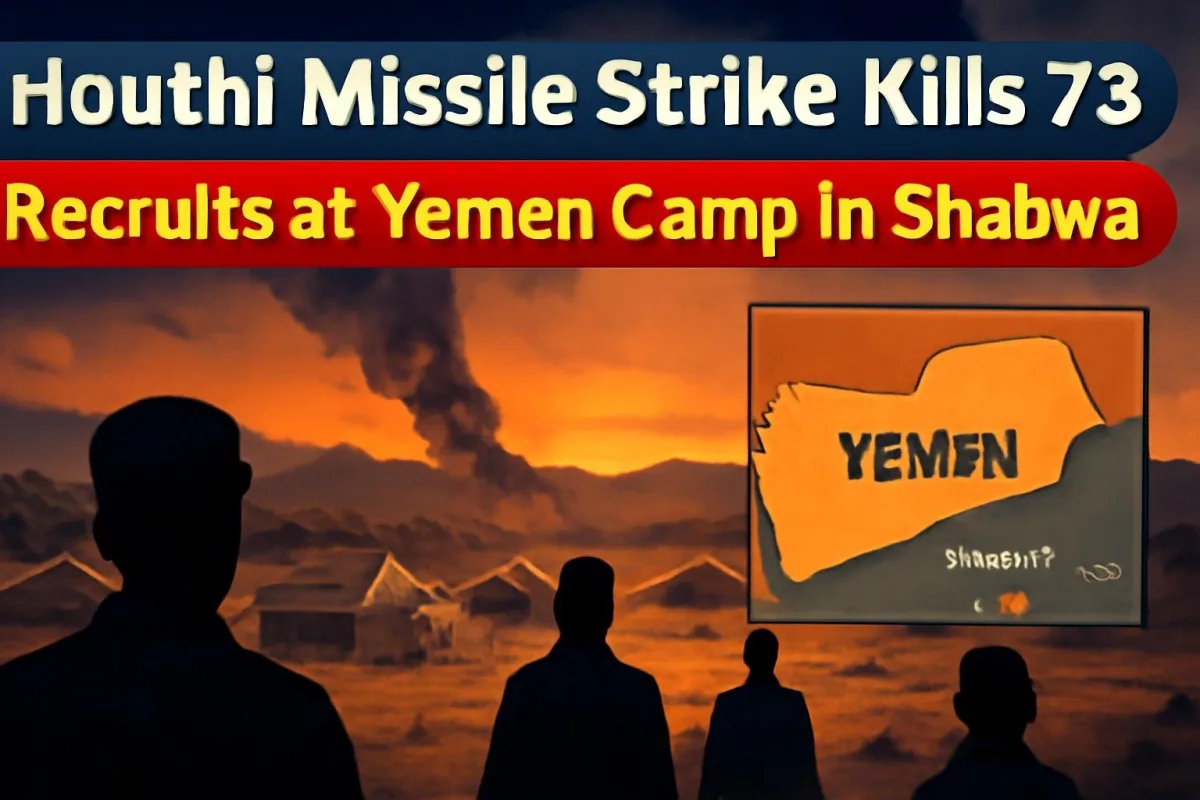
A Houthi missile strike on a government military training camp in southern Yemen has killed 73 people, almost all of them young recruits, making it the deadliest single attack since fighting in the country flared up again three months ago. The strike hit the al-Alam training camp in Shabwa province on Monday, October 19, 2026, as recruits were lining up for a training session.
The death toll climbed through Tuesday. Initial reports put it at more than 50 and then around 60, before a senior Yemeni government official said 73 had died. More than 200 recruits were wounded, and some were still missing a day after the attack.
What Happened at al-Alam Camp
The camp lies in the Jardan district, north of the provincial capital Ataq. Shabwa authorities said three ballistic missiles struck the site. Governor Awad Ibn al-Wazir said the victims were new recruits, aged between 18 and 20 and drawn from across Shabwa, who were being trained for local security duties rather than frontline combat. He said they had not attacked anyone.
Several of the wounded were in a critical condition and were moved to hospitals in other provinces. Local tribes were hit hard: at least 15 of the dead belonged to the Awlaqi tribe, and the Maraziq tribe lost 16 members, according to reports.
The Iran-backed Houthis claimed responsibility, saying they had killed and wounded dozens, without giving further details.
Shabwa Attack: Key Facts
| Date of attack | Monday, October 19, 2026 |
| Target | Al-Alam training camp, Jardan district, north of Ataq |
| Province | Shabwa, southern Yemen |
| Weapons | Three ballistic missiles, as per local authorities |
| Killed | 73 (latest official toll) |
| Wounded | More than 200 |
| Victims | Recruits aged 18 to 20 training for local security |
| Claimed by | Houthis |
Background: A Collapsing Ceasefire
Yemen's civil war began in 2014 when the Houthis seized the capital Sanaa, and a Saudi-led coalition joined the fight in 2015. The conflict has killed more than 150,000 people. A ceasefire in 2022 largely halted major fighting, but it broke down in July this year when government forces and the Saudi-led coalition carried out airstrikes on Houthi-held Sanaa International Airport.
Since then, the Houthis have stepped up missile and drone attacks, both inside Yemen and on Saudi Arabia. Shabwa, along with Marib and Hadramawt, forms the government's oil and gas heartland, and the camp sits on a key supply route to Marib, making the area strategically important.
Saudi Arabia Under Fire
The attack came as Saudi Arabia faced its own pressure. On Tuesday, the kingdom said it intercepted a Houthi ballistic missile near Riyadh after an explosion was heard in the north of the city, close to King Khalid International Airport. The airport has faced repeated attacks this month and has suspended operations.
Western allies have pledged support but stopped short of direct combat. US envoy Tom Barrack said Washington backs Saudi Arabia and will provide logistical support but will not send troops into a ground war. Britain said it will expand Royal Air Force defensive patrols to protect Saudi cities but will not strike Houthi targets.
What It Means for India
The Gulf is home to millions of Indian workers and their families, and Saudi Arabia hosts one of the largest Indian communities abroad. Disruption at Riyadh's main airport affects travel for many of them. India also depends heavily on Gulf energy and on safe shipping through nearby waters. External Affairs Minister S Jaishankar this week described the Gulf situation as a matter of deep concern and called for dialogue and diplomacy, while reaffirming India's support for the free and safe flow of trade, energy and fertiliser.
What Happens Next
Rescue and identification work continues in Shabwa, and the toll could change as more information comes in. The strike is likely to harden positions on both sides, and with Saudi cities also under attack, the risk of a wider regional escalation remains high. Indians living or travelling in the region are advised to follow updates from Indian missions and airline advisories closely.





Comments (0)