
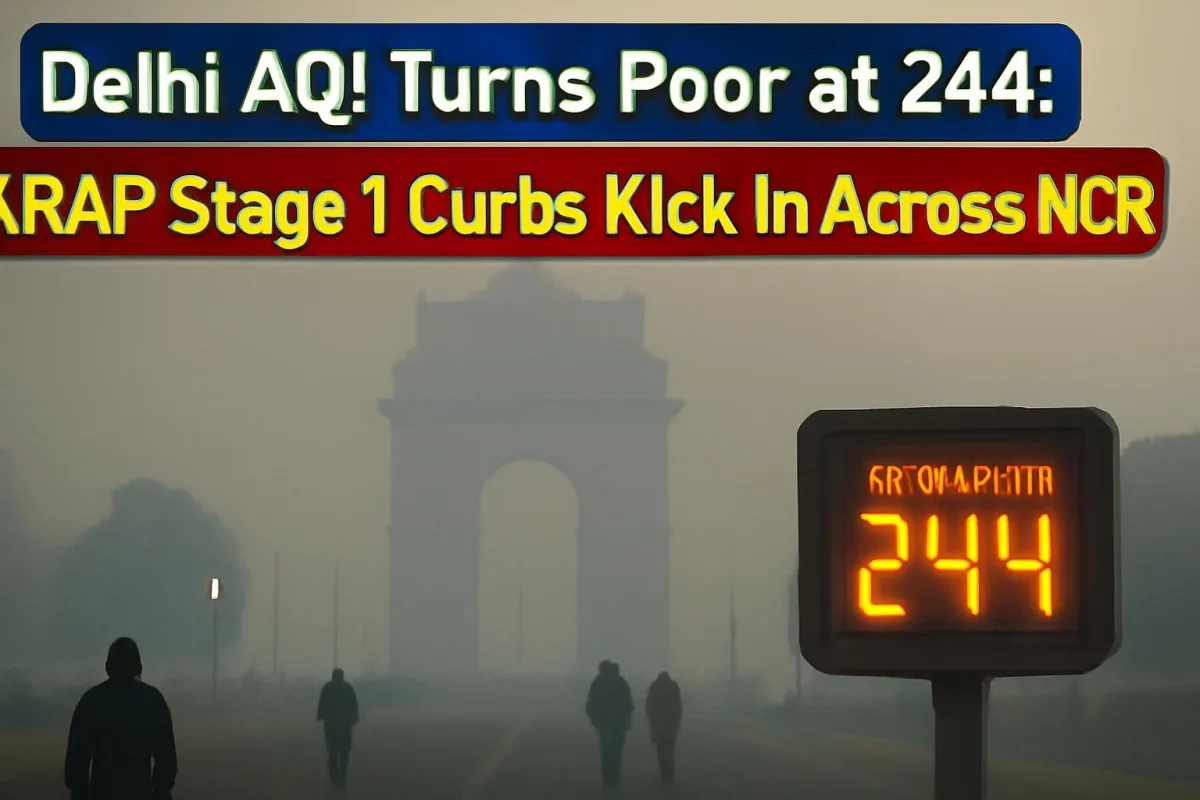
Winter's first pollution alarm has gone off in the capital. Delhi's Air Quality Index jumped from 179 on Tuesday to 244 by 2 pm on Wednesday, October 21, pushing the city into the "poor" category and prompting the Commission for Air Quality Management (CAQM) to enforce Stage 1 of the Graded Response Action Plan (GRAP) across the entire National Capital Region with immediate effect.
This is the first time GRAP has been invoked this season, and the forecast offers little relief: weather agencies expect the air to stay "poor" for the next few days.
How quickly the air turned
On Tuesday, Delhi's 24-hour average AQI stood at 179, which falls in the "moderate" band. By 9 am on Wednesday, data from the Central Pollution Control Board showed the number had climbed to 233, and by 2 pm it had touched 244. CAQM described this as a "sharp rise" in its order.
A GRAP sub-committee met on Wednesday, reviewed the air quality across the region and decided to bring in Stage 1 actions at once. The commission noted that forecasts from the India Meteorological Department (IMD) and the Indian Institute of Tropical Meteorology (IITM) "predicted AQI to remain in 'Poor' category in the coming days."
What GRAP Stage 1 means on the ground
GRAP is a tiered emergency plan that tightens restrictions as the AQI worsens. Stage 1 applies when the AQI is between 201 and 300. Under it, agencies across Delhi, and the NCR districts of Haryana, Uttar Pradesh and Rajasthan, are expected to step up:
- Mechanised sweeping of roads and regular water sprinkling to keep dust down.
- Dust-control rules at construction and demolition sites.
- Better waste management and strict prevention of open burning of garbage and biomass.
- Checks on visibly polluting vehicles and smoother traffic management at congestion points.
- Emission norms at industries, power plants and brick kilns.
CAQM has asked all implementing agencies to monitor these measures closely so that the AQI does not slip further, and has urged residents to follow the Stage 1 citizen charter – simple steps such as keeping vehicle engines tuned, carrying a valid pollution certificate, avoiding idling at red lights and not burning waste.
Key numbers at a glance
| AQI on Oct 20 | 179 (Moderate) |
| AQI on Oct 21, 9 am | 233 (Poor) |
| AQI on Oct 21, 2 pm | 244 (Poor) |
| Stage invoked | GRAP Stage 1 (AQI 201-300) |
| Area covered | Entire Delhi-NCR |
| Stage 2 trigger | AQI 301-400 |
| Stage 3 trigger | AQI 401-450 |
| Stage 4 trigger | AQI above 450 |
Delhi government's response
Delhi Environment Minister Manjinder Singh Sirsa said the government is working alongside the Centre under an 11-point action plan. Among the steps he highlighted are refusing fuel to vehicles without a valid Pollution Under Control (PUC) certificate, higher parking charges across the city except at Metro parking, staggered office hours and work-from-home arrangements in government and MCD offices, and a strict ban on open burning.
The city has deployed 608 anti-smog guns and 1,150 mist-spray units, according to the minister, while an integrated command centre is tracking dust from construction sites and an AI-based traffic system is being used to cut vehicle emissions.
Sirsa also claimed that Delhi recorded 214 days of "good" or "moderate" air this year, which he called the best figure in 12 years outside the COVID-hit period, and said GRAP had been triggered later this season than in previous years. He listed long-term goals such as removing dust from every road, end-to-end road carpeting and a faster shift to electric vehicles.
What it means for you
A "poor" AQI can cause breathing discomfort for many people on prolonged exposure, and the risk is higher for children, older adults and anyone with heart or lung problems. Doctors generally advise limiting strenuous outdoor exercise during the early morning and late evening, when pollution tends to settle closer to the ground, and keeping an eye on daily AQI readings before planning outdoor activities.
Drivers should make sure their PUC certificate is up to date, since enforcement checks usually intensify once GRAP is in place.
What happens next
The CAQM sub-committee will keep reviewing the situation using Delhi's AQI and IMD-IITM forecasts. If the index crosses 300 and enters the "very poor" range, Stage 2 measures – including tighter controls on diesel generators and more public transport – would follow. With the festive season and colder, calmer nights approaching, the coming weeks will be a real test of whether this year's measures can keep Delhi out of the higher stages.



Comments (0)