
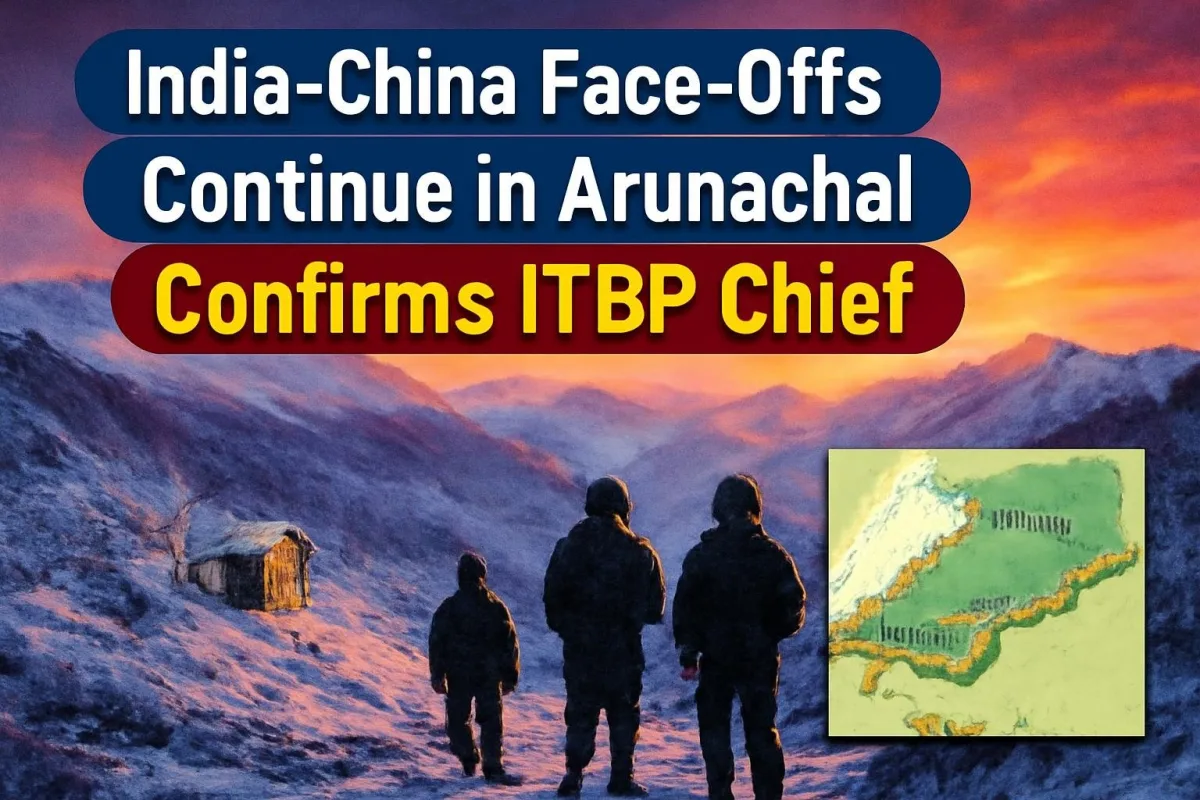
For months there were only whispers. Now the man who leads the force guarding India's Himalayan frontier has said it out loud: Indian and Chinese troops are facing off at more than one location in Arunachal Pradesh, and the standoff has not ended. Indo-Tibetan Border Police (ITBP) Director General Shatrujeet Kapur made the remarks at a ceremony for his personnel in Alwar, Rajasthan, on October 22, just two days before the force marks its 65th Raising Day today, October 24.
"Face-off happened at several locations in Arunachal and it still continues," Kapur said, as reported by The Hindu. It is the first official acknowledgement of how widespread the friction along the eastern sector has become since July.
Where the standoff is
According to government sources quoted in reports, the most prominent standoff is at Asaphila, close to Taksing in Arunachal Pradesh's Upper Subansiri district. It began during a routine patrol in July near the Maja company operating base. Both sides initially pulled back, but personnel of China's People's Liberation Army (PLA) returned a few days later in larger numbers and pitched tents on higher ground roughly 6 to 7 km inside what India regards as its side of the Line of Actual Control (LAC).
India has since increased its own deployment in the area. Kapur said the force's newly raised Shaurya commando platoons had played an "exemplary role" in handling the situation on the ground.
Key facts
| Who confirmed it | ITBP Director General Shatrujeet Kapur |
| Where he spoke | Himveer Samman Samaroh, Alwar, Rajasthan, October 22 |
| Main standoff point | Asaphila, near Taksing, Upper Subansiri district |
| Ongoing since | Late July 2026 |
| Reported PLA position | Tents about 6-7 km inside India's perception of the LAC |
| Indian response | Additional deployment; ITBP Shaurya commando platoons |
| ITBP Raising Day | October 24 (65th) |
Talks have not ended the friction
What makes the ITBP chief's statement significant is the backdrop. Since the standoff began, India and China have held several rounds of engagement. The Working Mechanism for Consultation and Coordination on India-China Border Affairs met on August 6. National Security Adviser Ajit Doval led India at the 25th round of Special Representatives' talks in Beijing on August 26. On September 6, the two armies held their first Corps Commander-level meeting in the Eastern Sector, at Vacha-Damai in Arunachal Pradesh, a departure from the usual Chushul-Moldo venue in Ladakh.
Chinese President Xi Jinping also travelled to India for the BRICS Summit in mid-September. Yet, as Kapur's words make clear, the situation on the ground has not been resolved.
ITBP's preparations: drones, bunkers and strike training
Kapur used the occasion to speak candidly about the force's needs. He said much of ITBP's weaponry is around 50 years old and needs to be modernised, and pointed to drones and anti-drone systems as the priority, citing the way smaller actors have used drones in Ukraine and Iran. About 70% of a Rs 400 crore modernisation allocation has gone towards drones, every border battalion now has a drone platoon, and Rs 1,000 crore of a larger Rs 3,500-4,000 crore scheme has been earmarked for them.
He also said a high-altitude mountain fighting force is being raised. Reports from the event said the force aims to complete strike training for all personnel by late 2027, stock essential equipment at forward posts to handle "Galwan-like situations", and build reinforced underground shelters and bunkers along the frontline.
Opposition questions the government's silence
The admission quickly turned political. Congress general secretary Jairam Ramesh praised the ITBP chief for his candour but accused Prime Minister Narendra Modi's government of "deafening silence" on the developments. In a post on X, Ramesh claimed that patrolling points had been lost, as he said happened in Ladakh, and pointed to China's renaming of places in Arunachal Pradesh, its planned mega-dam on the Brahmaputra, and India's widening trade deficit with China. The government had not publicly responded to the ITBP chief's remarks or to the Congress criticism at the time of writing, and there was no official comment from Beijing.
Why it matters for India
Arunachal Pradesh is the most sensitive part of the eastern frontier. China claims the entire state as "South Tibet", a claim India firmly rejects. A prolonged face-off in the Subansiri region, which has seen far less attention than Ladakh or Tawang, signals that friction along the 3,488-km LAC has not been confined to the western sector even after the 2024 disengagement agreements in eastern Ladakh.
For people living in border villages, it means continued heavy military presence and possible restrictions on movement in certain areas. For policymakers, it complicates the cautious thaw in India-China ties that has seen resumed flights, pilgrimages and high-level visits over the past two years.
What happens next
More military and diplomatic talks are expected, and Parliament's winter session could see the opposition push for a statement from the government. All eyes will also be on the ITBP Raising Day events today for any further comment from the force's leadership. ViralDose will update this story as official responses come in.





Comments (0)