
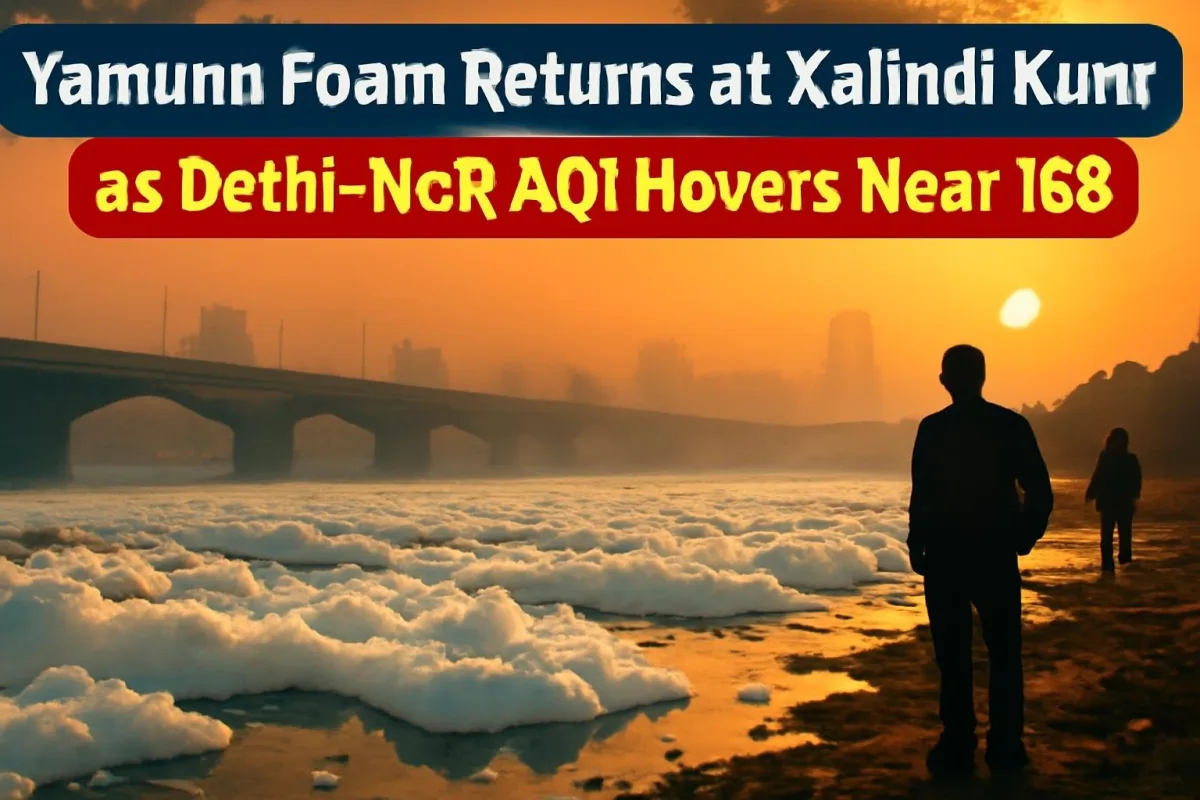
The familiar, unsettling sight is back on the Yamuna. Thick layers of white foam were seen floating on the river near Kalindi Kunj in south-east Delhi on Sunday, October 25, 2026, even as the air across Delhi-NCR stayed hazy with an overall air quality index (AQI) of about 168. The return of the foam comes just days after the Delhi government inaugurated around Rs 9,000 crore worth of projects tied to river rejuvenation and infrastructure.
What is happening on the river
Visuals from Kalindi Kunj showed long stretches of the river covered in a thick white froth – the kind of chemical foam that has become a recurring autumn image in the capital. Environmental experts have long linked such foam to untreated sewage and industrial effluents carrying detergents and phosphates, which whip up into froth as water tumbles over barrages. Reports on Sunday did not identify a specific source this time.
The timing is awkward for the government. Chief Minister Rekha Gupta had described the recent project inaugurations as a joyful day for Delhi. “Today is a joyful day for the people of Delhi, as projects worth around Rs 9,000 crores have been inaugurated today,” she said, adding that her government aims to make the Yamuna clean and flowing within a few years.
Those inaugurations came alongside a wider push from the Centre. Last week, Union Home Minister Amit Shah launched an Rs 8,941 crore Yamuna clean-up programme with a 2029 target.
Air quality: where Delhi stands
The overall AQI across Delhi-NCR was reported at about 168 on Sunday morning, with PM2.5 and PM10 as the main pollutants. Readings varied widely between monitoring stations – around 110 at PGDAV College in Sriniwaspuri, and between roughly 118 and above 180 at several others. On India's national AQI scale, readings between 101 and 200 fall in the ‘moderate’ band, which can cause breathing discomfort for people with lung or heart conditions, children and the elderly.
That is noticeably better than earlier in the week, when the AQI slipped into the ‘poor’ zone at 244 and triggered curbs. Late-night rain in parts of the city helped clear the air somewhat and brought cooler weather.
GRAP Stage 1 curbs remain in force
The Commission for Air Quality Management (CAQM) invoked Stage 1 of the Graded Response Action Plan (GRAP) across Delhi-NCR on October 21. Under Stage 1:
- Coal and firewood cannot be used in tandoors at hotels, restaurants and open-air eateries.
- Diesel generator sets are restricted to essential and emergency use.
- Dust control rules at construction sites and road cleaning measures are tightened.
Key facts
| Date | Sunday, October 25, 2026 |
| Foam spotted at | Kalindi Kunj, Yamuna, south-east Delhi |
| Delhi-NCR AQI | About 168 (PM2.5, PM10 main pollutants) |
| Lowest station reading | About 110, PGDAV College, Sriniwaspuri |
| GRAP status | Stage 1, in force since October 21 |
| Recent projects | About Rs 9,000 crore inaugurated by Delhi govt |
What it means for residents
With Diwali and Chhath approaching, the Yamuna ghats will soon draw large crowds of devotees, and the foam is a reminder of how far the river still has to go. Health experts usually advise against direct contact with polluted river water and foam. On the air front, Sunday's moderate reading is a welcome breather, but people with asthma or other respiratory problems should still limit long outdoor workouts in the early morning and evening, when pollution tends to peak.
Practical steps help: check the AQI on the SAMEER app or CPCB website before heading out, keep windows shut during peak hours, and avoid burning waste or leaves.
What happens next
Air quality in Delhi typically worsens through late October and November as winds slow, temperatures fall and stubble burning in neighbouring states peaks, with Diwali firecrackers adding to the load. If the AQI crosses into the ‘very poor’ range, CAQM can move to GRAP Stage 2 with stricter curbs. On the river, the test for the new projects will be whether the foam fades in the weeks ahead – or returns again during Chhath.




Comments (0)