
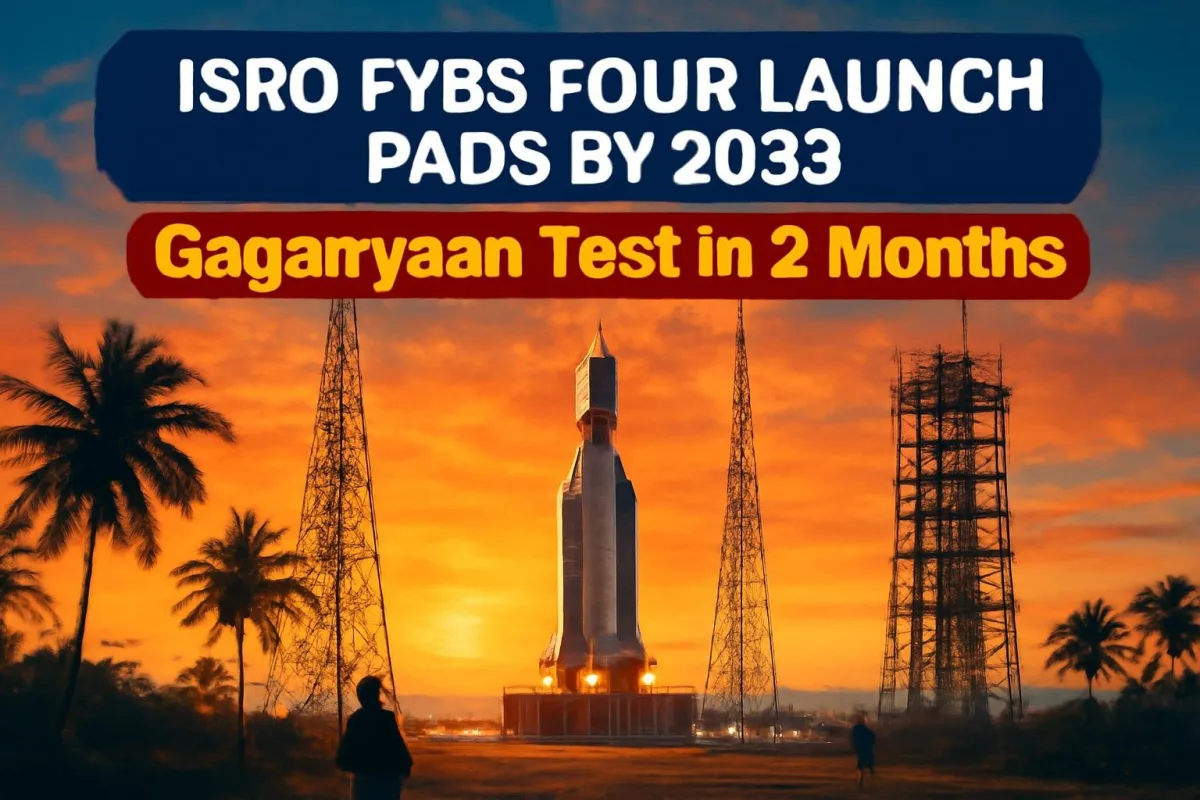
India's space programme is getting ready for a much busier launch calendar. ISRO chairman V Narayanan has said the country will have four functional launch pads by 2029, a major expansion that he linked to stronger partnerships with private industry. Speaking at a graduation ceremony at a private university in Chennai over the weekend, he also said the first uncrewed test flight of the Gaganyaan human spaceflight mission is planned within the next two months.
The remarks offer a clear picture of where Indian space infrastructure is heading as demand for satellite launches rises at home and abroad.
Why India Needs More Launch Pads
For decades, almost every Indian orbital launch has lifted off from the Satish Dhawan Space Centre at Sriharikota in Andhra Pradesh, which currently has two operational launch pads. As launch numbers grow and private companies build their own rockets, that becomes a bottleneck. Every pad needs time between missions for integration, checks and repairs, so more pads mean more launches in a year.
Narayanan said the world will need thousands of satellites in the coming years, for communication, navigation, earth observation and more, and India wants a bigger share of that market.
Kulasekarapattinam: The New Spaceport
A central part of the expansion is the new spaceport at Kulasekarapattinam in Tamil Nadu's Thoothukudi (Tuticorin) district. Narayanan said it will include a dedicated 2,000-acre complex for the Small Satellite Launch Vehicle (SSLV), with integration buildings, launch pads, rail-track systems and telemetry, tracking and command facilities.
The location on the southern tip of the peninsula allows rockets to fly directly south over the sea towards polar orbits, without the fuel-costly manoeuvre needed to avoid Sri Lanka when launching from Sriharikota. That makes it well suited to small satellites headed for sun-synchronous orbits, a fast-growing segment of the market. Work is also under way on a third launch pad at Sriharikota, meant to support heavier next-generation rockets.
| Key fact | Details |
|---|---|
| Target | Four functional launch pads by 2029 |
| New spaceport | Kulasekarapattinam, Thoothukudi, Tamil Nadu |
| SSLV complex size | 2,000 acres |
| Gaganyaan | First uncrewed test within two months; two more before crewed flight |
| Ground tests completed | About 8,000 |
| Astronaut-designates in training | Four |
| Chandrayaan-5 | With Japan; 350-kg rover for 100 days of experiments |
Private Industry, Not Privatisation
Narayanan was clear that ISRO itself will not be privatised. Instead, he said partnering with private firms is essential to meet the scale of demand. ISRO plans to support startups and private companies and transfer technology to them, which he said could generate thousands of high-tech jobs. This builds on the reforms of recent years that opened the space sector to private players and let companies build and launch their own rockets and satellites.
Gaganyaan Countdown
On India's first human spaceflight mission, Narayanan said the first uncrewed Gaganyaan test is planned within the next two months, to be followed by two more uncrewed flights before astronauts fly. These tests will check environmental control, safety systems, crew escape mechanisms and how the module's interior behaves under changing pressure, temperature and humidity. ISRO has completed around 8,000 ground experiments for the mission, and four astronaut-designates are undergoing specialised training.
He also spoke about Chandrayaan-5, a joint lunar mission with Japan's space agency, which will carry a 350-kg rover designed to conduct experiments on the Moon's surface for 100 days.
What It Means for India
More pads mean more launches, which means faster access to space for Indian satellite makers, quicker replacement of navigation and communication satellites, and more revenue from foreign customers. For students and young engineers, the push for private partnerships promises new jobs in rocket building, satellite manufacturing and ground systems. It also adds weight to India's ambition of becoming a reliable, low-cost launch provider for the world. Tamil Nadu, in particular, could see a new space-industry cluster grow around Kulasekarapattinam.
What Happens Next
The near-term focus is the uncrewed Gaganyaan flight and the NVS-03 navigation satellite launch scheduled for October 30. Over the next three years, progress on the Kulasekarapattinam complex and the new Sriharikota pad will show whether the 2029 target is on track.





Comments (0)