
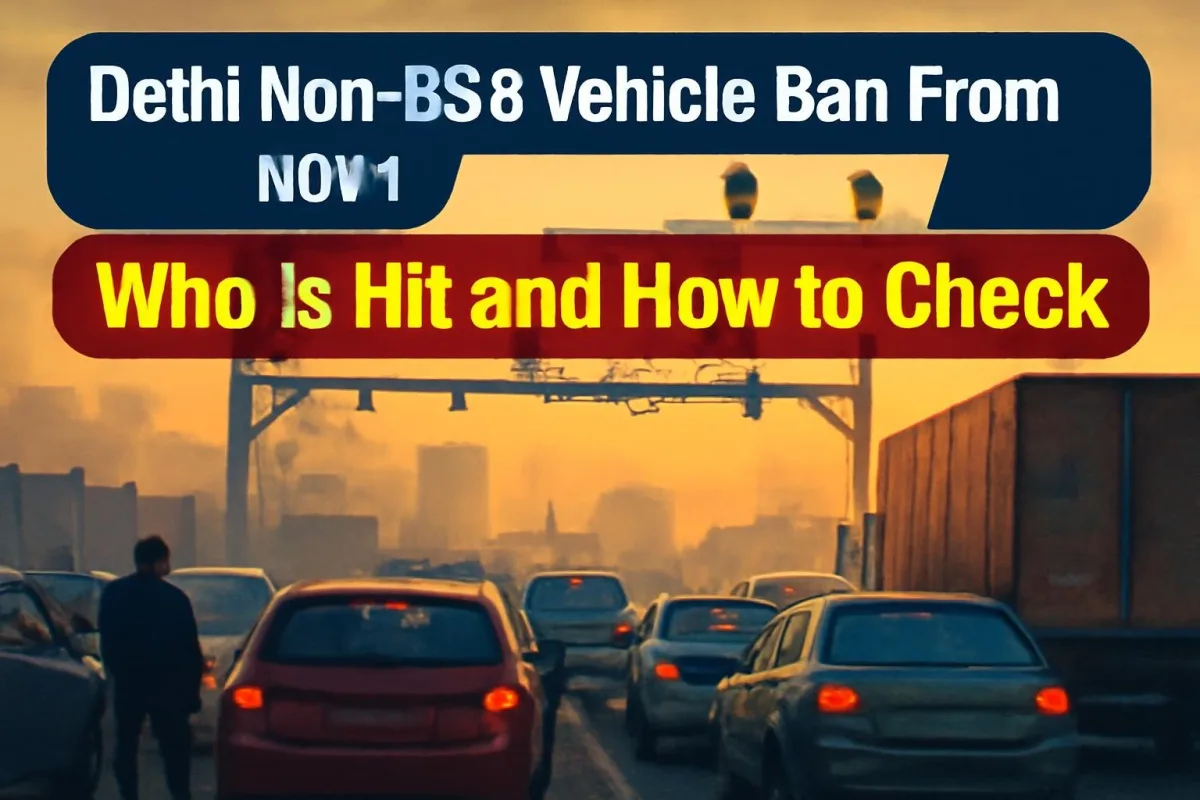
If you drive into Delhi from Gurugram, Noida, Faridabad or Ghaziabad, check your registration certificate now. From November 1, 2026 to January 31, 2027, vehicles registered outside Delhi that do not meet BS6 emission norms will not be allowed to enter the capital, as part of the Delhi government's Winter Action Plan against pollution.
The move was announced by Chief Minister Rekha Gupta, who said Delhi is acting early and firmly against winter smog. With less than a week to go, here is what NCR commuters need to know.
What the New Rule Says
Under the plan, any vehicle registered outside Delhi that is below the BS6 (Bharat Stage VI) standard will be stopped from entering the city for three months, covering the peak pollution season. The government has said the rules apply to petrol, diesel and CNG vehicles. Reports indicate that electric vehicles and essential services are exempt; motorists using CNG vehicles of older standards should check the final official notification before travelling.
The restriction is in addition to the curbs under the Graded Response Action Plan (GRAP), which kick in automatically whenever air quality worsens to certain levels.
How Many Vehicles Are Affected
Transport department estimates suggest more than 10 lakh vehicles across the National Capital Region could be hit. Gurugram and Faridabad alone are estimated to have about 2 lakh non-BS6 vehicles, around 70 per cent of them BS3 or BS4, including nearly 50,000 commercial vehicles. Ghaziabad is estimated to have close to 4 lakh such vehicles. Many of them belong to daily commuters who travel into Delhi for work and business.
| Key fact | Details |
|---|---|
| Rule | No entry for non-BS6 vehicles registered outside Delhi |
| Period | November 1, 2026 to January 31, 2027 |
| Announced by | Delhi CM Rekha Gupta, under the Winter Action Plan |
| Vehicles likely affected | Over 10 lakh across NCR |
| Enforcement | Border checks and ANPR cameras |
| Fuel rule | No valid PUC certificate, no petrol, diesel or CNG |
| Reported exemptions | Electric vehicles, essential services |
How It Will Be Enforced
Checks are being stepped up at all Delhi border points. Traffic police will rely on Automatic Number Plate Recognition (ANPR) cameras that read number plates and match them against registration records to flag non-BS6 vehicles. Violators could face challans, although the exact penalty amount has not yet been spelt out.
Alongside the entry ban, a "No PUC, No Fuel" rule will apply at fuel stations across the city. Vehicles without a valid Pollution Under Control certificate will not be given petrol, diesel or CNG. This applies to Delhi-registered vehicles too, so owners of older cars and two-wheelers in the city need a valid PUC to keep filling up.
How to Check If Your Vehicle Is BS6
- Look at your registration certificate (RC). The emission standard is usually printed on it.
- Open the mParivahan app, enter your vehicle registration number and check the emission norm in the vehicle details.
- As a rough guide, most new petrol and diesel vehicles sold in India from April 2020 onwards are BS6 compliant, but always confirm using the RC or the app.
- Make sure your PUC certificate is valid before November 1, whether or not your vehicle is BS6.
What It Means for NCR Commuters
For people who drive older cars from satellite cities, the next three months may mean switching to the Delhi Metro, electric buses or carpooling with someone who has a BS6 vehicle. Transporters and businesses that depend on older commercial vehicles will also need to plan alternative routes or vehicles. The government has urged residents to use public transport and last-mile options wherever possible.
The logic behind the move is simple: vehicle exhaust is one of the main local sources of Delhi's winter pollution, and BS6 vehicles emit far less particulate matter and nitrogen oxides than older models. Keeping older vehicles out during the worst months is meant to cut that load.
What Happens Next
Watch for the formal notification spelling out exemptions, penalty amounts and border-wise arrangements in the coming days. Transport associations in neighbouring states may push back against the curbs. For now, commuters have until October 31 to check their papers and make other plans.


Comments (0)