
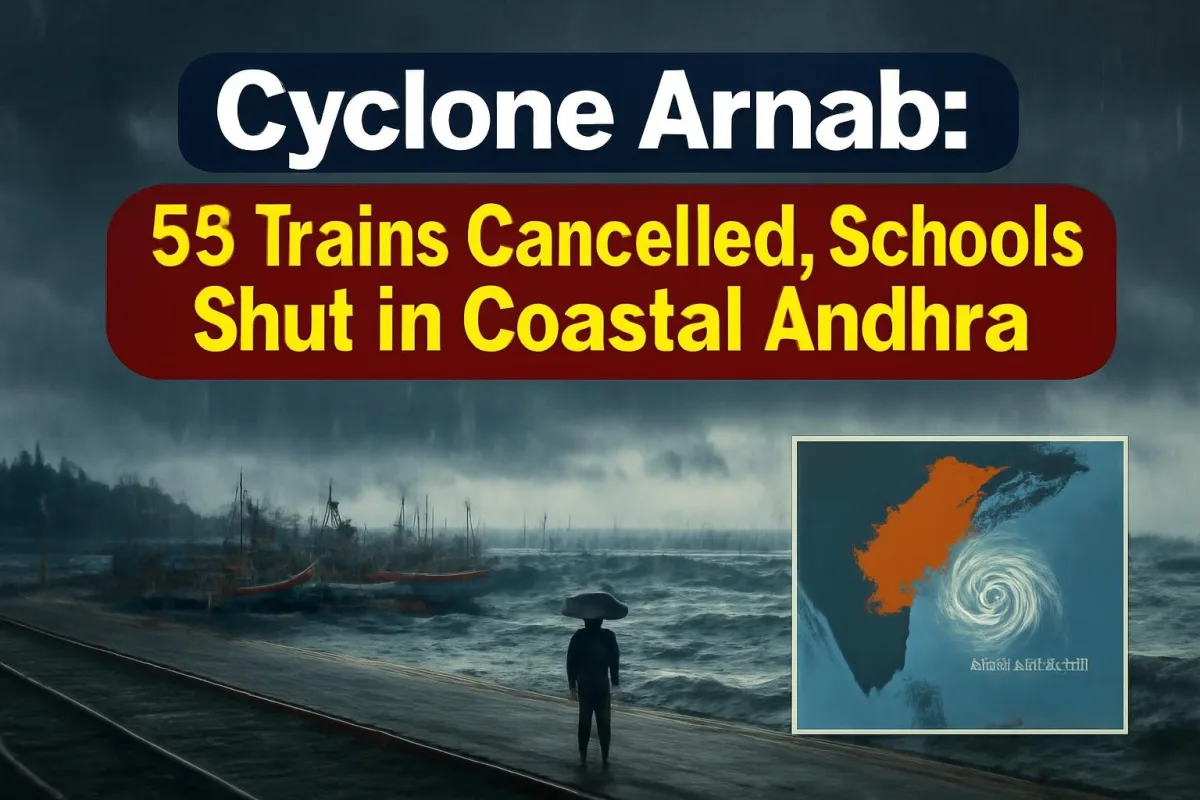
Coastal Andhra Pradesh is shutting down ahead of Cyclone Arnab. South Coast Railway has cancelled 53 trains, schools in Visakhapatnam, Kakinada, Dr B.R. Ambedkar Konaseema and Anakapalli districts are closed, and the state has released Rs 27 crore for emergency relief as the storm closes in on the coast for an expected landfall on Wednesday, October 28.
For lakhs of families along the Godavari delta and the north Andhra coast, Tuesday is the day to stock up, stay indoors and keep a close eye on official alerts. Here is what has changed since the weekend and what to expect over the next 48 hours.
Where Cyclone Arnab Is Now
The India Meteorological Department (IMD) upgraded the system from a deep depression to Cyclone Arnab over the Bay of Bengal on Monday. In its 2:30 pm bulletin on October 26, the IMD placed the storm about 540 km east-southeast of Visakhapatnam, moving west-northwest at around 13 kmph.
The weather office expects Arnab to strengthen into a severe cyclonic storm and then a very severe cyclonic storm before it reaches land. It is forecast to cross the Andhra Pradesh and Yanam coasts between Bapatla and Visakhapatnam, close to Yanam and Kakinada, by the forenoon of Wednesday. Sustained winds at landfall are projected at 115 to 125 kmph, with gusts touching 140 kmph.
A red alert for extremely heavy rain is in force for Tuesday over Kakinada, Konaseema, East Godavari, West Godavari, Eluru and Yanam, while several other coastal districts are under orange and yellow alerts.
Trains Cancelled and Schools Closed
South Coast Railway has cancelled 53 trains running within Andhra Pradesh on October 27 and 28 as a precaution, taking the total number of cancellations linked to the cyclone to 61. The Visakhapatnam–Kirandul Night Express will not run from October 29 to November 4. The railway has opened 24-hour war rooms at its zonal and divisional headquarters to track the storm and manage passengers.
District collectors have declared school holidays in the worst-exposed districts:
- Visakhapatnam, Kakinada and Konaseema: holidays on October 27 and 28.
- Anakapalli: schools closed for three days, from October 27 to 29.
In neighbouring Odisha, schools and colleges in several southern districts have also been closed, and the state has begun shifting people out of low-lying and landslide-prone areas.
| Key fact | Details |
|---|---|
| Expected landfall | Between Bapatla and Visakhapatnam, near Yanam–Kakinada, forenoon of Oct 28 |
| Wind speed at landfall | 115–125 kmph, gusting to 140 kmph |
| Red alert districts (Oct 27) | Kakinada, Konaseema, East Godavari, West Godavari, Eluru, Yanam |
| Trains cancelled | 53 within AP on Oct 27–28; 61 in total |
| Schools shut | Visakhapatnam, Kakinada, Konaseema (Oct 27–28); Anakapalli (Oct 27–29) |
| Relief funds | Rs 27 crore to 20 districts |
| Rescue teams in AP | 10 NDRF and 11 SDRF teams |
Rs 27 Crore Released, Rescue Teams on Standby
The Revenue (Disaster Management) Department issued an order on Monday sanctioning Rs 27 crore for 20 districts. Seven districts in the direct path of the storm, Bapatla, Krishna, West Godavari, Konaseema, East Godavari, Kakinada and Anakapalli, get Rs 2 crore each. Thirteen others, including Visakhapatnam, Vizianagaram, Srikakulam, Guntur, NTR, Eluru, Prakasam and Nellore, get Rs 1 crore each. Collectors can draw the money immediately for evacuation, food, water and repairs.
Chief Minister N. Chandrababu Naidu has ordered round-the-clock monitoring, control rooms in every district and early evacuation from flood-prone pockets. Ten National Disaster Response Force (NDRF) teams and 11 State Disaster Response Force (SDRF) teams are in position. Authorities have identified around 5.7 lakh people living in high-risk coastal and low-lying areas, and government schools and colleges can be used as relief shelters. APSRTC buses can be hired to move people out quickly.
The power utility APEPDCL has set up 30 divisional and 11 circle-level control rooms to restore supply fast if lines go down. At sea, more than 4,800 fishing boats have returned safely to Kakinada and other harbours, and fishermen have been told not to venture out until the warning is lifted.
What It Means for You
If you live in or are travelling to coastal Andhra this week, a few simple steps can make a big difference:
- Check your train status before leaving home; many services on October 27 and 28 will not run.
- Charge phones and power banks, and keep torches, drinking water, dry food and essential medicines ready.
- Stay away from beaches, river banks and old buildings once the rain intensifies.
- Move to a relief centre if local officials ask you to, and do it early rather than at night.
- Follow only official updates from the IMD, the district administration and the state disaster management authority, and avoid forwarding unverified messages.
What Happens Next
The heaviest rain is expected on Tuesday and Wednesday, with the storm likely to weaken over land after crossing the coast. Odisha's forecast also shows very heavy rain on October 29 and heavy rain on October 30, so disruption may continue in north Andhra and south Odisha for a few days. The IMD will issue fresh bulletins every few hours, and the exact landfall point could still shift slightly as the storm nears the coast.
The name Arnab, proposed by Bangladesh, means "ocean" in Bengali. For the people of the Godavari delta, the next 48 hours will show how well the lessons of past cyclones have been learned.





Comments (0)