
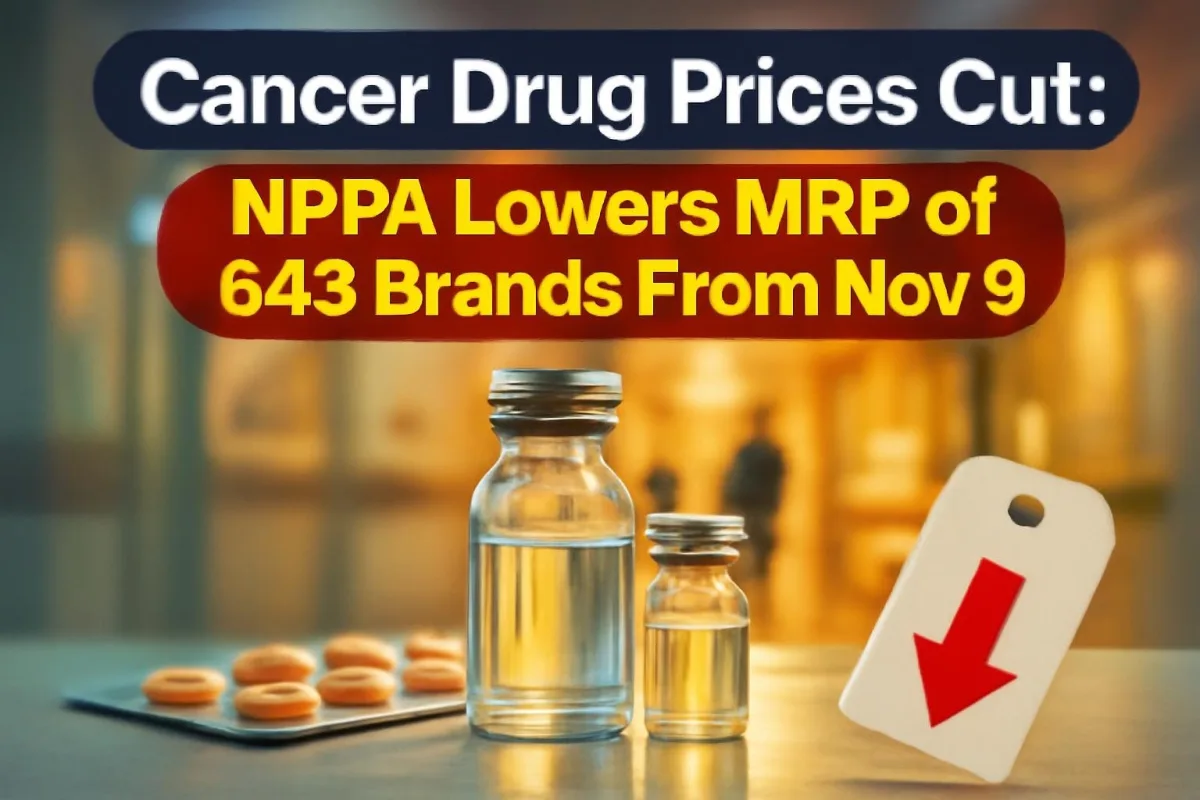
Cancer treatment in India is about to get noticeably cheaper for thousands of families. On Wednesday, October 28, 2026, the National Pharmaceutical Pricing Authority (NPPA) released a list of 543 anti-cancer medicine brands whose maximum retail prices (MRPs) have been revised downward, some by more than 90%. The new prices come into force on November 9, 2026.
The move is the first visible result of the government's decision earlier this month to rein in the huge trade margins that pile up between a drug's factory gate and the chemist's counter.
What the NPPA has announced
The list, issued through the Department of Pharmaceuticals under the Ministry of Chemicals and Fertilizers, covers 543 brands and pack sizes of anti-cancer medicines. It is based on revised prices that pharmaceutical companies submitted up to October 27, 2026. The NPPA has said the list is not final: it will keep updating it on its portal as more manufacturers file revised prices for non-scheduled cancer drugs.
Patients and caregivers can check the latest list on the NPPA website. From November 9, a chemist should not charge more than the revised MRP printed against a brand on that list.
How big are the cuts?
The reductions are steep, especially for costly injectables and targeted therapies. A few examples from the published list and media reports:
| Brand (company) | Old MRP vs new MRP |
|---|---|
| Fulbreca 5 ml vial (RPG Life Sciences) | Rs 26,072 to Rs 5,491 |
| Bevacizab 100 mg/4 ml vial (Abbott) | Rs 21,768 to Rs 5,930 |
| Debrumab 60 mg PFS (RPG Life Sciences) | Rs 22,031 to Rs 5,941 |
| Fludanox vial (Hetero Healthcare) | Rs 14,235 to Rs 2,432 |
| Azacytin (Dr Reddy's) | Rs 6,337 to Rs 1,495 |
| Anarzole 1 mg, 10 tablets (anastrozole) | Rs 696 to Rs 73 |
| Dasanat 20, 60 tablets (Natco Pharma) | Rs 2,812 to Rs 1,086 |
| Effective date | November 9, 2026 |
Business Standard reported that the biggest cut was on Palbopro, a palbociclib brand used in breast cancer, whose per-unit MRP fell from about Rs 40,421 to Rs 2,720, a drop of roughly 93%. That is far deeper than the 'up to 70%' reduction the government had earlier projected.
Background: why trade margins were targeted
On October 17, 2026, the NPPA announced Trade Margin Rationalisation (TMR) for 137 non-scheduled anti-cancer drugs. These include immunotherapy medicines used across more than 20 cancer types, as well as drugs such as bevacizumab, denosumab and pegfilgrastim, which is given to prevent dangerously low white blood cell counts during chemotherapy.
Non-scheduled drugs are not under direct price control, so companies set their own MRPs. In practice, many cancer drugs were sold to distributors and hospitals at a fraction of the printed price, and the gap became margin for the supply chain while patients paid the full MRP. Under the new framework, the trade margin is capped at 30% of the price to the stockist, which means the MRP cannot sit more than about 42.86% above that price, excluding GST.
The issue has also been before the Supreme Court, where a bench recently questioned why trade margins on essential medicines had not been capped earlier and why action on cancer drugs came only after judicial scrutiny.
Not every drug got cheaper
The revision does not mean every cancer medicine has dropped in price. According to Business Standard, original brands such as Roche's Avastin (bevacizumab) and MSD's Keytruda (pembrolizumab) remain unchanged, as do all versions of nivolumab. Officials indicated that cuts apply where MRPs were inflated by large trade margins. Where a company's margin was already within the limit, the price stays the same.
Patient groups have welcomed the cuts but raised concerns. The All India Drug Action Network has argued that the prices are self-reported by companies without independent verification, and that patient assistance programmes were left out of the calculation, which may understate real margins.
What it means for patients in India
Cancer care is one of the biggest causes of out-of-pocket medical spending in India, and a single course of a biosimilar injection can run into lakhs of rupees. For families buying generic or biosimilar brands of drugs like bevacizumab, palbociclib or anastrozole, the savings could be substantial from the next billing cycle.
- Note the brand name, strength and pack size of the medicine you are prescribed.
- Check that brand against the revised list on the NPPA website.
- From November 9, ask your chemist or hospital pharmacy to bill at the revised MRP.
- Discuss with your oncologist whether an equivalent brand with a lower price is suitable for you. Never switch on your own.
What happens next
The NPPA will keep adding brands to the list as companies submit revised prices for the 137 drugs under trade margin rationalisation. Old stock printed with the higher MRP is expected to be relabelled or sold at the new price once the order takes effect. Whether the government extends a similar margin cap to other expensive therapy areas will be closely watched by the industry and by patient groups alike.




Comments (0)