
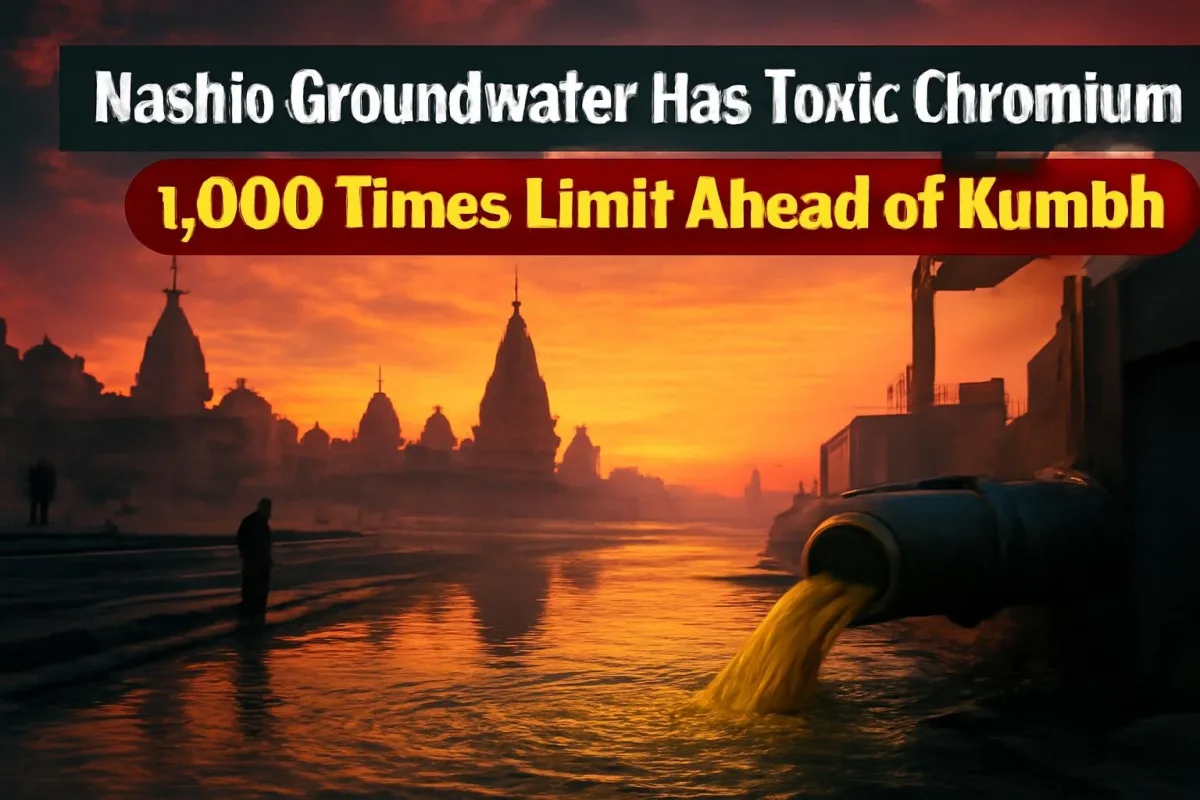
Groundwater drawn near the Ambad industrial area in Maharashtra's Nashik has tested for hexavalent chromium at more than 1,000 times the safe drinking water limit, according to the South Asia Network on Dams, Rivers and People (SANDRP). The findings, released on October 8 and reported widely over the weekend, have set off alarm because the contaminated water is reportedly flowing into the Godavari along the stretch where the Simhastha Kumbh Mela will be held.
For a city preparing to host millions of pilgrims, the report raises an uncomfortable question: is the water near the ghats safe, and who is checking?
What the tests found
SANDRP, an informal network that tracks rivers and water issues, analysed laboratory test results of groundwater from the area. The sample showed hexavalent chromium at 50.3 milligrams per litre, within a total chromium level of 50.5 mg/L. The Bureau of Indian Standards (BIS) limit for chromium in drinking water is 0.05 mg/L. That puts the reading at roughly 1,000 times the permissible level.
Hexavalent chromium, often written as chromium-6 or Cr(VI), is the most toxic form of the metal. It is widely recognised as a carcinogen, and long exposure through drinking water or skin contact is linked to serious health problems.
| Location | Ambad, near Ambad MIDC, Nashik (Maharashtra) |
| Hexavalent chromium found | 50.3 mg/L |
| Total chromium found | 50.5 mg/L |
| BIS drinking water limit | 0.05 mg/L |
| Exceedance | Over 1,000 times the limit |
| Report released by | SANDRP, on October 8, 2026 |
| Suspected sources | Electroplating, metal finishing, paint units |
| Regulator action so far | MPCB show-cause notice to one firm, Sept 30 |
Where is the chromium coming from?
According to SANDRP, the likely sources are electroplating, metal finishing, paint and other units operating in the Ambad MIDC (Maharashtra Industrial Development Corporation) zone. These industries use chromium compounds, and untreated or poorly treated effluent can seep into the ground or enter storm drains.
The network says the contaminated water is reaching the Godavari through local drains. That is what links an industrial pollution problem on the edge of the city to the Kumbh, because the affected river stretch includes ghats where pilgrims will take holy dips.
Health complaints reported by residents
SANDRP has documented health complaints from people living in the affected settlement. These include skin problems such as chemical ulcers, rashes and blisters among residents, including children and women. It also reported painful, swollen lymph nodes and chronic illnesses among young women and children.
Two women in the settlement reported miscarriages. SANDRP has said the true number could be higher, but it has also been careful to say that any link with the contamination needs a proper medical assessment. No official health survey of the area has been made public so far.
Part of the problem, the report says, is that residents have little choice. Water supply from the Nashik Municipal Corporation in the area is low and irregular, so families end up using borewell water that may be contaminated.
How the authorities have responded
The Maharashtra Pollution Control Board (MPCB) issued a show-cause notice to one company on September 30, after media reports of "yellow water" in the area. SANDRP has called this response inadequate, noting that complaints have been raised repeatedly. It has also pointed out that the MPCB has not published its own water testing data or shared it with the residents who are affected.
It is worth noting that the figures so far come from SANDRP's analysis, and an independent, official round of testing has not yet been published. That is exactly what environmental groups and residents are now asking for.
What it means for pilgrims and residents
For people living near Ambad, the advice of health experts in such situations is simple: avoid using borewell water for drinking or cooking until it is tested and cleared, and seek medical attention for persistent skin lesions. For the millions expected at the Kumbh, the bigger issue is whether the river stretch near the ghats will be monitored and cleaned up in time.
Simple precautions for residents
- Do not drink or cook with untested borewell water from the affected area.
- Use municipal tanker or treated water where available, and store it in clean containers.
- Report yellow or discoloured water to the municipal corporation and MPCB.
- Consult a doctor if skin ulcers, rashes or swelling do not heal.
What happens next
With Kumbh preparations under way in Nashik, pressure is building on the MPCB and the state government to carry out transparent testing, identify the polluting units and stop effluent from reaching the Godavari. Whether the regulator publishes its data, and whether stricter action follows the single show-cause notice issued so far, will decide how this story unfolds in the coming weeks.






Comments (0)