
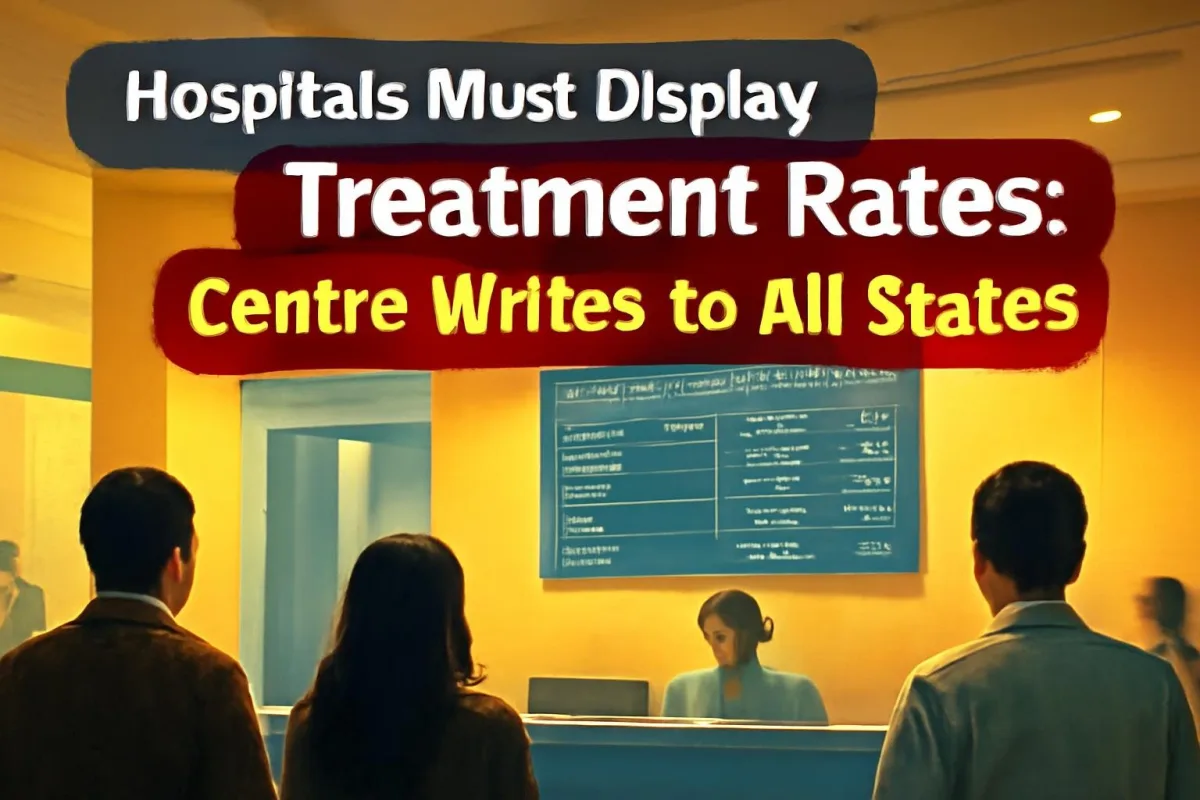
Walking into a hospital without any idea of what treatment will cost could soon become less common. The Union Health Ministry has asked all states and Union Territories to ensure that hospitals and clinics prominently display the rates for their services, in both English and the local language. Union Health Secretary Punya Salila Srivastava conveyed the directive in a letter to state chief secretaries, reported on October 12, 2026.
The aim, the ministry says, is simple: help patients and their families understand likely costs before they commit to treatment, and cut down on billing disputes at the discharge counter.
What the Centre has asked for
The letter draws on rules that already exist. Under the Clinical Establishments (Registration and Regulation) Act, 2010, and the Clinical Establishments (Central Government) Rules, 2012, every registered clinical establishment must display the rates charged for each type of service and the facilities available. The display has to be at a conspicuous place, in English and the local language, so that patients and attendants can easily read it.
The ministry noted that "a conspicuous display of rates" would help families make informed choices. States and UTs have been asked to review how well these provisions are being followed and to take steps to improve price transparency.
| Key point | Details |
|---|---|
| Issued by | Union Ministry of Health and Family Welfare |
| Signed by | Health Secretary Punya Salila Srivastava |
| Sent to | Chief Secretaries of all States and UTs |
| Legal basis | Clinical Establishments Act, 2010 and Rules, 2012 |
| What to display | Rates for each service and facilities available |
| Language | English and the local language |
| Foreign patients | Display of package rates for medical and Ayush visa holders encouraged |
What about states where the Act does not apply?
Health is a state subject, and not every state has adopted the central Clinical Establishments Act. In states where it does not apply, hospitals are governed by their own state laws and frameworks. The ministry pointed out that several of these state laws also require display of service and facility charges, and asked them to enforce those provisions.
A nudge for medical tourism too
The letter also asks states to encourage hospitals to clearly display package rates offered to foreign patients who come to India on medical or Ayush visas. Clear pricing, the ministry believes, will reduce complaints from international patients and strengthen India's image as a destination for treatment and traditional medicine.
Why this matters now
The directive comes amid growing concern over steep mark-ups at hospital pharmacies. Some state drug regulators have flagged differences of nearly 1,000% between the price at which retailers buy certain medicines and consumables and the maximum retail price charged to patients.
The Supreme Court has also been looking into the issue. A bench of Justices Vikram Nath and Sandeep Mehta recently examined high mark-ups on essential medicines, including cancer drugs, and asked the Centre whether a uniform trade margin cap could apply to essential drugs outside the Drugs (Prices Control) Order, 2013.
What it means for patients
If enforced well, rate boards could make a real difference to families facing a hospital visit. Here is how you can use them:
- Check the board before admission: Look for room rent, consultation fees, common procedures and package rates.
- Compare: Where possible, compare charges for planned procedures across two or three hospitals.
- Ask for an estimate: Request a written estimate for planned surgeries and keep it for reference.
- Match the bill: At discharge, compare the final bill with displayed rates and raise any differences with the hospital's billing desk.
- Complain if needed: If a hospital does not display rates, you can approach the district health authority or the state's clinical establishments registering authority.
What happens next
The letter does not set a deadline or mention new penalties. The ball is now in the states' court, since they register and inspect hospitals. How strictly district authorities check for rate boards, especially in private hospitals and smaller clinics, will decide whether this becomes a real change on the ground or stays on paper.






Comments (0)