
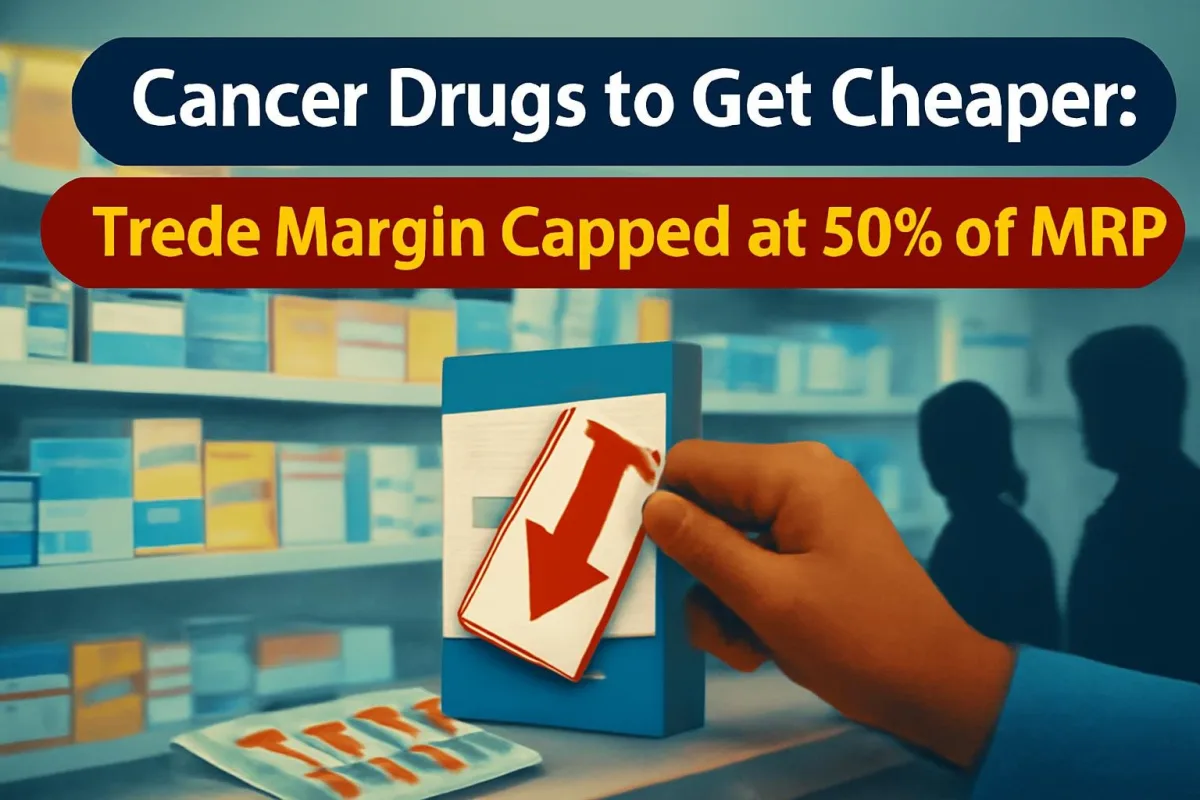
Families paying for cancer treatment could soon see their medicine bills shrink sharply. The National Pharmaceutical Pricing Authority (NPPA) has approved in principle a cap on trade margins for non-scheduled anti-cancer drugs, limiting them to 30% of the maximum retail price (MRP). The government expects prices of some medicines to fall by up to 70%, saving patients an estimated Rs 2,500 crore every year.
The decision was taken at an NPPA meeting in New Delhi on Thursday, October 8, chaired by Department of Pharmaceuticals Secretary Manoj Joshi, and will take effect once the final list of medicines is notified.
The problem: huge gaps between cost and MRP
Essential cancer medicines that appear on the National List of Essential Medicines are already price-controlled, with ceiling prices fixed by the NPPA. But a large part of the market sits outside that list. These non-scheduled drugs, many of them newer or branded therapies, have had no limit on how much distributors and retailers can add between the price they pay and the MRP printed on the pack.
Industry data cited in reports shows the average trade mark-up on non-scheduled anti-cancer drugs is around 170%, and in some cases as high as 700%. The issue drew sharp attention at a Supreme Court hearing on September 29, when a bench of Justices Vikram Nath and Sandeep Mehta pointed to a cancer drug that reportedly cost retailers around Rs 2,700 but carried an MRP of Rs 27,000. The court asked the Centre to examine uniform trade margins, and the matter is listed again on October 12.
What the new cap does
Under the new approach, the total trade margin on covered drugs cannot exceed 30% of the MRP. In simple terms, if the first point of sale is Rs 1,000, the printed MRP can be no more than about Rs 1,430 (so that the Rs 430 margin is 30% of the MRP), instead of being two or three times that amount. Companies will have to revise MRPs downwards where current margins are higher.
The cap is expected to cover branded and generic drugs, domestic and imported products, and both patented and off-patent medicines. Reports indicate that around 110 anti-cancer drugs, including 35 patented medicines, could come under the measure, though the official list is still being drawn up. Manufacturers are required to maintain current production levels so that patients do not face shortages after prices fall.
Key facts at a glance
| Decision by | National Pharmaceutical Pricing Authority (NPPA) |
| Meeting date | October 8, 2026 |
| Trade margin cap | 30% of MRP |
| Drugs covered | Non-scheduled anti-cancer drugs (list being finalised) |
| Expected price cut | Roughly 20% to 70%, depending on the drug |
| Estimated annual saving | About Rs 2,500 crore |
| Legal basis | Paragraph 19, Drugs (Prices Control) Order, 2013 |
| Expert panel report due | October 14, 2026 |
It has worked before
This is not the first time the government has used this tool. In February 2019, the NPPA capped trade margins on 42 non-scheduled anti-cancer drugs at 30%. The MRPs of 526 brands came down, in some cases by as much as 91%, and patients saved an estimated Rs 984 crore a year. The new exercise is far wider in scope, reflecting how quickly the cancer drug market has grown. Reports put the total anti-cancer drug market at about Rs 12,500 crore a year, with scheduled medicines making up only around Rs 2,250 crore of it.
What it means for patients
Cancer incidence in India is rising, and treatment often stretches over months or years, with families paying a big share out of their own pockets. Lower MRPs will help most directly those who buy medicines at retail pharmacies or hospital stores. Patients should keep these points in mind:
- The cut applies only after the NPPA issues its formal notification for each drug.
- Once the notification is out, check the MRP on the pack and compare it with what you paid earlier.
- Scheduled cancer medicines are already under ceiling prices, so their rates will not change because of this decision.
- Jan Aushadhi stores remain an option for many generic medicines.
What happens next
The Department of Pharmaceuticals has asked the Health Ministry to set up an expert committee under the Directorate General of Health Services to recommend which medicines should be covered, with its report sought by October 14. After that, the NPPA will notify the list and the revised margins, which could happen later this month. The list may be revised from time to time as new drugs enter the market. The NPPA said consumer interest "must remain paramount", given what it described as excessive profiteering in anti-cancer drugs.





Comments (0)