
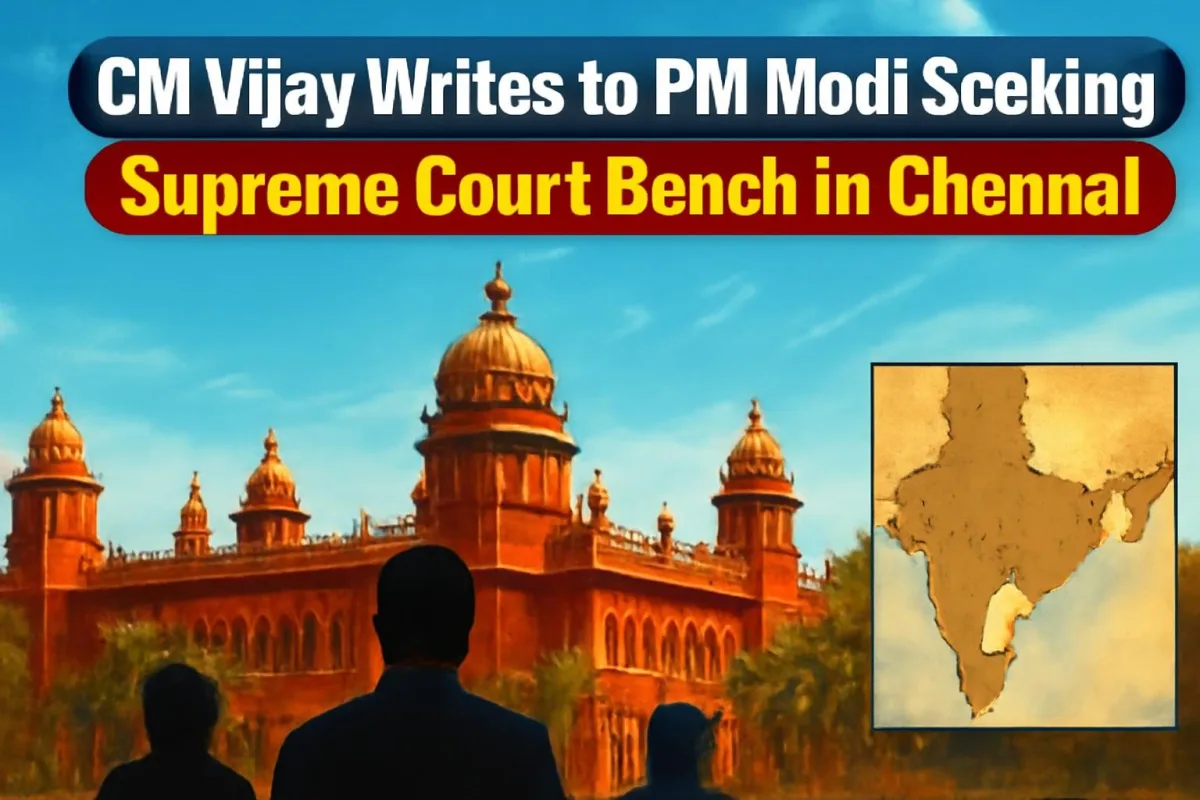
Tamil Nadu Chief Minister C Joseph Vijay has revived one of the state's oldest legal demands. In a letter to Prime Minister Narendra Modi on Wednesday, November 4, he asked the Centre to take the necessary steps to set up a bench of the Supreme Court in Chennai, so that people from southern India do not have to travel to New Delhi for justice.
The demand is more than four decades old. It was first raised around 1980, and has since been backed by parliamentary committees and the Law Commission, but has repeatedly been turned down by the Supreme Court itself.
What Vijay Has Asked For
In his letter, the Chief Minister urged the Prime Minister to move on establishing a Supreme Court bench in Chennai. He pointed to Article 130 of the Constitution, which says the Supreme Court shall sit in Delhi or in such other place or places as the Chief Justice of India may decide, with the approval of the President. In other words, the Constitution already allows the court to sit outside Delhi.
According to reports on the letter, Vijay argued that a Chennai bench would reflect the federal character of the country and make the top court more accessible to litigants from Tamil Nadu and neighbouring states. He also stressed that such a bench would not affect the independence of the judiciary, since control would remain with the Chief Justice of India.
A Demand With a Long History
The idea of regional benches has been discussed for decades. A conference of Chief Justices in 1979 took up the question, and Tamil Nadu formally pushed for a Chennai bench soon after. The state has offered to provide infrastructure and residential accommodation for judges and staff.
Despite that, a Full Court meeting of the Supreme Court on August 7, 2007, found no justification to depart from its earlier resolutions against setting up benches outside Delhi. In 2016, in the case of V Vasanthakumar vs H.C. Bhatia and others, the Supreme Court referred the broader question of regional benches and a National Court of Appeal to a five-judge Constitution Bench headed by the Chief Justice.
On the other side, Parliament's Standing Committee on law and justice recommended regional benches in reports in 2004, 2006, 2008 and 2021. The Law Commission of India has also supported permanent regional benches in its reports.
Timeline of the Chennai Bench Demand
| 1979 | Chief Justices' conference discusses regional benches |
| 1980 | Demand for a Chennai bench first raised |
| 2004, 2006, 2008 | Parliamentary Standing Committee recommends regional benches |
| Aug 7, 2007 | Supreme Court Full Court finds no reason to change its stand |
| Jul 13, 2016 | Issue referred to a five-judge Constitution Bench |
| 2021 | Standing Committee repeats recommendation |
| Nov 4, 2026 | CM Vijay writes to PM Modi seeking a Chennai bench |
Why the Issue Matters
Every appeal to the Supreme Court currently has to be argued in New Delhi. For litigants from Tamil Nadu, Kerala, Andhra Pradesh, Telangana, Karnataka and Puducherry, that often means expensive travel, hiring Delhi-based lawyers and long waits. Supporters of regional benches argue that distance has effectively made the top court less accessible to people in the south and northeast.
Chennai also has a strong legal tradition. The Madras High Court, established in 1862, is among the oldest High Courts in the country, and the city has a large and experienced bar.
Those opposed to regional benches, including successive Supreme Court full courts, have argued that splitting the court could weaken its unity, lead to inconsistent rulings and turn it into just another appellate forum. Some have instead suggested creating a separate National Court of Appeal with regional seats while keeping the Supreme Court in Delhi for constitutional matters.
The Political Angle
Vijay, whose party TVK formed the government in Tamil Nadu, has been taking up issues that resonate across party lines in the state. A Supreme Court bench in Chennai has long had support from Tamil Nadu parties of all stripes, so the letter is likely to find broad backing within the state. The question of how to make the top court more accessible to litigants far from Delhi has also come up repeatedly in debates on judicial pendency and reform.
What Happens Next
The decision does not lie with the Centre alone. Under Article 130, it is the Chief Justice of India who decides, with the President's approval, whether the court can sit elsewhere. The Centre could take up the matter with the Supreme Court, and the pending reference before a Constitution Bench could also shape the outcome. For now, there has been no public response from the Prime Minister's Office or the Union Law Ministry to the Chief Minister's letter.

Comments (0)