
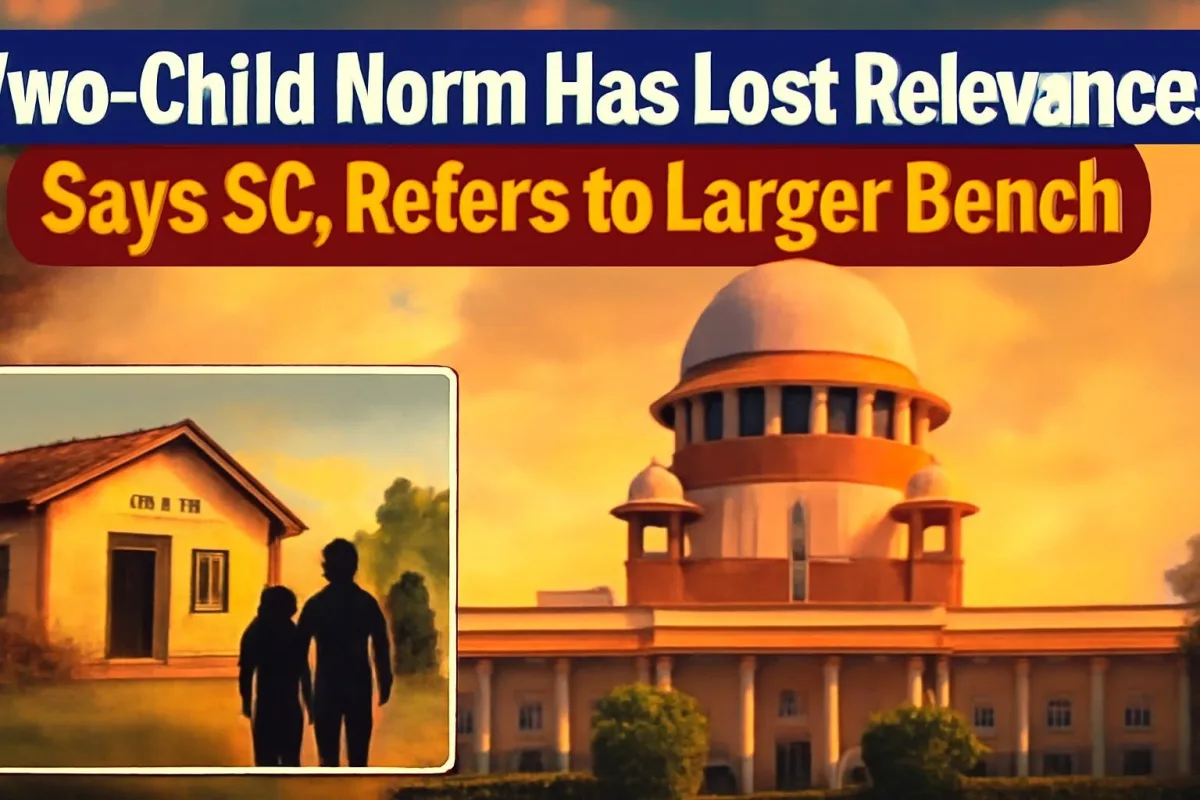
The Supreme Court on Wednesday said that laws penalising people for having more than two children "have lost their relevance", pointing to India's sharp fall in fertility over the past two decades. A bench of Justices PS Narasimha and Alok Aradhe stayed proceedings against a disqualified Maharashtra sarpanch and referred the larger question of whether such two-child disqualification rules are valid to a larger bench.
The ruling could eventually affect rules in several states that bar people with more than two children from contesting or holding panchayat and local body posts.
The case that reached the Supreme Court
The appeal was filed by Mangala Bhimrao Ingle, who was elected sarpanch of the Kakoda gram panchayat in Maharashtra. A complaint alleged she was disqualified under Section 14(1)(j-1) of the Maharashtra Village Panchayats Act, 1959, which bars a person with more than two children from being a panchayat member or sarpanch. The provision was added through an amendment that took effect in September 2000.
In October 2024, the additional collector in Buldhana disqualified her. Her appeal before the additional commissioner of Amravati division was dismissed, and in August 2025 the Bombay High Court upheld both orders, treating the birth certificate of her third child as reliable evidence. She then moved the Supreme Court.
What the Supreme Court said
The bench noted that in 2003, a three-judge bench in Javed v. State of Haryana upheld a similar provision in the Haryana Panchayati Raj Act, 1994. That judgment was based on the concern of a rapidly growing population. According to the bench, that concern has been overtaken by events.
"We have explained how, from 2003, after Javed v. State of Haryana upheld such laws, India's total fertility rate has fallen from 3 to 1.9," Justice Narasimha said while pronouncing the judgment. A fertility rate of 1.9 is below the replacement level of 2.1, the level at which a population replaces itself from one generation to the next.
The court made several strong observations, as reported by legal news outlets:
- The fear of overpopulation that justified these laws has "crumbled due to demographic changes".
- Barring people from elections because they have more than two children interferes with reproductive autonomy protected under Article 21.
- Such a rule "excludes an entire class of citizens from political representation" on grounds with little link to a person's ability to hold office.
- It forces citizens into "an unconscionable choice between bearing children and democratic participation".
The bench also warned that a fertility rate below replacement, while not yet shrinking India's population, would over time lead to an older population and a smaller share of working-age people.
Key facts at a glance
| Detail | Information |
|---|---|
| Bench | Justices PS Narasimha and Alok Aradhe |
| Petitioner | Mangala Bhimrao Ingle, former sarpanch, Kakoda gram panchayat |
| Law challenged | Section 14(1)(j-1), Maharashtra Village Panchayats Act, 1959 |
| Earlier precedent | Javed v. State of Haryana (2003), three-judge bench |
| Fertility rate cited | Fell from 3 (2003) to 1.9 now |
| Replacement level | 2.1 |
| Outcome | Proceedings stayed; validity question referred to a larger bench |
Why a larger bench is needed
Because the 2003 Javed ruling came from a three-judge bench, a two-judge bench cannot overrule it. That is why the court stayed the case and sent the broader question to a larger bench. In an earlier hearing, the bench had asked counsel to check whether similar two-child disqualification provisions exist in other states and appointed advocate Rukmini Bobde as amicus curiae to help on the wider issue.
What it means for people in India
For now, nothing changes automatically. Two-child rules in state panchayat and municipal laws remain on the books until the larger bench decides. But the observations are significant for thousands of local representatives and aspiring candidates, particularly women in rural areas, who have faced disqualification complaints after the birth of a third child.
The ruling also adds to a broader national debate. In recent years, several leaders and states have spoken about the need to address falling birth rates and an ageing population, especially in southern states where fertility dropped below replacement level long ago. A top court saying that population-control-era penalties no longer fit today's demographic reality is likely to shape that conversation.
What happens next
The Chief Justice will now constitute a larger bench to hear the reference. The judgment did not set a hearing date. Until then, the proceedings against Ingle remain stayed. Candidates facing similar disqualification cases in other states may also seek relief by pointing to the reference.



Comments (0)