
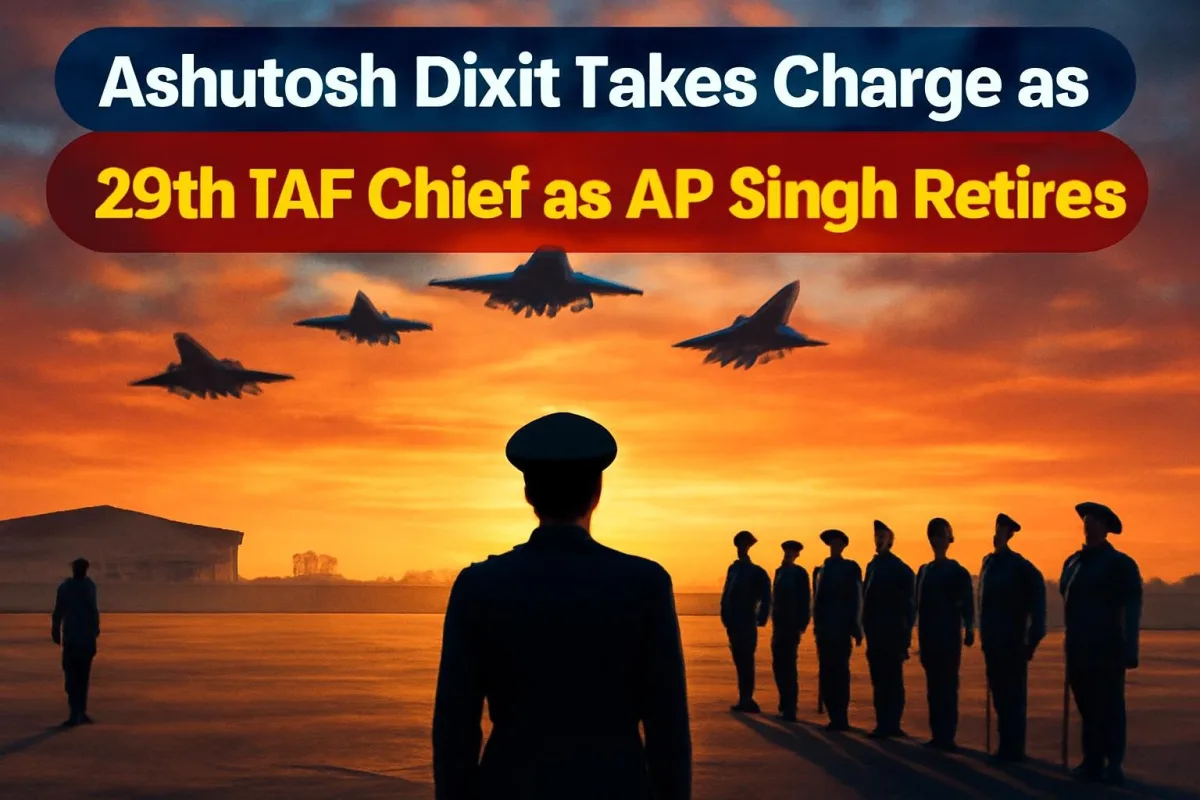
The Indian Air Force has a new man at the top. Air Chief Marshal Ashutosh Dixit took charge as the 29th Chief of the Air Staff on Saturday, October 31, 2026, succeeding Air Chief Marshal Amar Preet Singh, who retired after 42 years in uniform. The handover took place at Air Force Station New Delhi, and it closes a chapter on the generation of commanders who led India's forces through Operation Sindoor.
Dixit is no stranger to the job's demands. He was serving as Vice Chief of the Air Staff when the government named him the next chief in early October, and he steps in at a moment when the IAF is short of fighter squadrons and in the middle of one of its biggest equipment overhauls in decades.
A farewell after four decades
Air Chief Marshal AP Singh's last day followed the traditions of the service. He received an Air Warriors Guard of Honour and laid a wreath at the National War Memorial in New Delhi before formally handing over command. In a social media post, the IAF said he had handed over command "after 42 years of distinguished service". Reports also noted an emotional farewell sortie in a Tejas before his retirement, a fitting send-off for an officer closely linked to the indigenous fighter programme.
Singh was the last of the top military commanders who were in charge during Operation Sindoor to leave active service, which is why his retirement has been read as the end of an era rather than a routine change of guard.
Who is Air Chief Marshal Ashutosh Dixit?
Born on December 9, 1966, Dixit is a graduate of the National Defence Academy and was commissioned into the fighter stream of the IAF in December 1986. Over nearly four decades he has built a reputation as a pilot's pilot. He is a qualified flying instructor and an experimental test pilot, and has logged more than 3,300 flying hours on aircraft such as the Mirage-2000, several MiG variants, the Jaguar, the Hawk and the home-grown Tejas.
His test-flying background matters. Dixit was involved in finalising the upgrade projects for the Jaguar and MiG-27 and worked on the Initial and Final Operational Clearance of the Tejas, the milestones that certified the light combat aircraft for frontline use.
Command and staff roles
- Commanded a frontline Mirage-2000 squadron
- Commanded a Forward Base Support Unit in the Western Sector and Air Force Station Bidar
- Air Officer Commanding-in-Chief of Central Air Command
- Chief of Integrated Defence Staff to the Chairman, Chiefs of Staff Committee, a post he held during Operation Sindoor
- Vice Chief of the Air Staff, immediately before his elevation
He is also an alumnus of the Defence Services Command and Staff College in Bangladesh and the National Defence College in New Delhi. Among his decorations is the Param Vishisht Seva Medal, awarded in 2026.
Key facts at a glance
| New chief | Air Chief Marshal Ashutosh Dixit (29th Chief of the Air Staff) |
| Took charge | October 31, 2026, at Air Force Station New Delhi |
| Predecessor | Air Chief Marshal Amar Preet Singh, retired after 42 years |
| Commissioned | December 1986, fighter stream |
| Flying experience | 3,300+ hours; test pilot and flying instructor |
| Previous post | Vice Chief of the Air Staff |
| Fighter squadrons | 29 in service against a sanctioned 42 |
The in-tray: squadrons, jets and new warfare
The headline challenge is numbers. The IAF currently fields 29 fighter squadrons against a sanctioned strength of 42, and defence watchers estimate it needs 36 to 40 new jets every year just to keep pace with retirements. The force has been described as being "at the cusp of a major modernisation drive", and much of that drive will now play out on Dixit's watch.
Several big-ticket programmes are converging. The first squadron of the Tejas Mk1A is expected within months, a deal for 114 Rafale jets is expected this financial year, and the last S-400 air defence squadron is due next year, with five more systems already cleared in principle. Because the indigenous Advanced Medium Combat Aircraft is still about a decade away, a fifth-generation fighter is being weighed as a stop-gap.
Beyond aircraft, the IAF has put out a roadmap seeking indigenous drone engines and navigation that works without GPS, a dedicated IAF satellite has been cleared, and the IACCS air defence network is being upgraded to shorten the time between a sensor spotting a threat and a weapon engaging it. Airbus A321-based surveillance aircraft are also in development.
Policy questions too
Dixit also inherits debates that go beyond hardware. The IAF has been wary of the proposed theatre commands, which would split its fighter assets across regional commands. And the first batch of 2,850 Agniveers is due to complete its tenure, with 25 per cent to be retained, giving the new chief an early test of how the Agnipath scheme works in practice.
What it means for India
For ordinary readers, the change at the top is about more than ceremony. A chief with deep test-flying experience on the Tejas is likely to push hard on indigenous aircraft, which affects jobs at HAL and its suppliers as well as how quickly India can close its squadron gap. His joint-staff experience during Operation Sindoor also points towards closer working with the Army and Navy, a theme the government has been stressing.
What happens next
In the coming weeks, watch for Dixit's first formal message to the force, his early visits to frontline bases, and progress on the Tejas Mk1A deliveries and the Rafale deal. His tenure will be judged largely on whether the IAF's squadron numbers finally start moving up.



Comments (0)