
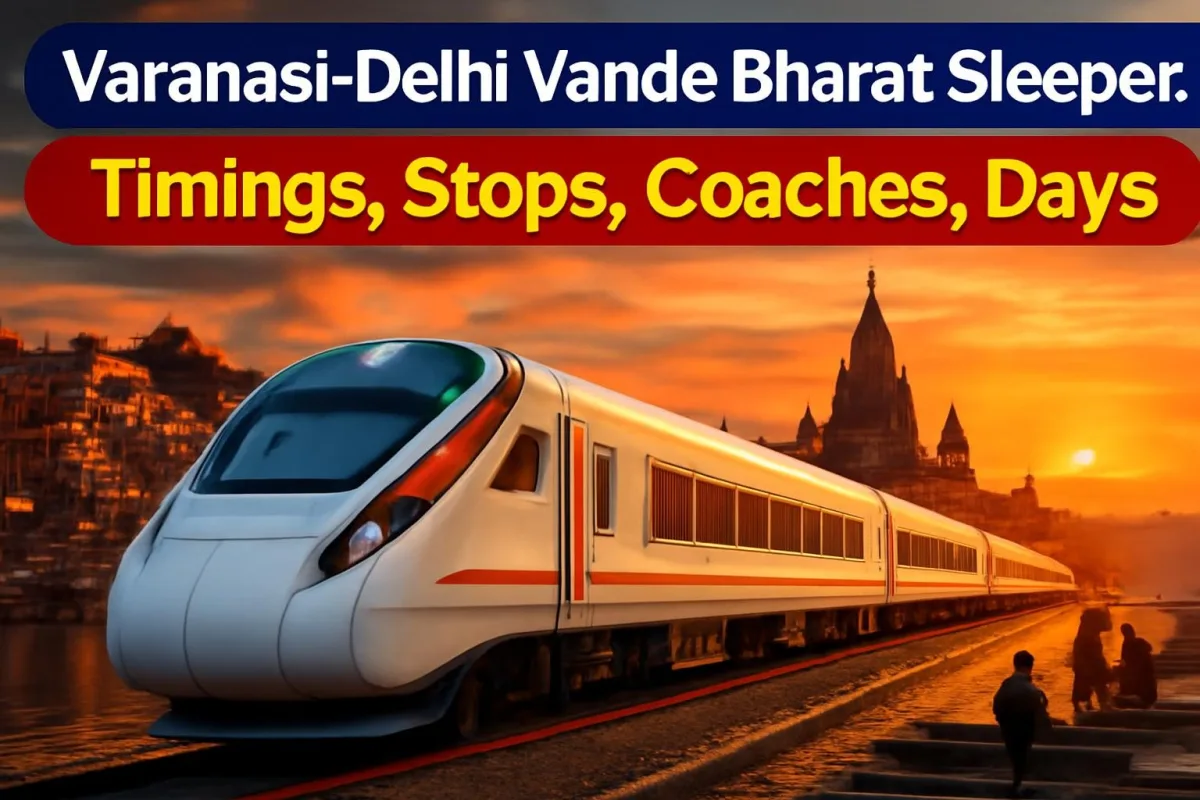
Travellers between Kashi and the capital now have a faster way to sleep through the journey. Uttar Pradesh Chief Minister Yogi Adityanath and Railway Minister Ashwini Vaishnaw flagged off the Varanasi-New Delhi Vande Bharat Sleeper Express from Varanasi on Saturday, October 31, 2026. It is UP's first Vande Bharat Sleeper and the country's second, running overnight with stops at Prayagraj, Kanpur, Aligarh and Ghaziabad.
Vaishnaw summed up the pitch neatly at the launch: sleep in Varanasi at night and wake up in Delhi in the morning. Here is everything passengers need to know.
Train numbers and timings
The service runs as train numbers 27421 and 27422, and was approved by the Railway Board in a notification dated October 27. The timetable is built around an overnight run in both directions:
| Varanasi to New Delhi | Departs 8:50 pm, arrives 6:10 am next day |
| New Delhi to Varanasi | Departs 9:40 pm, arrives 7:10 am next day |
| Train numbers | 27421 / 27422 |
| Stops | Prayagraj, Kanpur Central, Aligarh, Ghaziabad |
| Running days | Six days a week (no Friday departure from Varanasi, no Saturday departure from New Delhi) |
| Coaches | 16 air-conditioned coaches, self-propelled |
| Berths | 823 in total |
| Operating speed | 160 kmph (tested at 180 kmph) |
According to the Railway Ministry, the new train cuts travel time by 55 minutes from Varanasi to Delhi and by 35 minutes on the return leg compared with the Shiv Ganga Express, one of the most popular overnight trains on this route.
Coach mix: First AC, 2AC and 3AC
The 823 berths are split into three classes. There are 24 berths in First AC, 188 in AC 2-tier and 611 in AC 3-tier, which means the bulk of the train is aimed at middle-class families and regular travellers rather than only premium passengers. Fares had not been widely published at the time of the launch, so check the IRCTC website or app for the latest prices before booking.
What is new inside
The Vande Bharat Sleeper is a big step up from older sleeper rakes. Key features include:
- Ergonomically designed berths, better suspension and noise reduction for a smoother night
- Hot-water showers in First AC
- 52 vacuum toilets, sealed gangways between coaches and mini pantries
- USB Type-A and Type-C charging points along with three-pin sockets
- Dedicated berths and accessible toilets for passengers with disabilities
- Regenerative braking to save energy
Safety systems
The train is fitted with the indigenous Kavach automatic train protection system, CCTV surveillance, smoke and fire detection, fire suppression and emergency alarms. It has also been built to the European EN 15227 crashworthiness and EN 45545 HL3 fire-safety standards, and was developed under the Make in India programme.
How to book: step by step
- Open the IRCTC website or the IRCTC Rail Connect app and log in.
- Enter Varanasi (BSB) and New Delhi (NDLS), or your boarding and destination stations, and choose the date.
- Look for train number 27421 or 27422 in the results.
- Select the class (1A, 2A or 3A), check availability and fare, and add passenger details.
- Pay online and save the e-ticket on your phone.
What it means for passengers
The Varanasi-Delhi corridor is one of the busiest in north India, used by pilgrims heading to Kashi Vishwanath, students travelling to Delhi and Prayagraj, and business travellers from Kanpur. Trains on the route are often wait-listed for weeks. An extra overnight train with more than 800 berths adds real capacity, and the shorter journey means an earlier arrival for office-goers and an easier connection for onward travel.
Prayagraj and Kanpur passengers also benefit, since both get a direct premium sleeper link to Delhi without changing trains. For the Railways, the route is a showcase for the sleeper version of Vande Bharat, which until now had mainly run as chair-car services on day routes.
What happens next
The first few weeks of operation will show how quickly the train fills up and whether more Vande Bharat Sleeper rakes are added on busy north Indian routes. For now, passengers should watch IRCTC for fare tables and booking windows, and expect high demand in the first few weeks, especially with the wedding season and winter travel around the corner.






Comments (0)