
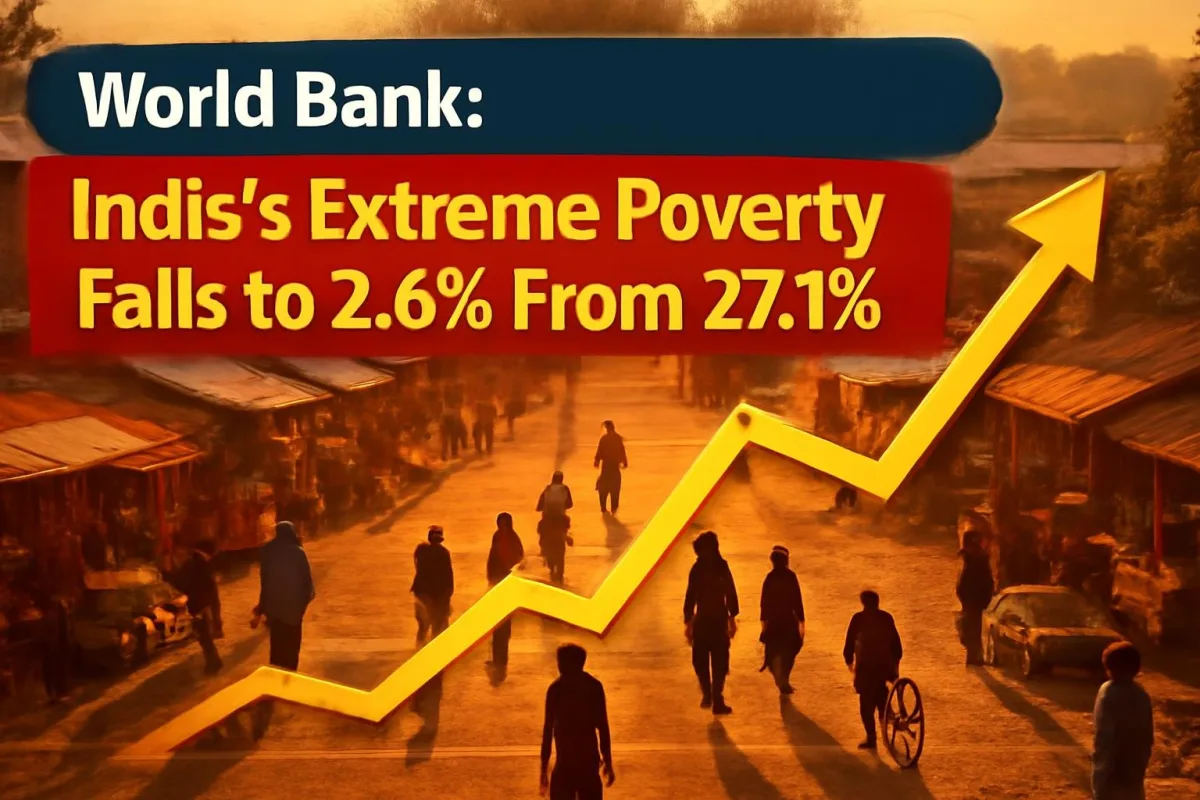
India has recorded one of the fastest falls in extreme poverty anywhere in the world over the past decade, according to the World Bank. Its India Poverty and Equity Brief for October 2026 estimates that the share of Indians living in extreme poverty dropped from 27.1% in 2011 to just 2.6% in 2023, measured against the international poverty line of USD 3 a day. The findings, released this week, have quickly become one of the most discussed economic data points in the country.
The headline numbers
The World Bank uses internationally comparable poverty lines based on 2021 purchasing power parity (PPP), which adjusts for differences in prices between countries. At the extreme poverty line of USD 3 per person per day, India's poverty rate has collapsed over 12 years. A wider measure, the lower-middle-income poverty line of USD 4.20 a day, shows a similar story: the share of people below it fell from 57.7% to 16.1% between 2011 and 2023.
| Report | World Bank India Poverty and Equity Brief, October 2026 |
| Extreme poverty (USD 3/day) | 27.1% in 2011 → 2.6% in 2023 |
| Lower-middle-income line (USD 4.20/day) | 57.7% in 2011 → 16.1% in 2023 |
| People lifted above USD 4.20 line | About 496 million (estimate) |
| Projection at USD 4.20 line | 14.2% in 2026 → 12.1% by 2028 |
| Price basis | 2021 purchasing power parity |
What is driving the decline?
The brief points to a mix of factors. Strong growth in household consumption has lifted spending above the poverty thresholds for millions of families. Employment rose over the period, with a notable increase in the number of women in work. Social transfers, particularly free and subsidised food grain, have also cushioned the poorest households.
Finance Minister Nirmala Sitharaman highlighted the report in a post on X, crediting consumption growth, higher employment among women and expanded welfare transfers, and linking the outcome to the government's policies.
How the numbers are worked out
Poverty estimates of this kind rely on household consumption surveys, which record how much families spend on food and other essentials. The World Bank converts these into international dollars at PPP rates so that India can be compared with other countries. The USD 3 line, adopted after the 2021 PPP update, is now the global benchmark for extreme poverty, while the USD 4.20 line is used for lower-middle-income countries such as India.
The fine print
The World Bank has been careful to describe its projections as indicative. The figures for 2026 to 2028 are microsimulation estimates and will be revised as new labour market and macroeconomic data come in. Economists have also long debated how changes in survey design affect comparisons over time, so the exact percentages may shift as more data becomes available.
It is also worth noting that escaping extreme poverty is not the same as being financially secure. Even with the steep fall, around one in seven Indians is projected to remain below the USD 4.20 line in 2026, meaning a large section of the population is still vulnerable to shocks such as illness, crop failure or job loss. Concerns around youth unemployment and the quality of jobs being created remain part of the wider picture.
What it means for readers in India
For households, the numbers reflect a broad rise in household spending over the past decade, along with wider access to subsidised food. For policymakers, the shift raises a new question. With extreme poverty close to being eliminated, the focus will increasingly move from basic survival to raising incomes, creating better-paying jobs and improving health and education outcomes.
The data could also shape debates on welfare targeting. If very few people remain below the extreme poverty line, governments may face pressure to refine schemes so that benefits go to those who need them most, rather than covering very large sections of the population.
What happens next
The World Bank will update its India estimates as new survey rounds and official statistics are released. Closer home, fresh population data from Census 2027 will help sharpen the picture of where poverty remains concentrated, giving states better information for planning.




Comments (0)