
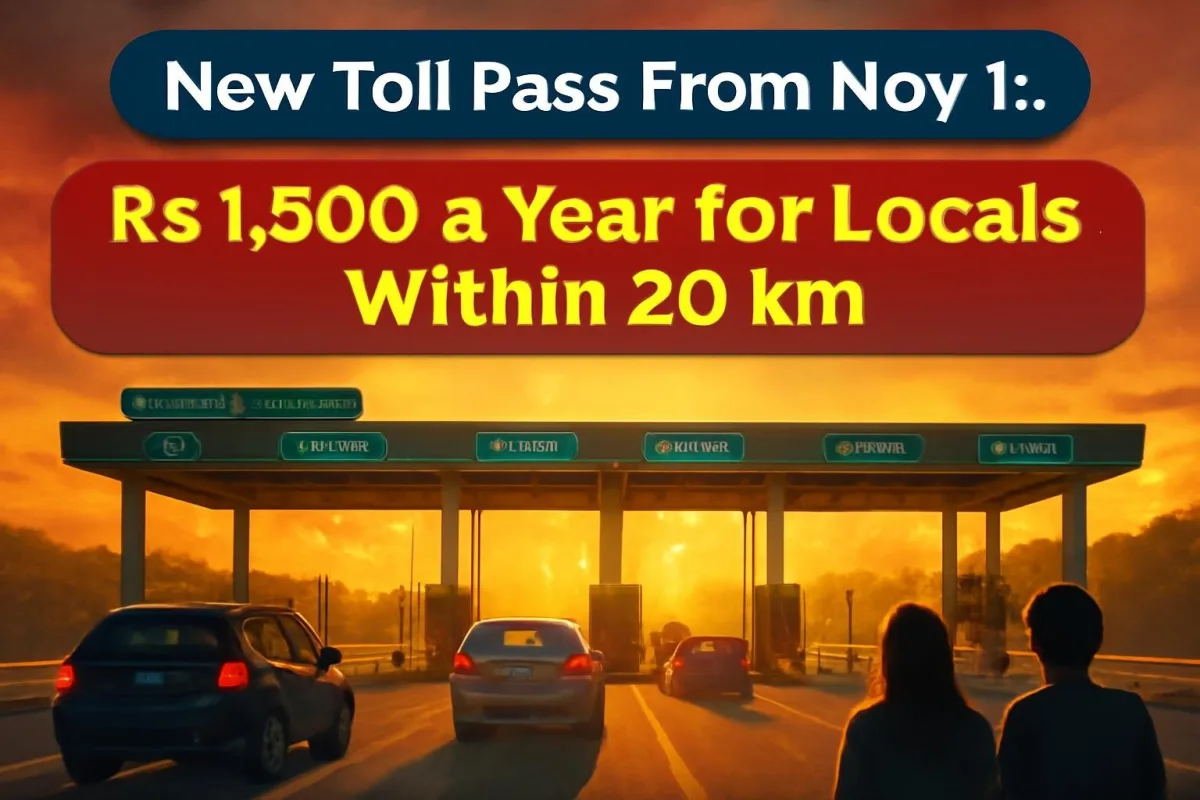
If you live close to a highway toll plaza and cross it almost every day, your annual toll bill is about to get a lot smaller. The Ministry of Road Transport and Highways (MoRTH) has notified a new concessional annual pass for local residents living within 20 km of a National Highway fee plaza, and it comes into force on November 1, 2026.
The pass will cost Rs 1,500 or Rs 3,000 a year depending on where the plaza is located, against roughly Rs 4,320 that a resident currently pays over 12 months using the monthly local pass.
What the New Rule Says
The change has been made through the National Highways Fee (Determination of Rates and Collection) (Fifth Amendment) Rules, 2026, notified on October 26. It amends the 2008 rules that govern how tolls are charged on national highways.
Under the new system, eligible residents can buy a pass that is valid for one year at a single toll plaza, the one nearest their home. It does not offer free passage anywhere else in the country. The government will review the fee every year on April 1, so the rates may change in future.
The National Highways Authority of India (NHAI) has also flagged the change on its official handle, urging people living within 20 km of a toll plaza to check the new local pass rules.
Price, Eligibility and Savings at a Glance
| Starts from | November 1, 2026 |
| Who can apply | Private vehicle owners living within 20 km of a National Highway toll plaza |
| Vehicle type | Non-commercial vehicles with a valid, working FASTag registered for non-commercial use |
| Fee (plaza outside town limits) | Rs 1,500 per year |
| Fee (plaza inside municipal or town limits) | Rs 3,000 per year |
| Validity | One year, only at the toll plaza for which it is issued |
| Current monthly local pass | Rs 360 a month, about Rs 4,320 a year |
| Possible annual saving | Up to Rs 2,820 (Rs 1,500 pass) or Rs 1,320 (Rs 3,000 pass) |
| Fee review | Every year on April 1 |
Who Will Not Get the Pass
Living within 20 km is not enough by itself. The notification leaves out some cases:
- Closed tolling systems: Highways and expressways where toll is collected under a closed user fee system, where you pay based on the distance you travel between entry and exit, are not covered.
- Alternative routes: Where a service road or another alternative road is available for local travel, residents may not get the concession.
- Commercial vehicles: Taxis, goods carriers and other commercial vehicles are not eligible. The pass is only for private cars and similar non-commercial vehicles.
Eligible residents can still choose to stay on the existing monthly pass if that suits them better, for example if they only need it for a few months.
How to Get Ready Before November 1
The ministry has not yet published a detailed step-by-step application process, and NHAI is expected to share it as the facility opens. Until then, these are sensible steps for anyone who expects to qualify:
- Check that your FASTag is active, linked to the right vehicle and registered as non-commercial.
- Keep your vehicle's Registration Certificate (RC) handy.
- Keep a valid address proof that shows you live within 20 km of the toll plaza.
- Find out whether your nearest plaza falls inside or outside municipal limits, since that decides whether you pay Rs 1,500 or Rs 3,000.
- Watch NHAI's official channels and the toll plaza office for the exact application steps.
How It Differs From the FASTag Annual Pass
This new local pass should not be confused with the FASTag Annual Pass launched on August 15, 2025. That pass costs Rs 3,075 for 2026-27 and covers up to 200 crossings or one year, whichever comes first, at about 1,150 toll plazas on National Highways and National Expressways across the country. It has already crossed one crore users.
The new local pass is narrower but much cheaper. It is meant for people whose daily lives, such as the commute to work, school runs or trips to the local market, take them through the same plaza again and again.
What It Means for Commuters
For thousands of families living on the edge of growing cities, the toll plaza on the bypass or ring road is a daily cost rather than an occasional one. Locking in a full year of crossings for Rs 1,500 turns that into a fixed, predictable expense, and the saving of up to Rs 2,820 a year is meaningful for a middle-class household.
The bigger test will be implementation. Residents will want clarity on how proof of address is checked, how quickly passes are issued and how the "alternative route" exclusion is applied at each plaza. Those details will decide how many people actually benefit once the rule kicks in on November 1.



Comments (0)