
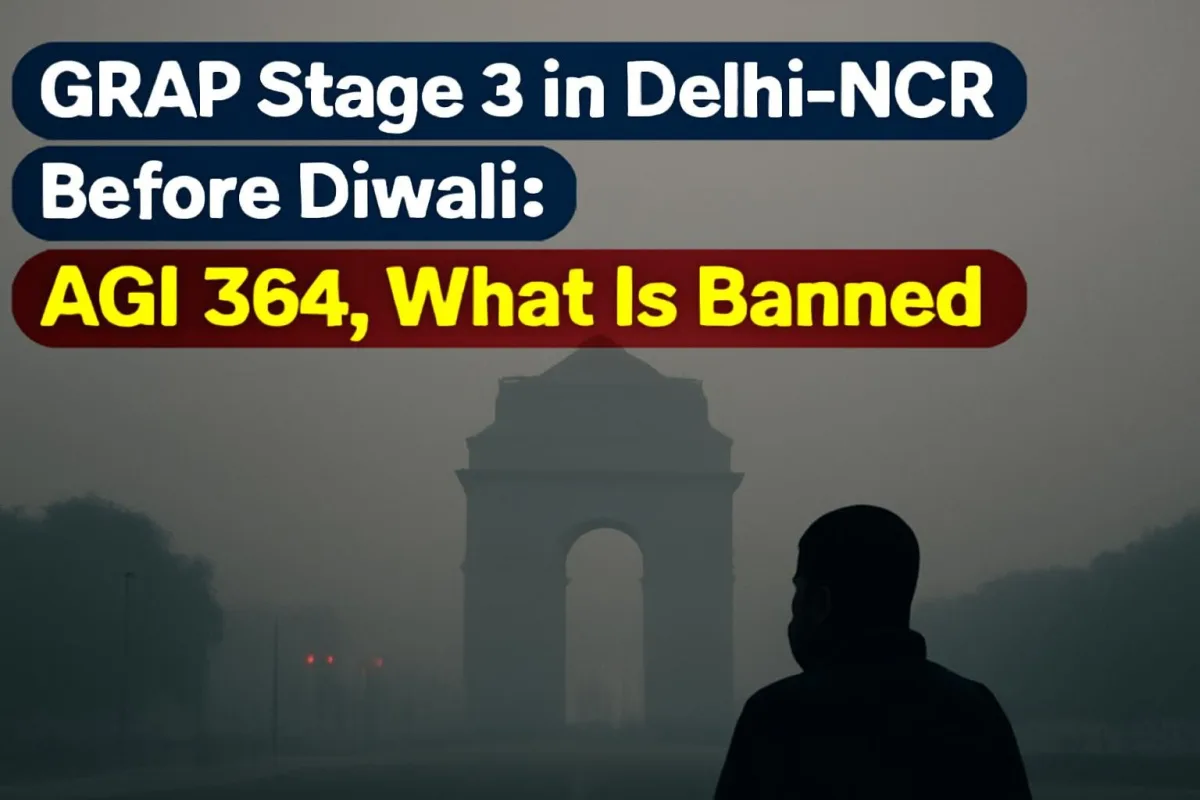
Delhi-NCR has moved to Stage III of the Graded Response Action Plan (GRAP) on the eve of Diwali, after the city's air slipped deep into the "very poor" zone. The Commission for Air Quality Management (CAQM) invoked the stricter curbs on Friday, November 6, when Delhi's average AQI touched 382, and the air had not improved much by Saturday morning, with the overall AQI at 364 at 8 am.
The decision brings back familiar restrictions on construction, older vehicles and diesel generators across the capital region, just as families prepare for Diwali celebrations on Sunday, November 8. Here is what the latest numbers show and what is now banned.
Delhi AQI Today: How Bad Is the Air?
According to Central Pollution Control Board data reported on Saturday morning, the overall AQI stood at 364. Several monitoring stations were already in the "severe" range above 400. IIT Delhi recorded 443, Punjabi Bagh 433, Vivek Vihar 424, Jahangirpuri 420 and Rohini 418, while RK Puram, Sirifort, Bawana, Dwarka Sector 8, North Campus and Alipur were also above the 400 mark.
On Friday afternoon, readings at some stations were even worse, with Jahangirpuri at 449, DTU at 445 and Bawana at 428. The air quality forecast from IITM Pune, cited in reports, has warned that pollution could enter the "severe" category between November 7 and November 9, the period covering Diwali and the day after.
| GRAP stage now | Stage III, invoked by CAQM |
| Invoked on | Friday, November 6, 2026 |
| Delhi average AQI (Nov 6) | 382, very poor |
| Overall AQI (Nov 7, 8 am) | 364, very poor |
| Worst station (Nov 7, 8 am) | IIT Delhi, 443 |
| Diwali | Sunday, November 8 |
| Forecast | Could turn severe from Nov 7 to Nov 9 |
Why GRAP Stage III Was Imposed
CAQM's sub-committee on GRAP said it was invoking Stage III as a precautionary measure, with immediate effect, because air quality was worsening and was expected to deteriorate further. Reports point to smoke from stubble burning in neighbouring states and heavy festive traffic as the main reasons, made worse by the calm, cool weather typical of early November that traps pollutants close to the ground.
Delhi had already been under Stage II after the AQI turned very poor earlier this season. Stage III is triggered when the situation is expected to get more serious, and the curbs under Stages I and II remain in force alongside the new ones.
What Is Banned Under GRAP Stage III
- Construction and demolition: Non-essential construction and demolition work is stopped, including dust-raising activities such as earthwork, piling and trenching. Essential and public projects get limited exemptions under the CAQM order.
- Building materials: Transport of sand, cement and similar materials on unpaved roads is not allowed.
- Stone crushers and mining: Stone crushers and mining activities in the region have to shut. Hot-mix plants not running on approved clean fuel must also stop.
- Older cars: BS-III petrol and BS-IV diesel four-wheelers are restricted in Delhi and the NCR districts of Gurugram, Faridabad, Ghaziabad and Gautam Buddh Nagar, with some exemptions.
- Diesel goods vehicles: Diesel goods carriers are restricted, except those carrying essential commodities or providing essential services.
- Inter-state buses: Diesel buses from other states entering Delhi face restrictions, subject to exemptions.
- Diesel generators: DG sets are banned except for emergency and essential services.
Schools and Offices
Under Stage III, state governments are expected to move classes up to Class 5 to online or hybrid mode wherever possible. Authorities in Delhi and NCR can also decide to let government and private offices work with 50 per cent staff in office and the rest from home. Parents should check notices from their school and district administration for the exact arrangement.
Diwali Crackers: What the Rules Say
The Supreme Court has allowed only certified green crackers in Delhi-NCR, and only within fixed windows on November 7 and 8: from 6 am to 7 am and from 8 pm to 10 pm. Each box must carry a QR code that shows the manufacturer and NEERI certification. Series crackers (ladi), barium-based crackers and anything not approved by CSIR-NEERI are banned, and crackers cannot be burst within 300 metres of hospitals, schools and other notified silence zones. The full ban returns from November 9.
What It Means for Residents
For people living in Delhi-NCR, the next few days are likely to be the hardest of the season so far. Doctors usually advise children, older adults and people with breathing or heart problems to limit time outdoors, especially in the early morning and late evening when pollution peaks. Wearing a well-fitted N95 mask outdoors, keeping windows shut on high-pollution hours and avoiding outdoor exercise can help reduce exposure.
Commuters with BS-III petrol or BS-IV diesel cars should check whether their vehicle is covered before driving, as traffic police enforce the GRAP curbs with fines.
What Happens Next
CAQM reviews GRAP stages based on daily AQI data and forecasts. If pollution crosses into "severe plus" territory after Diwali, Stage IV curbs, the strictest under the plan, could follow. If winds pick up and the AQI improves, the commission may relax Stage III. Under the Supreme Court's directions, pollution control boards also have to file daily AQI data for the period before, during and after Diwali.


Comments (0)