
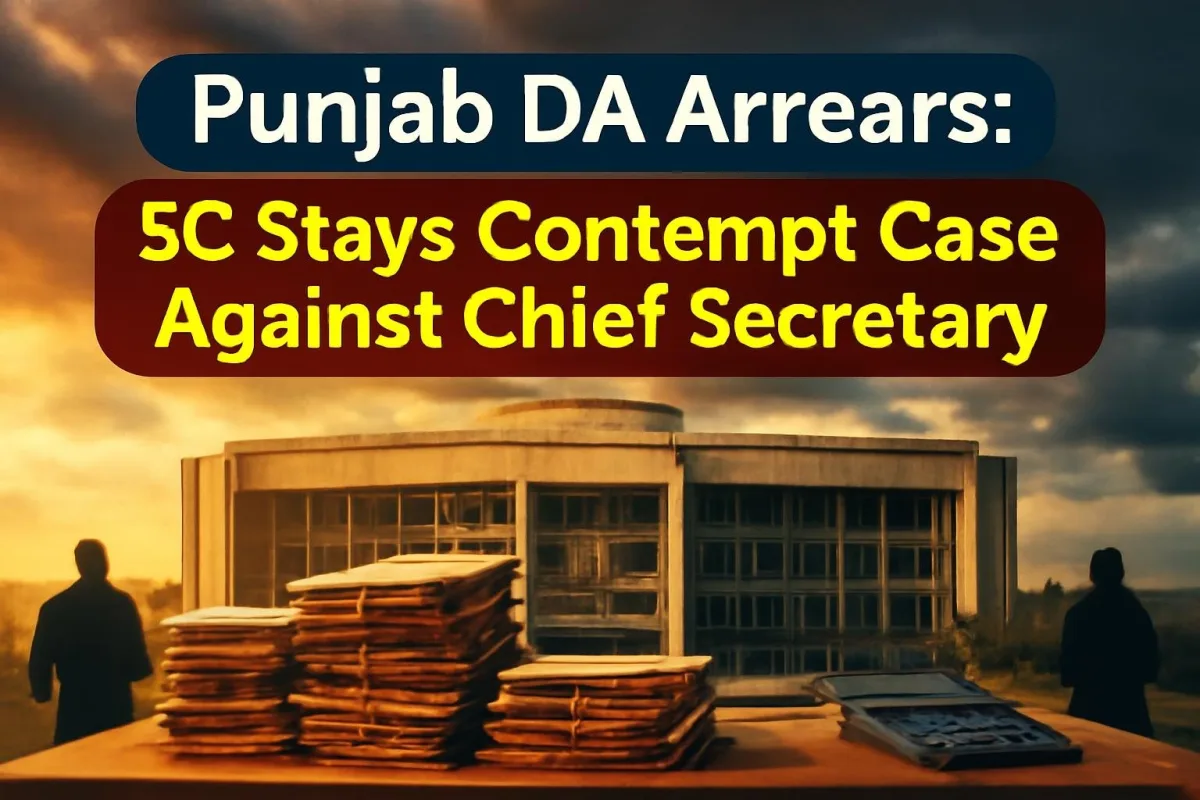
The Supreme Court on Thursday, November 5, gave Punjab's top bureaucrat a reprieve in the long-running dearness allowance (DA) dispute, staying criminal contempt proceedings against Chief Secretary KAP Sinha. But the court made it clear the state cannot sit on the money owed to its employees and pensioners, asking Punjab to come back with a concrete plan to clear arrears worth about Rs 22,818 crore.
A bench of Justices BV Nagarathna and R Mahadevan was hearing Punjab's challenge to orders of the Punjab and Haryana High Court, which had started criminal contempt action against the Chief Secretary.
What the Supreme Court Said
The bench stayed further proceedings in the criminal contempt case until further orders. According to reports, the judges also questioned whether an internal government communication alone could justify criminal contempt.
At the same time, the court did not let the state off the hook. Telling Punjab it had got a breather, the bench asked the state to come up with a positive response on how much it would release. Indian Masterminds reported that the court wants a roadmap for paying the dues by March 2027 and has listed the matter in December.
How the Case Reached Here
The dispute goes back to a High Court judgment of August 3, 2026. The High Court directed the Punjab government and the state power utility PSPCL to release pending DA and dearness relief (DR) instalments to employees and pensioners at the rates applicable to All India Services officers in the state. It set a two-week deadline and ordered 6% interest on delayed payments.
When the state did not pay, employees and pensioners went back to court. In the contempt case filed by petitioner Manjit Singh Randhawa, it was argued that a communication had gone out to departments saying the High Court's order did not need to be implemented yet. On October 12, the High Court issued a criminal contempt notice to the Chief Secretary and later asked him to appear in person on November 5. Punjab then moved the Supreme Court.
Key Facts of the Case
| Point | Details |
|---|---|
| Supreme Court bench | Justices BV Nagarathna and R Mahadevan |
| Date of order | November 5, 2026 |
| Officer involved | KAP Sinha, Punjab Chief Secretary |
| DA/DR arrears | About Rs 22,818 crore (July 1, 2021 to September 30, 2026) |
| Total dues to employees and pensioners | About Rs 32,418 crore |
| High Court judgment | August 3, 2026, with 6% interest on delay |
| Next hearing | December 2026 |
Punjab's Side of the Story
The state told the court that paying the full amount within 15 days was simply not possible. Its lawyers argued that money can only be withdrawn from the Consolidated Fund with legislative approval, and that the state already carries heavy committed spending on salaries, pensions and other obligations. Senior advocate Vikas Singh, appearing for the state, said Punjab had inherited roughly Rs 13,000 crore of arrears from the previous government.
According to the status report filed by the Chief Secretary before the High Court, the outstanding DA and DR for the period from July 1, 2021 to September 30, 2026 stands at about Rs 22,818 crore, part of a total liability of around Rs 32,418 crore towards employees and pensioners.
What It Means for Punjab Employees and Pensioners
For lakhs of serving employees and retired staff in Punjab, the order is a mixed bag. The stay protects the Chief Secretary from criminal contempt for now, but the underlying High Court direction to pay the arrears has not been set aside. The Supreme Court's push for a payment roadmap suggests employees could finally get a clear timeline for money they have been waiting on for over five years.
The issue is also politically sensitive. Government employees and pensioners are a large and vocal group in Punjab, and pending DA has been a recurring flashpoint between unions and the state government ahead of the 2027 Assembly elections.
What Happens Next
Punjab now has to return to the Supreme Court in December with a concrete answer on how much it can release and when. Employee unions are expected to watch that hearing closely. If the state's plan falls short, the pressure from both the courts and the streets is likely to rise again.



Comments (0)