
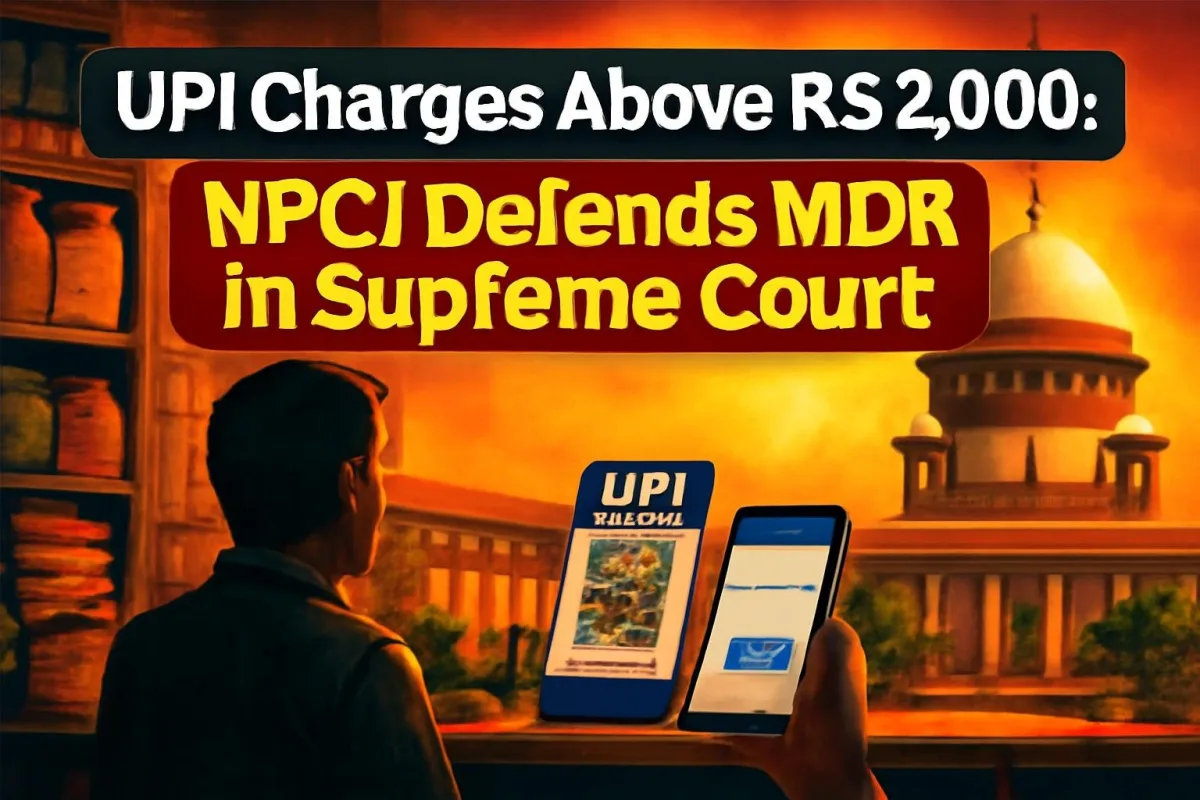
The National Payments Corporation of India (NPCI) has defended the new merchant charge on large UPI payments in the Supreme Court, saying it touches only a small slice of transactions and that shopkeepers are not allowed to pass the cost on to customers. The affidavit, reported on Thursday, November 5, is NPCI's formal reply to a petition challenging the merchant discount rate (MDR) on UPI shop payments above Rs 2,000.
For the millions of Indians who scan a QR code every day, the message from NPCI is that UPI stays free for users.
What Is the Case About?
The petition, filed by advocate Anjan Datta, challenges the Centre's gazette notification of September 14, 2026, issued under Section 10A of the Payment and Settlement Systems Act, 2007, and the framework announced a day later. That framework introduced MDR on specified person-to-merchant (P2M) UPI payments above Rs 2,000.
The petitioner calls the move arbitrary and discriminatory. He questions why a payment of Rs 2,001 attracts a charge while Rs 2,000 does not, how the Rs 1 lakh monthly receipt limit for small merchants was set, and whether a steering committee can be allowed to fix rates without clear guidance from Parliament. He wants the framework quashed, or at least reconsidered after public consultation and an impact study.
On September 28, a bench led by Chief Justice Surya Kant, with Justices Joymalya Bagchi and V. Mohana, issued notice to the Centre, RBI, NPCI and the UPI and Services Steering Committee, but refused to put the charges on hold.
NPCI's Key Arguments
- Small reach: NPCI says the MDR applies to only about 4% of P2M transactions. Roughly 96% of shop payments are Rs 2,000 or less and stay outside the framework.
- No charge for customers: Merchants cannot add MDR to bills or levy separate platform fees. NPCI calls this a binding direction backed by its contracts with banks and payment apps, and says violations can lead to action including loss of UPI access.
- Small merchants protected: Merchants receiving up to Rs 1 lakh a month through UPI QR codes pay zero MDR.
- Fears are speculative: NPCI says the petitioner has not shown a single real case of a customer being charged, and calls the apprehension misconceived.
UPI MDR Rules at a Glance
| Item | Rule |
|---|---|
| P2P transfers (person to person) | Free, any amount |
| Shop payments up to Rs 2,000 | No MDR |
| Eligible shop payments above Rs 2,000 | MDR up to 0.4% |
| Railways, telecom, insurance, fuel, agri-inputs | Flat Rs 5 above Rs 2,000 |
| Mutual funds, securities, stockbrokers | 0.02%, capped at Rs 300 |
| Payments of Rs 75,000 and above | Capped at Rs 300 |
| Merchants with UPI receipts up to Rs 1 lakh/month | Zero MDR |
| Who pays | Merchant, not the customer |
What the Government and RBI Say
At the September hearing, Additional Solicitor General N. Venkataraman told the court that the charge is not a tax and that the government does not receive any of it. It is a settlement fee shared between banks and payment players, he said, adding that card payments already carry such charges while UPI has been exempt.
The Finance Ministry has said the small fee on high-value merchant payments will help pay for UPI infrastructure, cybersecurity and support for small merchants in smaller towns and rural areas. A fund financed by 5% of MDR collections is meant to promote UPI among merchants with turnover up to Rs 20 lakh. The RBI has described the move as a step towards keeping UPI sustainable in the long run.
There is some confusion about when the charge actually kicks in. The government had pointed to October 15, but NPCI's FAQ, updated that day, says the go-live was deferred for the festive season and will happen soon after Diwali, on a date to be notified separately.
What It Means for You
If you send money to friends or family, nothing changes: P2P transfers remain free. If you pay at a shop, the payment app should not charge you anything extra, even for bills above Rs 2,000. If a merchant tries to add a UPI surcharge, NPCI's position is that this is not allowed.
For shopkeepers, the picture depends on size. A small kirana store taking less than Rs 1 lakh a month through QR codes pays nothing. Bigger merchants will see a small deduction on high-value payments, much like they do on card swipes.
What Happens Next
The Supreme Court will now consider the replies from NPCI, the Centre and RBI when the case is next heard. The court has already refused an interim stay, so unless it changes course, the framework is set to go ahead once NPCI notifies the final start date. Merchants and users should watch for that announcement in the coming weeks.
Comments (0)