
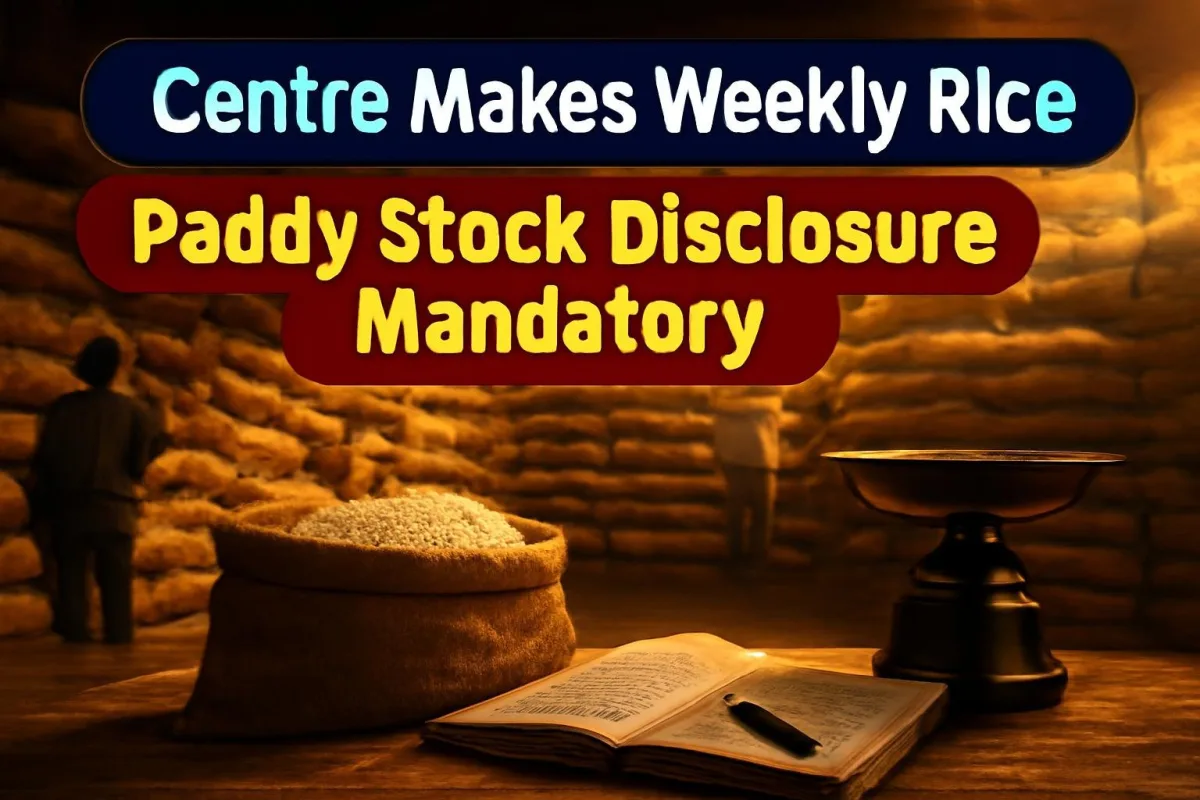
Rice prices have been rising, especially in South India, and the Centre has now stepped in. In an order dated 6 November 2026, the Union food ministry made it compulsory for traders, wholesalers, retailers, big retail chains, processors and millers in every state and Union Territory to declare their rice and paddy stocks every week. It has also allowed five southern states to set stock limits and doubled the amount of government rice it will sell in the open market.
What the new rule says
Every stockholding business must now update its stock position on the government's Food Stock Portal (foodstock.dfpd.gov.in) every Friday. The disclosure covers six categories: basmati rice, non-basmati premium rice, regular non-basmati rice, parboiled rice, broken rice and paddy.
The ministry has warned that businesses that do not register on the portal, or that break stock limits, will face action under Sections 6 and 7 of the Essential Commodities Act, 1955. The aim is to give the government a clear, weekly picture of how much grain is held in the trade, so it can spot hoarding early.
Stock limits in five southern states
The Centre has also agreed to let Andhra Pradesh, Karnataka, Kerala, Tamil Nadu and Telangana impose stock limits on rice and paddy through control orders where needed. These limits can stay in force until 31 January 2027. These states have seen some of the sharpest price increases, particularly for popular varieties like Sona Masoori.
More rice in the open market
The government is also adding supply. It has doubled the rice sale target under the Open Market Sale Scheme (Domestic), or OMSS(D), for 2026-27 from 25 lakh tonnes to 50 lakh tonnes. Under this scheme, the government sells rice from its stocks to private buyers through e-auctions. By 31 October, about 25 lakh tonnes had already been sold, compared with 11 lakh tonnes in the same period last year, which shows how high demand is.
More stock has also been given to NAFED, NCCF and Kendriya Bhandar for Bharat Rice, the government's lower-priced rice sold directly to consumers. These agencies have been asked to expand distribution, especially in southern states.
Key facts at a glance
| Order date | 6 November 2026 |
| Who must disclose | Traders, wholesalers, retailers, big retail chains, processors, millers |
| How often | Every Friday |
| Where | Food Stock Portal (foodstock.dfpd.gov.in) |
| States allowed stock limits | Andhra Pradesh, Karnataka, Kerala, Tamil Nadu, Telangana |
| Stock limits valid till | 31 January 2027 |
| OMSS(D) rice target | Raised from 25 to 50 lakh tonnes |
| Penalty provision | Sections 6 and 7, Essential Commodities Act, 1955 |
Why rice is getting costlier
Trade and industry experts say the main reason is a weak and uneven monsoon. According to agency reports, kharif paddy area for 2026-27 is down about 4% to 42.68 million hectares. Trade estimates put this year's rice output at around 147 million tonnes, compared with a record 154 million tonnes in 2025-26.
Agency reports also say retail rice inflation rose to 8.25% in September from 5.89% in August. The average retail price is about Rs 48 per kg, roughly 12% higher than a year ago. Trade sources say wholesale Sona Masoori has reached Rs 65-70 per kg, up from about Rs 50 a month earlier.
Experts say this is not a national shortage. Government rice stocks are described as comfortable, and the pressure is mostly in certain regions and varieties.
What it means for households
For families, especially in the South where rice is eaten every day, these steps are meant to stop prices from rising further in the coming weeks. Weekly reporting makes hoarding harder. Stock limits stop large traders from holding too much grain. More OMSS and Bharat Rice supply should help bring wholesale prices down.
Traders, on the other hand, have more paperwork to do. Small retailers and millers who have not yet registered on the Food Stock Portal should do so quickly to avoid penalties.
What happens next
Stockholders now have to update the portal every Friday. The next thing to watch is whether the five southern states actually issue control orders with specific stock limits, and whether wholesale prices come down before the rabi season. If prices keep rising, more steps from the Centre cannot be ruled out.




Comments (0)