
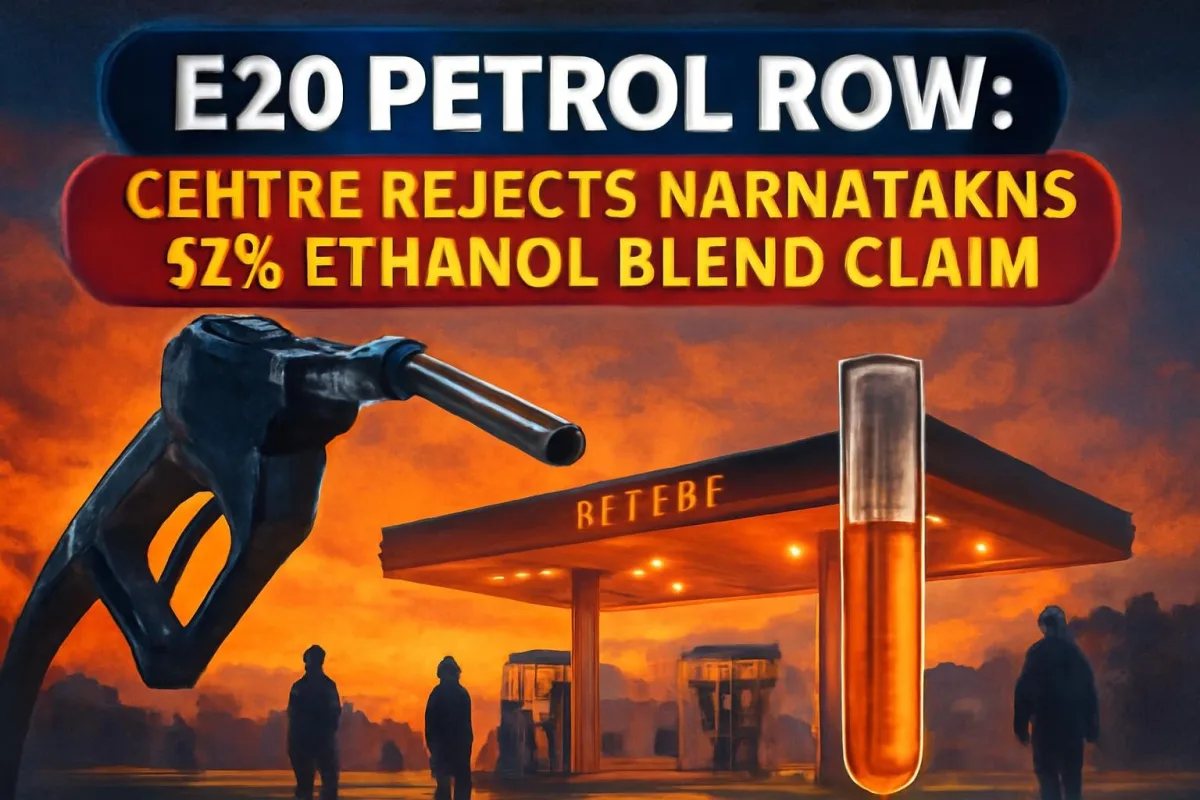
The fight over E20 petrol has become a direct clash between Karnataka and the Centre. On Friday, 6 November, Karnataka's Food and Civil Supplies Minister Rizwan Arshad said private lab tests had found petrol in the state with up to 31.2% ethanol, much higher than the 20% blend allowed under the E20 programme. On Saturday, 7 November, the Union Ministry of Petroleum and Natural Gas rejected the claim. It said all 893 E20 samples it tested across the country met the official standard.
What Karnataka found
Arshad said the state started testing after motorists complained of lower mileage and more frequent repairs. According to him, 63 petrol samples were collected from fuel stations in Bengaluru, Bengaluru Rural, Kolar, Chikkaballapura, Ramanagara, Tumakuru and Mangaluru. These covered outlets of IOCL, HPCL, BPCL, Nayara Energy, Shell and MRPL.
The minister said the samples were first sent to the companies' in-house labs, but those reports did not mention the ethanol content. The state then sent them to private NABL-accredited labs. Those results showed ethanol levels from 13.5% to 31.2%. The highest reading was in an IOCL sample, followed by 30.5% in an HPCL sample. Arshad said nearly four out of five samples had more than 20% ethanol.
Karnataka has asked Union Ministers Hardeep Singh Puri and Nitin Gadkari to explain how this happened. Its demands include action against oil companies, compensation for vehicle damage, displaying the ethanol percentage at every pump, and letting buyers choose between blends. The state also says lower mileage and repairs cost consumers about Rs 1.01 lakh crore a year.
The Centre's response
The Petroleum Ministry strongly disagreed. In a statement on Saturday, it said 893 E20 samples taken from IOCL, BPCL and HPCL depots and retail outlets in 27 states and Union Territories were tested under the BIS standard IS 17021. All of them were within the allowed range of 19% to 21% ethanol. The ministry said 56 of these samples came from Karnataka, with an average ethanol content of 19.30%.
The ministry also disputed the state's cost estimate. It said studies show a mileage drop of 1-2% for E20-compatible vehicles and 3-6% for some older vehicles, much lower than the 10% loss Karnataka assumed.
Oil companies question the testing
IOCL, BPCL and HPCL have also raised doubts about how Karnataka did its tests. They say the samples were collected without company representatives present, counter-samples and full lab reports were not shared, and the third-party lab certificates did not include details of the gas chromatography method, sample dilution and reference materials used. The companies have asked for joint sampling and fresh testing at authorised labs.
Claims side by side
| Karnataka's samples | 63, from seven districts |
| Ethanol found (state) | 13.5% to 31.2% |
| Centre's samples | 893 across 27 states/UTs (56 from Karnataka) |
| Ethanol found (Centre) | 19%-21% nationally; 19.30% average in Karnataka |
| Standard | BIS IS 17021, E20 allowed range 19%-21% |
| Mileage loss claimed | 10% (Karnataka) vs 1-6% (Centre) |
| Status | Unresolved; OMCs seek joint testing |
The political angle
The issue has quickly become political. Karnataka is ruled by the Congress, and Rahul Gandhi criticised the Centre over the findings on social media. Union Petroleum Minister Hardeep Singh Puri had earlier called concerns about E20 a "contrived narrative", and the Centre has said there is no plan to go back to ethanol-free petrol.
What it means for drivers
For ordinary drivers, the row adds to the confusion. E20 is now the main petrol sold at most pumps, and the government says it cuts crude imports, reduces emissions and helps sugarcane and grain farmers. But many owners of older cars and two-wheelers say they are getting lower mileage. Until both sides agree on a common way to test fuel, it will be hard to know who is right.
Drivers who are worried should check their vehicle manual or ask their manufacturer about E20 compatibility, and keep their fuel bills, especially if they plan to raise a complaint later.
What happens next
The next step is likely to be joint sampling by state officials and the oil companies, as the companies have asked. Karnataka is expected to keep pushing for pumps to display ethanol levels. Results from any joint tests could settle the matter, or make the political fight bigger.


Comments (0)