
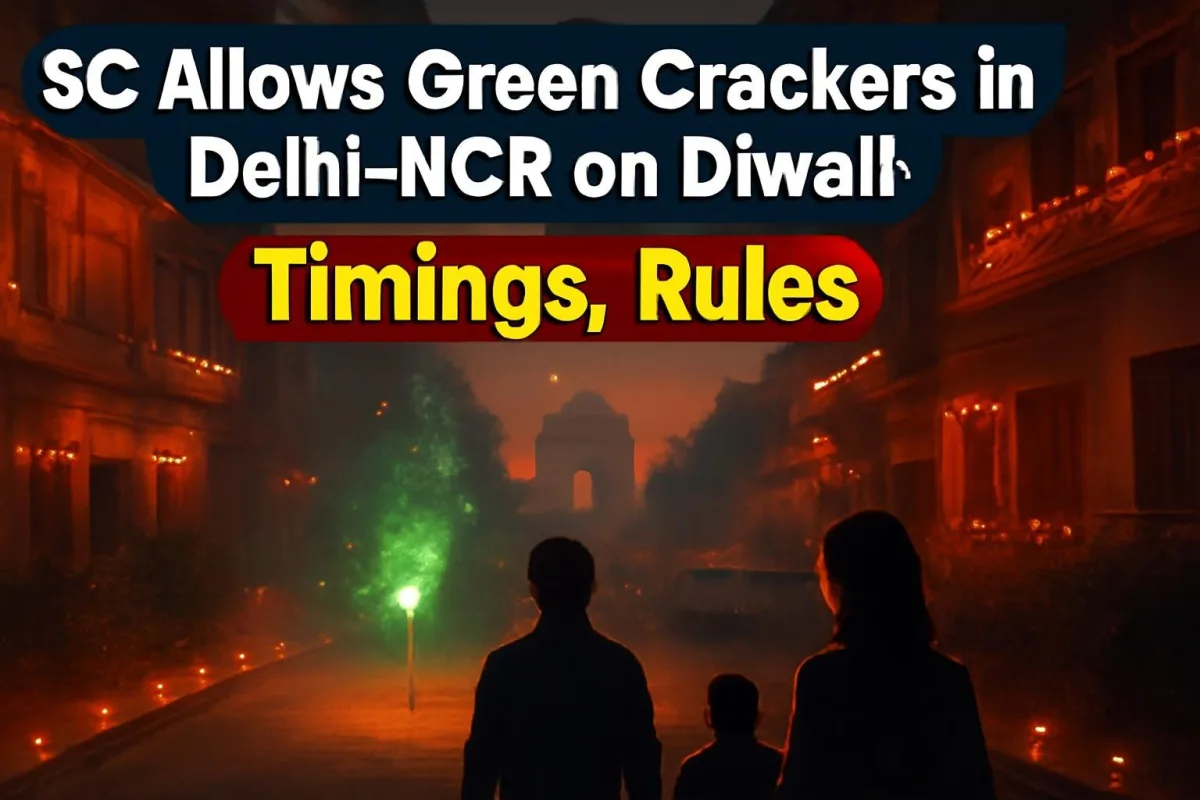
Diwali in Delhi-NCR will have a limited window for firecrackers this year. The Supreme Court has allowed the sale and bursting of certified green crackers in the region for Diwali, but only on November 7 and 8, and only between 6 am and 7 am and between 8 pm and 10 pm. The complete ban on firecrackers returns on November 9.
The order, passed by a bench of Justices MM Sundresh and Prasanna B Varale in the long-running Arjun Gopal v. Union of India case, comes with a long list of conditions, and a clear warning that officials who fail to enforce them could face contempt action.
Why the court relaxed the ban again
The petition dates back to 2015, and over the years the court has restricted firecrackers in Delhi and other north Indian states hit by severe winter pollution. Last year it allowed green crackers on a trial basis. This time, the bench noted that authorities had not placed enough data before it to show how effective the blanket prohibition had been, or what impact last year's relaxation had.
The court was also concerned that the ban was feeding an illegal trade, with conventional crackers being sold under "green" labels. During the hearing on October 29, the amicus curiae and the petitioners pushed for a total ban, arguing that earlier orders had been widely violated. Lawyers for manufacturers and traders said that stopping licensed sellers would only push buyers towards more dangerous illegal crackers. The Centre, the Delhi government and the Commission for Air Quality Management assured the court that a pollution-control plan would be implemented.
The bench made it clear that the right to practise religion under Article 25 is subject to public health and to the right to a clean environment under Article 21. It also urged lawyers, celebrities and sportspersons to join a voluntary awareness campaign, saying public perception itself has to change.
Key dates and rules at a glance
| Bursting allowed | November 7 and 8, 2026 |
| Permitted hours | 6 am to 7 am and 8 pm to 10 pm |
| Manufacturing window | November 2 to 6 (only CSIR-NEERI approved green crackers) |
| Sale window | November 4 to 6, at designated locations only |
| Online sale | Not allowed |
| Banned items | Ladis (series crackers), garlands, barium-based and unapproved crackers |
| No-cracker zones | 300 metres around hospitals, nursing homes, health centres, old-age homes, silence zones, educational institutions |
| Full ban resumes | November 9, 2026 |
| Compliance hearing | December 16, 2026 |
How to identify a legal green cracker
- Buy only from a designated stall. District Collectors and police chiefs will notify the sale locations. Shops must display banners and a copy of the court's directions.
- Check the box is sealed. Green crackers must come in completely sealed boxes.
- Scan the QR code. Each box must carry a product- and batch-specific QR code that shows the manufacturer, NEERI registration, PESO or DM licence, formulation and test certificate.
- Avoid ladis and garlands. Long series crackers are banned outright, even if marked green.
- Do not order online. Any online seller is operating outside the court's order.
What it means for families in Delhi-NCR
For most households, the practical rule is simple: a short burst in the morning and a two-hour window in the evening on the two festival days, using only QR-coded green crackers. Traders whose licences had been cancelled get them back temporarily from November 4 to 6, but any violation means immediate cancellation and loss of the security deposit they must furnish.
Police teams will patrol sale points, scan QR codes, seize illegal stock and start prosecutions. Vehicles entering Delhi-NCR will be checked for smuggled crackers. Bursting near hospitals, schools and old-age homes is off-limits, and these areas will be marked on the ground as "No-Cracker Zones".
Pollution watch
The Central Pollution Control Board and state boards must prepare daily air-quality reports for three periods: before Diwali (November 2–6), the festival days (November 7–8) and after (November 9–30). Sand and water samples will be collected, faulty monitoring stations must be repaired, and authorities must report any rise in hospital admissions linked to firecracker smoke up to November 30. Schools are to sensitise children, and the Delhi Metro will run awareness messages.
What happens next
All reports and affidavits on enforcement and air quality are due by December 14, and the court will take up compliance on December 16. Whether this relaxation continues in future years is likely to depend heavily on what that data shows. For now, residents who want to celebrate with crackers should stick to the timings and buy only certified products, because the court has signalled that it will hold officials to account for every lapse.


Comments (0)