
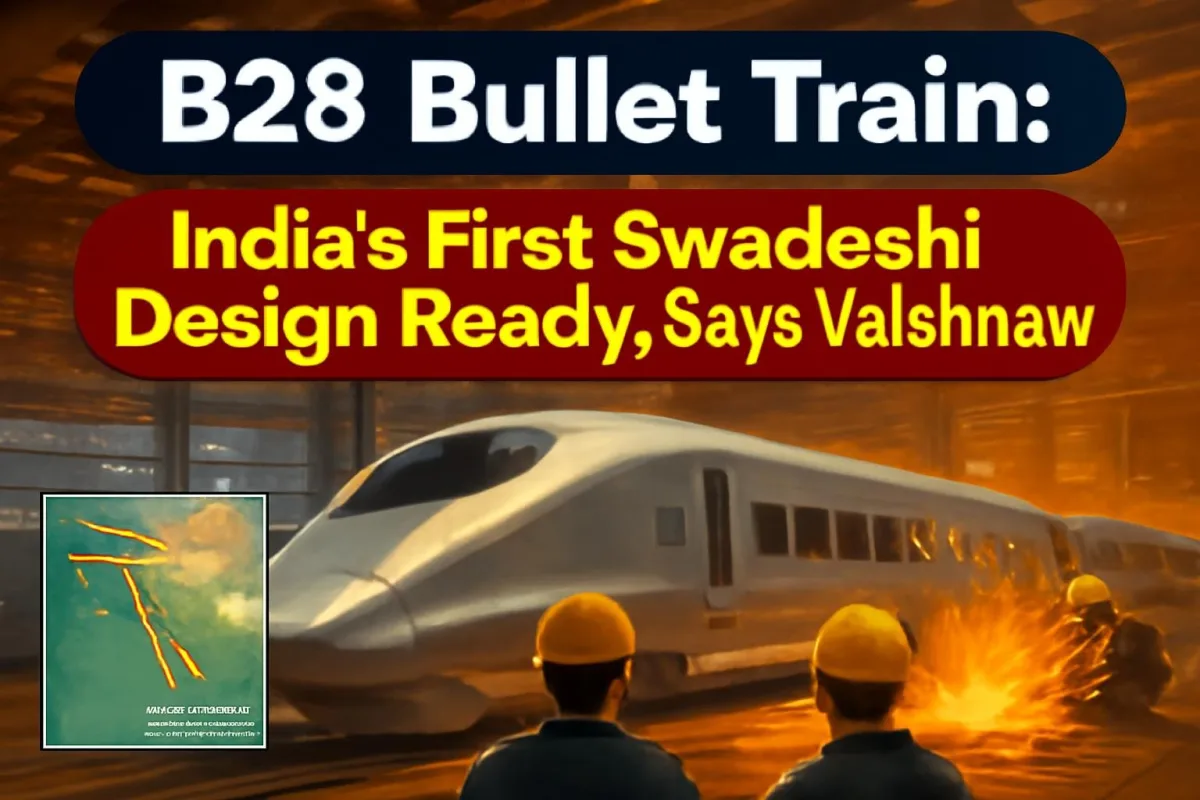
India's home-grown bullet train has moved from drawing board to factory floor. Railway Minister Ashwini Vaishnaw said on Saturday, November 1, that the design of India's first Swadeshi bullet train, the B28, is ready and manufacturing is moving fast. He made the remarks in Bengaluru after inspecting the trainset's models and systems at BEML, where it is being built.
The first prototype could roll out early next year, he said, and the train is meant for the Mumbai-Ahmedabad High-Speed Rail Corridor and future high-speed routes.
What Is the B28 Bullet Train?
The B28 is India's first indigenously designed high-speed trainset, built by a BEML-led consortium along with the Integral Coach Factory (ICF), Chennai. The name reflects its design speed of 280 km/h. Vaishnaw said a faster successor, the B35, designed for 350 km/h, will be the next step.
According to the minister, the propulsion system, electronics and bogies are all being manufactured to international standards, and every component is going through efficiency and safety tests before it is cleared.
The 'Squeeze Test' Explained
One of the more interesting details Vaishnaw shared was the squeeze test. At speeds of 280 to 350 km/h, air pressure acting on the coach changes sharply, especially when trains pass each other or enter tunnels. The coach body, welds and materials are therefore squeezed under pressure to confirm they do not deform. Only after a body passes this test does manufacturing move forward.
The first body frame has been completed and is undergoing structural testing. Visuals shared by the government showed the roof, side walls, end walls and driver's cab being built.
| Train | B28, India's first indigenous bullet train |
| Design speed | 280 km/h |
| Builders | BEML-led consortium with ICF |
| Factory | BEML, Bengaluru |
| Current stage | Design ready; first body frame under structural testing |
| Prototype | Expected early 2027 |
| Next model | B35, designed for 350 km/h |
| First corridor | Mumbai-Ahmedabad High-Speed Rail |
Where Will It Run?
The B28 is being built first for the Mumbai-Ahmedabad corridor, India's first bullet train project. The first high-speed service is planned for 2027 on the Surat-Vapi section, with the rest of the line to be opened in phases.
The bigger picture is a much larger network. The Union Budget 2026-27 announced seven high-speed rail corridors covering about 4,000 km, with an expected investment of around Rs 16 lakh crore. Projected travel times shared by the government include Mumbai-Pune in 48 minutes, Chennai-Bengaluru in 1 hour 13 minutes, Delhi-Lucknow in 2 hours 10 minutes and Delhi-Varanasi in 3 hours 50 minutes.
Why a Made-in-India Bullet Train Matters
India's bullet train journey began with Japanese Shinkansen technology for the Mumbai-Ahmedabad line. Building its own trainsets gives India more control over costs, spare parts and future upgrades, and could open up export opportunities later.
Local manufacturing is also spreading across the project. Electrification parts such as transformers, mast cross-arms and feeder wires are now made in India, and Indian engineers are casting the J-slab ballastless track, based on Japanese high-speed rail technology, at domestic yards for the first time.
For passengers, the payoff is simple: if the new corridors are built as planned, journeys that now take most of a day could shrink to a few hours, competing directly with short-haul flights.
Quick Facts: How Fast Is 280 km/h?
- At 280 km/h, a train covers about 4.7 km every minute.
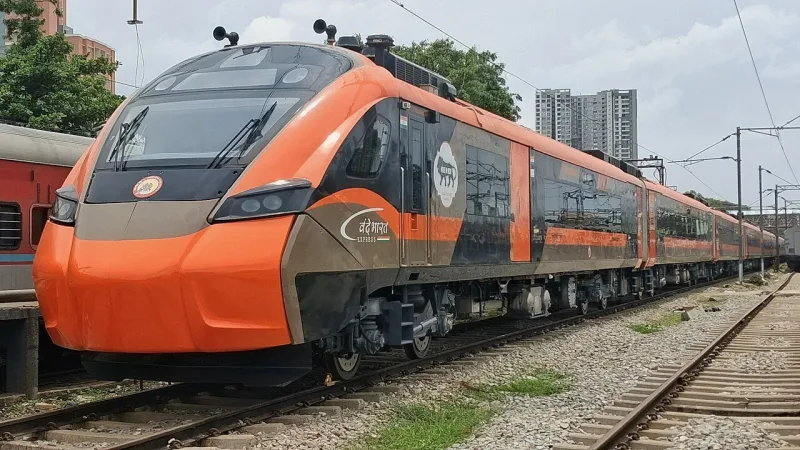
- That is far quicker than the 130 to 160 km/h at which Vande Bharat trains usually run.
- At the planned 350 km/h of the B35, the same minute would cover nearly 6 km.
Speeds like these are why safety testing is so strict. Every weld and panel on a high-speed coach has to cope with repeated pressure changes over years of service, not just a few trial runs.
What Happens Next
The immediate milestone is the prototype roll-out from BEML early next year, followed by track trials expected around mid-2027. After that comes the long certification process before any passenger rides at 280 km/h. Watch for updates on the Surat-Vapi stretch, which is set to be the first section of India's bullet train network to open.


Comments (0)