
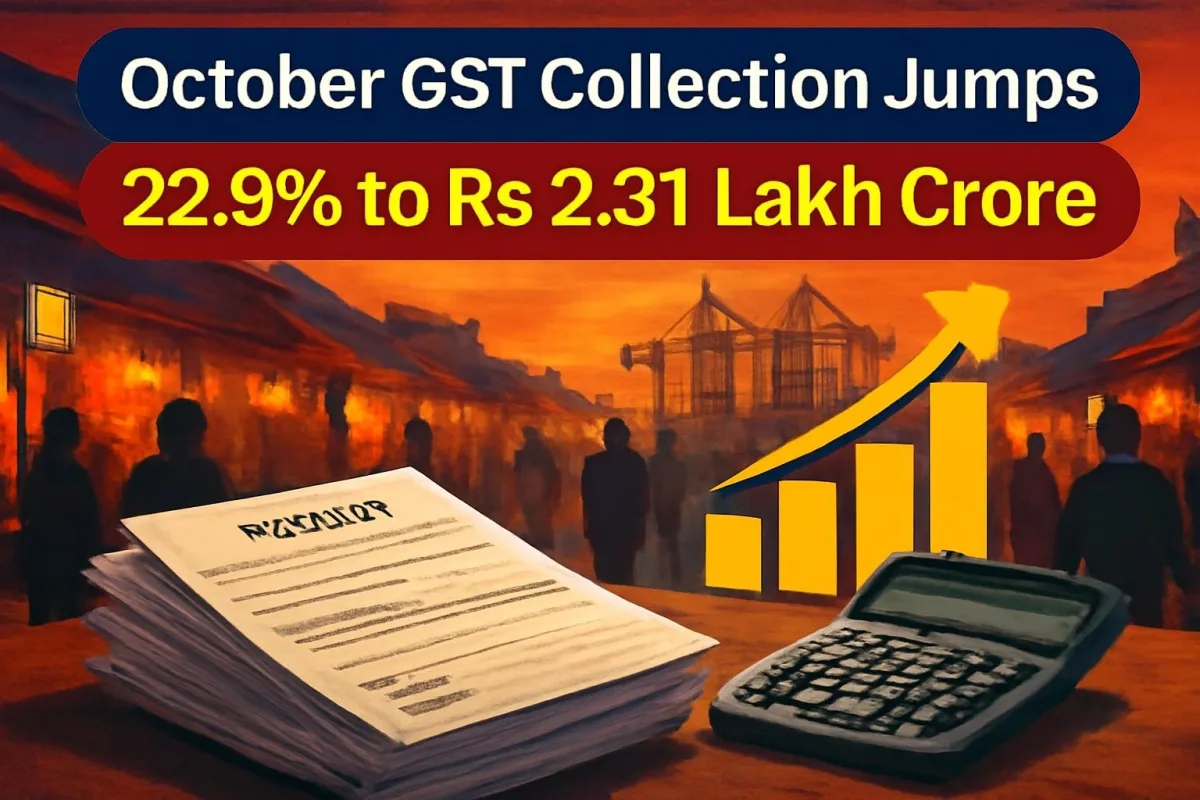
India's GST kitty had a bumper October. Gross Goods and Services Tax collections rose 22.9 percent year-on-year to Rs 2,31,290 crore in October 2026, according to provisional data released on November 1. Net revenue, after refunds, climbed even faster, up 25.6 percent to Rs 2,03,356 crore.
The standout driver was imports: tax collected on goods coming into the country jumped more than 42 percent, while domestic collections grew a healthy 15.8 percent.
GST Collection October 2026: Key Numbers
| Gross GST revenue | Rs 2,31,290 crore (up 22.9%) |
| Gross domestic revenue | Rs 1,59,044 crore (up 15.8%) |
| Gross import revenue | Rs 72,246 crore (up 42.2%) |
| CGST / SGST / IGST | Rs 42,935 cr / Rs 51,340 cr / Rs 1,37,015 cr |
| Total refunds | Rs 27,934 crore (up 6.5%) |
| Net GST revenue | Rs 2,03,356 crore (up 25.6%) |
| October 2025 gross (for comparison) | Rs 1,88,125 crore |
| April-October 2026-27 gross | Rs 14,77,569 crore (up 13.2%) |
Why the Jump Is So Big
Part of the story is the base. Last October, collections had grown only modestly, to about Rs 1.88 lakh crore, after the GST rate cuts of 2025 kicked in. That lower starting point makes this year's growth look sharper.
But the base effect is not the whole story. Domestic revenue, which reflects sales of goods and services within India, grew 15.8 percent, pointing to strong festive-season demand and business activity. Imports did the heavy lifting, though: gross IGST on imports rose to Rs 72,246 crore, and net customs-linked GST revenue surged 56.2 percent to Rs 58,319 crore.
Refunds grew at a slower 6.5 percent. Domestic refunds were up 9.8 percent to Rs 14,007 crore, while export refunds rose 3.4 percent to Rs 13,927 crore.
State-Wise: Who Grew Fastest
The state table shows wide gaps. Among the fastest-growing in October were Assam (47%), Meghalaya (35%), Jharkhand (31%), Madhya Pradesh and Jammu and Kashmir (29% each), and Punjab and Mizoram (25% each).
Among the big economies, Karnataka grew 18 percent, Gujarat 16 percent and Maharashtra 13 percent. Tamil Nadu lagged at just 3 percent, and Sikkim saw a 28 percent fall.
Tamil Nadu's weak number has already turned political. DMK chief M K Stalin on Monday cited the figure to accuse Chief Minister C Joseph Vijay's TVK government of putting the state 'in reverse gear', claims the state government has not yet answered publicly.
For the April to October period, Assam leads with 38.3 percent growth, followed by Uttar Pradesh (15.5%), Telangana (13.8%), Gujarat (12.5%) and Karnataka (12.2%).
What It Means for You
Higher GST collections do not change what you pay at the counter; rates stay the same. What they do is give the Centre and states more room to spend. Since SGST goes directly to states and a share of central taxes is passed on to them, strong months like this one help fund welfare schemes, roads and salaries without extra borrowing.
For businesses, the data is a sign of firm demand heading into the end of the festive season. For policymakers, it also eases pressure on the fiscal deficit target for the year.
How GST Revenue Is Split
A quick refresher helps make sense of these numbers. CGST goes to the Centre and SGST goes to the state where the sale happens. IGST, collected on inter-state sales and imports, is later divided between the Centre and the consuming state. That is why the IGST figure of Rs 1,37,015 crore is so much larger than the others: it includes the tax on all imports, which is then settled between governments.
So when import revenue jumps, as it did in October, both the Centre and states eventually benefit, even though the money first lands in the IGST pool.
A Note of Caution
These figures are provisional and can be revised once accounts are finalised. Monthly GST numbers also swing with festivals, import cycles and refund timing, so one strong month is not a trend on its own. The cumulative April to October growth of 13.2 percent is a better guide to the year's underlying pace.
What Happens Next
November's figures, due in early December, will show whether the festive momentum held after Diwali or whether October was a peak. Economists will also watch whether import-linked revenue stays this strong, since it depends heavily on global prices and trade flows.





Comments (0)