
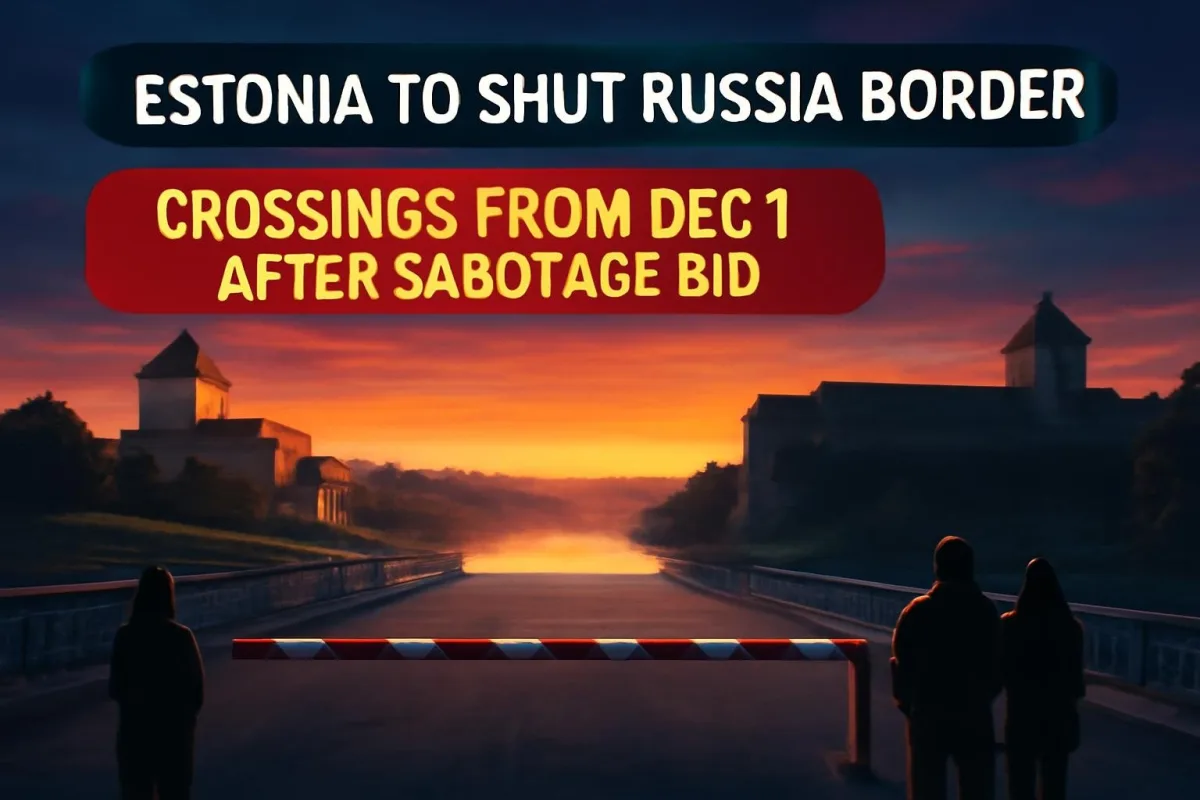
Estonia is preparing to close its land border crossings with Russia from December 1, after what its security service described as a Russian military intelligence plot to set fire to a drone manufacturer near Tallinn. Prime Minister Kristen Michal said on Sunday, November 15, that he had asked the interior ministry to prepare the steps, while Foreign Minister Margus Tsahkna said the crossings would shut from the start of December.
The attack that triggered the move
The decision follows an attempted attack on Threod Systems, an Estonian defence company in Viimsi, just north of Tallinn, which makes long-range reconnaissance and attack drones. According to Estonian public broadcaster ERR, a group tried to break into the company's premises on November 14 to cause an explosion and set the building on fire. Extensive damage was avoided.
ERR reported that eight Latvian citizens were detained. Estonia's Internal Security Service (KAPO) said the attempt was carried out on the orders of Russia's military intelligence agency, the GRU. ERR also noted that it was the second attempted arson on an Estonian defence firm since August, when Milrem Robotics in Tallinn was targeted.
What exactly is closing
Estonia currently has three road crossings open with Russia: Narva, Luhamaa and Koidula. They are open to pedestrians and freight and operate 12 hours a day. Interior Minister Igor Taro said he would propose that all road crossings be closed to both pedestrians and vehicles from the beginning of December, with the government set to discuss the plan this week.
There is still some uncertainty about the details. Tsahkna, writing on X, said Estonia would close "all border crossings" with Russia from December 1 and that Finland, Latvia and Lithuania had been informed. ERR's reporting focused on the road crossings and did not say whether the rail links at Narva and Koidula would also be shut. The government is also yet to decide whether the closure will be temporary or open-ended.
Key facts at a glance
| Country | Estonia |
| Closure date | From December 1, 2026 |
| Road crossings affected | Narva, Luhamaa, Koidula |
| Trigger | Attempted arson at Threod Systems, Viimsi (Nov 14) |
| Detained | 8 Latvian citizens (ERR) |
| Blamed on | Russia's GRU, according to KAPO |
| Key leaders | PM Kristen Michal, FM Margus Tsahkna, Interior Minister Igor Taro |
| Duration | Not yet decided |
Two weeks to get home
Taro advised Estonian residents and truck drivers who are currently in Russia to return within the next two weeks, warning that after that the journey home could become long and complicated. The Narva crossing in particular is one of the last land routes into Russia still open to ordinary travellers in Europe, and it is used by many local families with relatives on both sides of the river.
A wider pattern in the Baltics
The move comes amid growing alarm across Europe's eastern flank over sabotage, drone incursions and other "hybrid" attacks that governments blame on Moscow. Finland has already closed its land border with Russia, and Latvia and Lithuania have been tightening controls. Russia had not publicly responded to Estonia's announcement in the reports we reviewed.
For Estonia, a NATO and EU member with a large Russian-speaking population in the east, closing Narva is a significant step. It cuts a key everyday link and shows how seriously Tallinn is treating attacks on its defence industry, which has grown quickly since the war in Ukraine began.
Why it matters for India
Indian travellers rarely use these crossings, but the story is part of a bigger picture that does affect India. Rising tension between Russia and Europe shapes energy prices, shipping routes and the diplomatic balancing act New Delhi maintains with both sides. Indian students and workers in the Baltic states should also keep an eye on travel advisories if they planned overland trips into Russia this winter.
What happens next
Estonia's government is expected to formally approve the closure this week and decide how long it will last. Investigations into the Threod Systems attack are continuing, and further arrests or details from KAPO could follow. Neighbouring countries will be watching closely, and a joint Baltic and Nordic response cannot be ruled out.




Comments (0)