
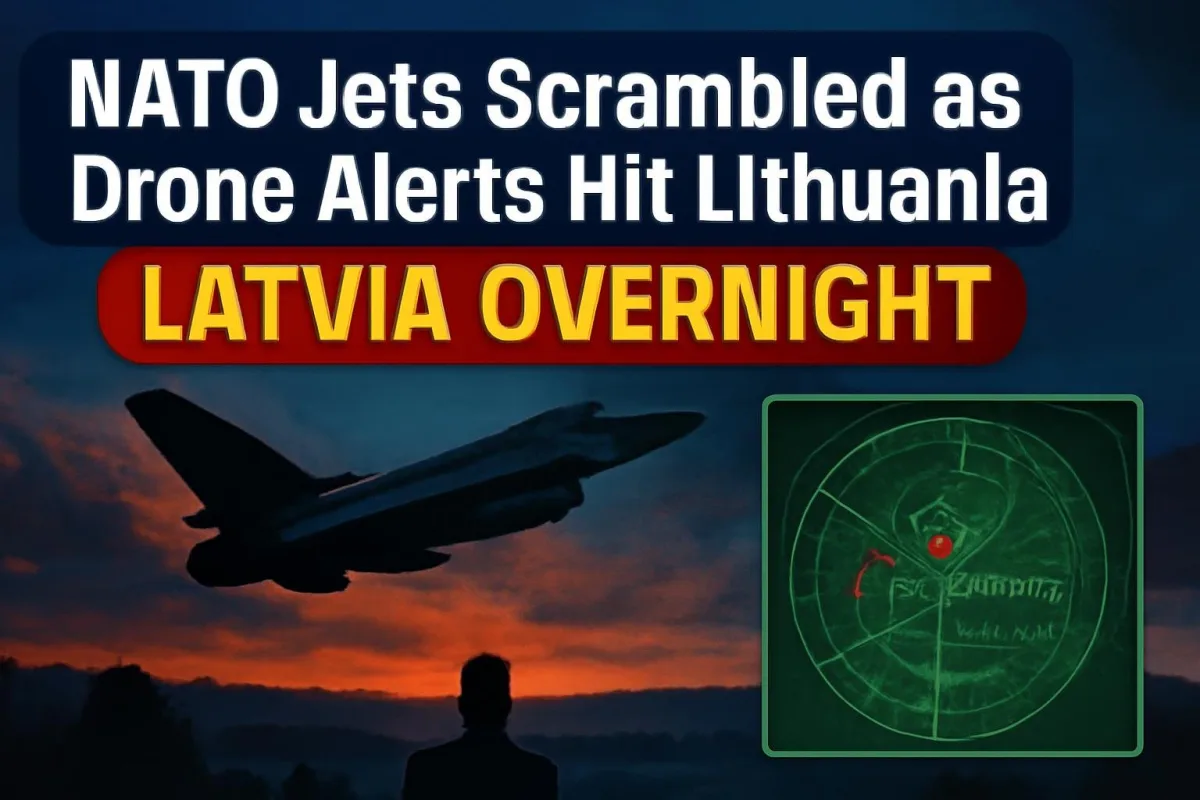
NATO fighter jets were scrambled overnight between Tuesday, November 10, and Wednesday, November 11, as drones tracked near the Baltic states triggered air alerts across Lithuania and Latvia. Residents in parts of Lithuania were told to seek shelter, flights at Vilnius airport were disrupted, and authorities in Latvia and Finland also took precautionary steps. No injuries were reported in the Baltic countries.
What happened overnight
In Lithuania, the first warning was issued at around 11 pm local time on Tuesday for the Vilnius and Utena regions, according to the country's public broadcaster LRT. It was lifted shortly after midnight. A second alert, starting in the southern Alytus region, was later widened to parts of central and northern Lithuania and upgraded to a red level, which tells people to move to shelters.
Vilmantas Vitkauskas, head of Lithuania's National Crisis Management Centre, said three drones were first detected over Belarus and did not enter Lithuanian airspace in the first incident, though one later crossed into Latvia. In the second incident, he said, a drone entered Lithuania from Belarus near the spa town of Druskininkai and left near Pasvalys in the north. NATO jets detected it but did not shoot it down, possibly because of poor weather and safety concerns. He added that three flights at Vilnius Airport, affecting more than 400 passengers, were disrupted.
Lithuania's Prime Minister described it as a difficult night, saying four drones had been detected across the region, that an attempt was made to shoot one down over northern Lithuania and that debris from a NATO missile was later found on the ground. It was not clear whether any drone was hit.
Key facts
| When | Night of November 10–11, 2026 |
| Countries with alerts | Lithuania, Latvia (Estonia also on alert, per reports) |
| Drones reported | Three first detected over Belarus; four across the region per Lithuania's PM |
| Entry point (second incident) | Near Druskininkai, from Belarus |
| NATO response | Baltic Air Policing jets scrambled twice |
| Flights | Three flights at Vilnius, 400+ passengers affected |
| Casualties in Baltics | None reported |
Latvia and Finland also react
Latvia's National Armed Forces issued an airspace threat warning for several municipalities early on Wednesday and activated drone interceptors, air defence units and NATO air policing jets. Latvian Defence Minister Raivis Melnis said the military had shortened its decision-making process and given ground-based interception teams more authority to act.
In Finland, the defence forces briefly imposed airspace and maritime restrictions in the eastern Gulf of Finland as a precaution, before lifting them later in the day.
Where did the drones come from?
Officials in Lithuania tracked the drones coming from the direction of Belarus, a close ally of Russia. However, the incident took place on a night of heavy drone activity between Russia and Ukraine. Ukrainian drones struck targets in northwest Russia, including the Ust-Luga port area, while Russian authorities said drone debris killed two people in the Smolensk region bordering Belarus. Russia also launched overnight strikes on Ukrainian cities.
Ukrainian drones aimed at Russia's Baltic Sea oil ports have strayed off course before, setting off alerts in neighbouring NATO countries. Kyiv has blamed Russian signal jamming for diverting some of its drones, while Moscow accuses Ukraine of using NATO airspace as cover. NATO members, for their part, hold Russia responsible for the war and the instability that comes with it. Officials did not publicly confirm who launched the drones seen on Tuesday night.
Why it matters for India
The Baltic incidents show how easily the Russia-Ukraine war can spill over into NATO territory – a risk that affects global energy markets, shipping and flight routes that Indian businesses and travellers depend on. They also come as US-mediated talks between Russia and Ukraine continue in Abu Dhabi, where India has been watching closely given its ties with both Moscow and Kyiv. Any escalation involving NATO would complicate those diplomatic efforts.
What happens next
Lithuania and Latvia are reviewing how they detect and intercept drones, with Latvia already giving its ground teams more power to act. Expect NATO to keep air policing jets on high alert, and for Baltic governments to press allies for more air defence support as the war's drone campaigns intensify.
Also Read
Russia-Ukraine Talks in Abu Dhabi: US Pushes to Bring Europe In
Modi-Zelenskyy Call: Kyiv Says India Ready to Aid Black Sea Corridor
France Blames Iran's IRGC for Cyberattack on Supermarket Fridges





Comments (0)