
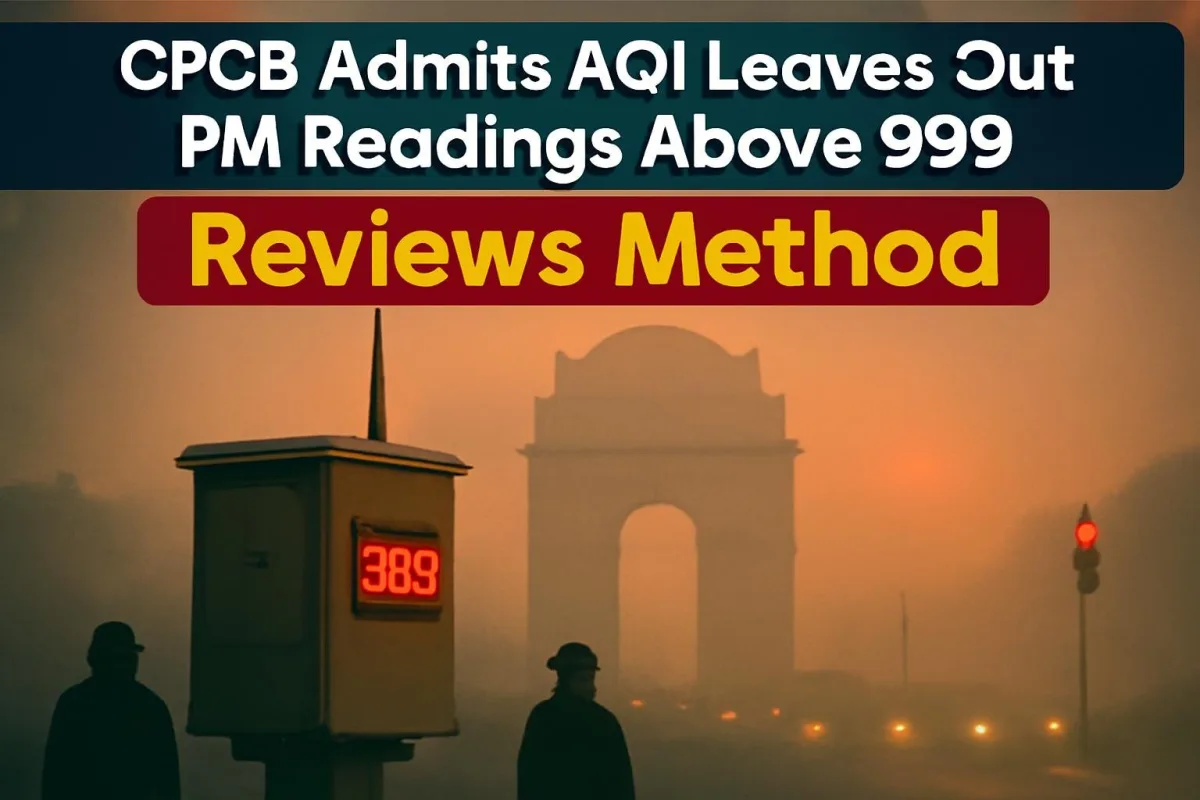
The Central Pollution Control Board (CPCB) has acknowledged that hourly particulate matter readings above the range its monitors are calibrated for were not used when Delhi's Air Quality Index was calculated during the post-Diwali pollution spike. In a detailed statement on X on Tuesday, November 10, the board defended the National Air Quality Index (NAQI) but confirmed that its methodology is under internal review.
The clarification comes after experts flagged large gaps in Delhi's official data as PM2.5 levels neared 1,000 micrograms per cubic metre around Diwali, raising a simple question for residents: was the air even worse than the numbers showed?
What Triggered the Row
Reports after Diwali said that 45 of Delhi's 59 monitoring stations had missing hourly readings for at least one pollutant. At the same time, people noticed that private air-quality apps were showing much higher numbers than the official AQI, which never goes above 500. Together, these raised concerns that the official index was understating the crisis on the worst nights.
What CPCB Said
CPCB explained that its continuous ambient air quality monitoring stations are calibrated for a measurement range of 0 to 1,000 µg/m³. Its automated data validation treats any hourly reading beyond that range as out of range, and such readings are not used in the computation. During extreme episodes such as firecracker bursting on Diwali, those hours therefore do not count toward a station's 24-hour average for that pollutant.
An Environment Ministry source told ANI that the data itself was not lost, saying in effect that the readings exist but were kept out of the index calculation.
Why AQI Stops at 500
On the cap, the board said the 0-500 scale is a deliberate design feature of the NAQI introduced in 2015, in line with international practice such as the US EPA scale. Any value above 500 stays in the "Severe" category, since the health risk at that level is already at its highest band. CPCB also said the gap between official numbers and private apps is due to differences in instruments and methodology, not under-reporting. Private platforms may use instantaneous readings and different breakpoints, while NAQI uses averages over several hours.
Key Facts
| Agency | Central Pollution Control Board (CPCB) |
| Statement issued | Tuesday, November 10, 2026, on X |
| Monitor calibration range | 0-1,000 µg/m³ |
| AQI scale | 0-500; above 500 remains "Severe" |
| Index introduced | 2015, developed with IIT Kanpur and an expert group |
| Pollutants tracked | PM2.5, PM10, NO2, SO2, CO, ozone, ammonia, lead |
| Delhi monitoring stations | 59 (up from 10 in 2014-15) |
| Stations nationwide | 634 (up from 30 in 2014-15) |
Is the Method Being Changed?
CPCB said the methodology has been kept under review and that internal deliberations are under way on how to handle data beyond the designed range. According to an Environment Ministry source quoted by ANI, two to three scientists are already working on the issue internally. The same source said no external expert group has been formally set up so far, though one should be formed, as was done in 2015. No timeline for a revised method has been announced.
What It Means for Your Health
For people living in Delhi-NCR and other north Indian cities, the practical message is this: when the official AQI shows "Severe", the real exposure on the worst hours could be well beyond what the number suggests. The index tops out at 500, but the air does not.
Doctors routinely advise the following on severe-pollution days:
- Limit outdoor exercise, especially early morning and late evening when smog is thickest.
- Use a well-fitted N95 or N99 mask outdoors; cloth and surgical masks offer little protection against PM2.5.
- Keep children, older adults and people with asthma, heart or lung conditions indoors as far as possible.
- Run an air purifier in the room where you sleep, and keep windows shut during peak hours.
- Seek medical help early if you notice breathlessness, chest tightness or persistent cough.
It also makes sense to check more than one source. The official CPCB index is the legal benchmark used for measures such as GRAP restrictions, while instantaneous readings can help you time a walk or a commute.
What Happens Next
The admission is likely to strengthen calls for an updated, transparent AQI framework that can capture extreme pollution spikes, especially around festivals and crop-burning season. Whether the review leads to new monitor ranges, revised validation rules or a public expert panel will be watched closely as Delhi heads into its toughest winter months.





Comments (0)