

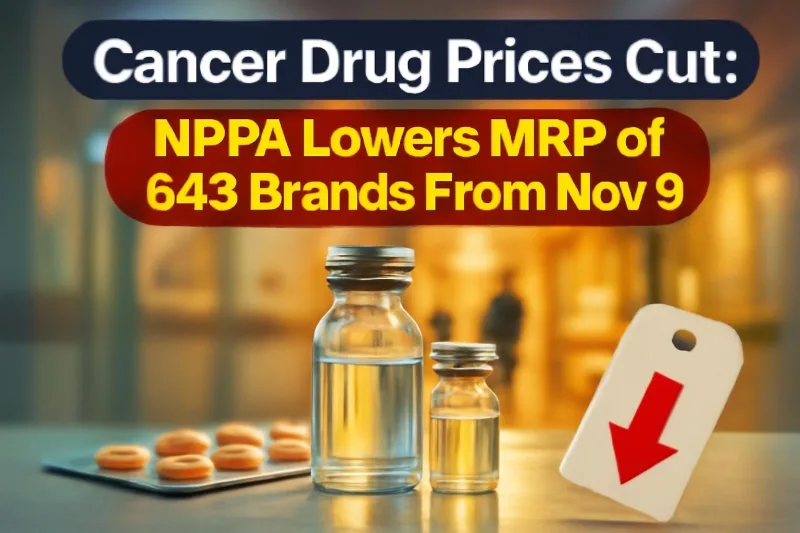
Cancer patients and their families have some relief coming their way from Monday. Revised and much lower prices of 137 anti-cancer medicines will come into force across India from November 9, 2026, after the National Pharmaceutical Pricing Authority (NPPA) capped the trade margins on these drugs at 30%. The Ministry of Chemicals and Fertilizers said on November 7 that the move is expected to save consumers about Rs 3,502.31 crore every year.
For some brands, the drop is dramatic. Medicines that cost tens of thousands of rupees per pack will now sell for a fraction of their earlier price.
What Has Changed
Trade margin is the gap between the price at which a company sells a medicine to its stockist or distributor and the maximum retail price (MRP) printed on the pack. For many cancer drugs, this gap had grown very wide, meaning patients paid far more than the actual selling price at the distribution level.
Under the new rule, the margin across the supply chain cannot exceed 30%. The new MRPs are calculated from the average price to stockists in March 2026, with the 30% cap and GST added on top. The decision follows a recommendation by an expert committee under the Directorate General of Health Services (DGHS), and the cap has been notified under the Drugs (Prices Control) Order, 2013.
Key Numbers at a Glance
| Detail | Figure |
|---|---|
| Anti-cancer drugs covered | 137 |
| Trade margin cap | 30% |
| Effective date | November 9, 2026 |
| Companies that reported revised MRPs | 76 |
| Formulations with revised MRPs | 1,225 (covering 121 drugs) |
| Formulations with MRP cuts | 1,031 |
| Brands cut by more than 50% | About 600 |
| Steepest reduction | 96.45% |
| Estimated annual savings | Rs 3,502.31 crore |
Examples of Price Cuts
The government shared several examples of how much prices will fall:
- Palbopro (Palbociclib 125 mg), a breast cancer capsule by RPG Life Sciences: from Rs 40,421.33 to Rs 2,720.
- Abirone (Abiraterone acetate 250 mg), a prostate cancer tablet by Arvincare Pharma: from Rs 41,250 to Rs 3,218.23.
- Bryxta (Bevacizumab 100 mg), an injection used in lung and cervical cancer, by Zydus Lifesciences: from Rs 25,995 to Rs 3,318.
- DenOsteoRel (Denosumab 60 mg) by Reliance Life Sciences: from Rs 24,955 to Rs 6,240.
- Lupiher 2 (Pertuzumab 420 mg), a breast cancer injection by Lupin: from Rs 83,520 to Rs 37,358.30.
Of the 137 drugs, around 10 to 15 have not yet been launched in India. The margin cap will apply to them as and when they reach the market.
Why It Matters for Patients
Cancer treatment in India is often paid for out of pocket, and targeted therapies and biologics can run into lakhs of rupees over a full course. Families frequently dip into savings or take loans to keep treatment going. Lower MRPs on such medicines directly reduce that burden, especially for patients buying drugs from retail chemists rather than through government hospitals or insurance.
In its statement, the government described the trade margin rationalisation of non-scheduled anti-cancer medicines as an important step towards improving affordability and access. This is not the first such exercise: a 2019 pilot capped margins on 42 anti-cancer drugs and brought down prices of over 500 brands, some by up to 90%.
The NPPA has also clarified that stock already in the supply chain does not need to be recalled or relabelled, which should help avoid shortages at chemist shops during the changeover. What matters for the buyer is that the revised price is charged at the counter.
How the Rule Will Be Enforced
Retailers, dealers, hospitals and institutions must prominently display the revised MRP list at their premises and on their websites. State drug controllers have been tasked with monitoring compliance. Manufacturers can still take the annual price increase permitted under the drug pricing rules, provided the 30% margin limit is maintained.
What You Should Do Next
- Check the new price. Look up your medicine on the NPPA website or the Pharma Sahi Daam app before buying.
- Compare with the bill. From November 9, the amount charged should not exceed the revised MRP.
- Report overcharging. If a chemist or hospital charges more, you can complain to the NPPA or your state drug controller.
- Talk to your doctor. Do not switch brands or change treatment on price alone; ask your oncologist first.



Comments (0)