
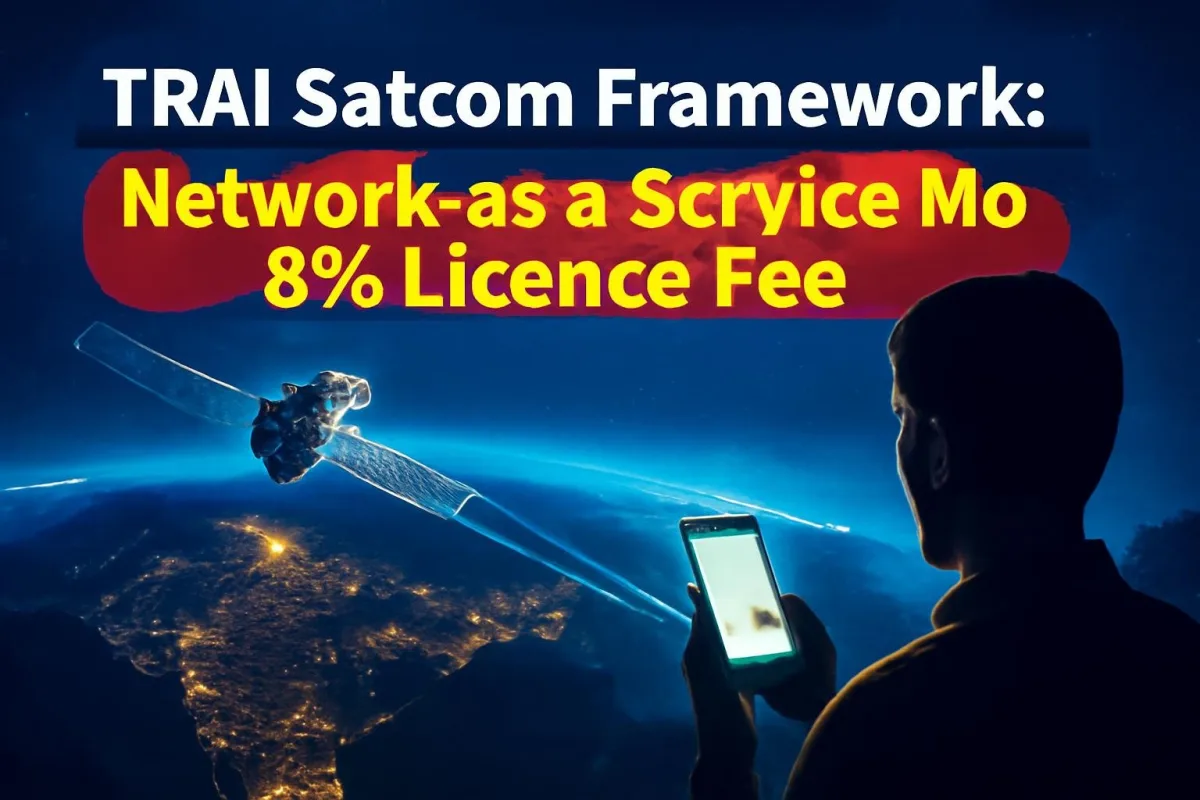
India's telecom regulator has laid out how satellite networks could plug into the country's mobile and broadband ecosystem. On Thursday, November 5, the Telecom Regulatory Authority of India (TRAI) released its recommendations on a new "Satellite Communication Network Provider" authorisation under the Telecommunications Act, 2023. The headline idea is a wholesale model: satellite companies would build and run the networks, while licensed telecom and internet providers sell services to customers.
The proposal also opens the door to direct-to-device (D2D) services, where an ordinary smartphone connects straight to a satellite in areas without mobile towers.
What is Satellite Network-as-a-Service?
Under the new category, an authorised Satellite Communication Network (SCN) provider would offer "Satellite Communication Network-as-a-Service", or SCNaaS. In simple terms, it would rent out satellite capacity and infrastructure to eligible service providers. Those providers, such as telecom operators, internet service providers or VSAT companies, would then serve end users.
The key restriction: SCN providers will not be allowed to sell telecom services directly to consumers. The aim, as TRAI described it during consultations in April, is to separate the network layer from the service layer, so that operators do not need to build their own satellite networks to offer satellite-backed connectivity.
TRAI's key recommendations
| Service area | All of India |
| Validity | Up to 20 years, renewable for another 20 |
| Entry fee | Rs 37.5 lakh |
| Authorisation fee | 8% of adjusted gross revenue, no minimum |
| Minimum net worth / equity | Rs 60 lakh each |
| Spectrum method | Administrative assignment, up to 5 years (+2) |
| Minimum spectrum charge | Rs 3,500 per MHz per year |
| Bands covered | C, Ku, Ka, Q/V, L and S |
Direct-to-phone satellite services
Perhaps the most interesting part for ordinary users is D2D. TRAI has recommended allowing satellite-to-smartphone services using mobile satellite service spectrum in the L and S bands. It has also suggested that telecom operators partnering with satellite providers be allowed to use their existing mobile spectrum in the 600, 700, 800, 900, 1800 and 2100 MHz bands for D2D, on a non-interference basis, without waiting for the next World Radiocommunication Conference in 2027.
Operators would not pay an extra spectrum charge for using their own mobile spectrum this way. TRAI has also asked the government to encourage phone makers to build L and S band support into handsets, which would let more devices connect to satellites directly.
Who could benefit
India's existing satellite broadband players include Starlink, Eutelsat OneWeb and Jio Satellite Communications. Under TRAI's framework, new companies could also enter by taking the separate SCN authorisation. Holders of unified, access, internet and long-distance licences, along with commercial VSAT and GMPCS players, would be eligible to buy SCNaaS capacity.
How the recommendations came about
- July 3, 2025: The Department of Telecommunications (DoT) asked TRAI to suggest terms for the new authorisation.
- April 8, 2026: TRAI released a consultation paper on the framework.
- May 2026: TRAI received 31 comments and 12 counter-comments from stakeholders.
- July 2, 2026: An open house discussion was held.
- November 5, 2026: Final recommendations sent to the government.
What it means for users in India
For people in remote villages, hilly regions, islands and border areas, the framework could eventually mean better coverage without waiting for towers and fibre. If telecom operators can simply buy satellite capacity instead of building it, more of them may offer satellite-backed plans, which could increase competition. Satellite-to-phone services could also help in emergencies and natural disasters, when ground networks fail.
TRAI says the goal is to encourage investment in satellite infrastructure, make better use of spectrum and expand both broadband and mobile coverage. For businesses such as shipping, mining, aviation and logistics firms that operate far from cities, a wholesale satellite market could also bring more choice of providers and potentially lower costs over time.
What happens next
The recommendations are not binding. The DoT will now examine them and decide whether to accept them in full, in part or with changes. Only after the government notifies the rules and assigns spectrum can companies apply. No timeline has been announced, so users should not expect satellite-to-phone services on their handsets immediately, but the regulatory roadmap is now on the table.




Comments (0)