

Very severe cyclonic storm Arnab began crossing the Andhra Pradesh coast near Yanam, close to Kakinada, in the early hours of Wednesday, October 28. Fierce winds of 125–135 kmph, gusting to 150 kmph, and heavy rain lashed the Godavari delta and north coastal districts as more than 84,000 people waited out the night in cyclone shelters.
The landfall process started around 1:20 am, according to the India Meteorological Department (IMD), and the storm sat almost stationary near the shoreline for several hours. Officials expected the crossing to finish by about 4 am, after which Arnab is forecast to weaken quickly as it moves inland. For lakhs of families along the coast, though, the hardest part of the night is only now giving way to an anxious morning of damage checks.
How the night unfolded
Arnab, the first cyclone to form over the Bay of Bengal this year, had been tracking towards the coast since the weekend. On Tuesday morning the IMD placed it about 170 km southeast of Visakhapatnam with sustained winds of 150–160 kmph. By afternoon the weather office brought forward the expected landfall to between 2 am and 4 am on Wednesday, and by Tuesday evening the Chief Minister's Office in Amaravati said the process had started near Yanam, the Puducherry enclave surrounded by Andhra's Konaseema and Kakinada districts.
Chief Minister N. Chandrababu Naidu said the impact zone had shifted north and would stretch from Srikakulam to Krishna district, rather than down to Bapatla as first projected. Overnight, heavy to extremely heavy rain and strong winds were reported in Visakhapatnam, Anakapalli, Vizianagaram, Srikakulam, Kakinada and Dr B.R. Ambedkar Konaseema.
Storm surge warning for the Godavari mouth
The IMD warned of a storm surge of 1.5 to 2.5 metres above the astronomical tide, enough to flood low-lying areas around Kakinada, Yanam and the mouth of the Godavari. Kakinada port was placed under Great Danger Signal 10, the highest level, while Visakhapatnam and Gangavaram ports hoisted signal 9.
Key facts at a glance
| Storm | Very Severe Cyclonic Storm Arnab |
| Landfall area | Near Yanam, close to Kakinada |
| Landfall began | About 1:20 am, Wednesday, October 28 |
| Wind speed at landfall | 125–135 kmph, gusting to 150 kmph |
| Storm surge | 1.5–2.5 m above tide in low-lying areas |
| People in shelters (AP) | 84,000+ across 290 cyclone shelters |
| Rescue teams in AP | 12 NDRF and 10 SDRF teams |
| Power crews on standby | 8,400+ restoration personnel |
Evacuation and preparedness
The state government says it had identified 2,199 cyclone shelters and moved over 84,000 people into 290 of them by Tuesday afternoon. In Kakinada alone, district officials shifted tens of thousands of residents to relief camps, while Visakhapatnam moved people out of 122 low-lying pockets. More than 2,300 pregnant women were moved to hospitals ahead of the storm so they would not be stranded if roads were cut off.
Over 30,000 fishing boats were pulled back to shore, and the power department kept more than 8,400 workers ready to restore lines once the winds drop. The National Crisis Management Committee had asked all agencies to aim for "zero loss of life".
Reuters, quoting the Chief Minister's Office, reported that no loss of life had been reported from the landfall area as the storm crossed. Earlier, on Tuesday, local reports said a 65-year-old man died in Mangalapalem in Visakhapatnam after coming into contact with a snapped live wire, and the city reported more than 200 uprooted trees.
"I appeal to everyone to remain calm, stay alert and cooperate with the authorities," Naidu said, adding that fishermen must not go to sea until official clearance is given and that families should keep essential supplies and charged phones ready. The Real Time Governance Society had advised residents not to step out of their homes until 9 am on Wednesday.
Trains, flights and schools
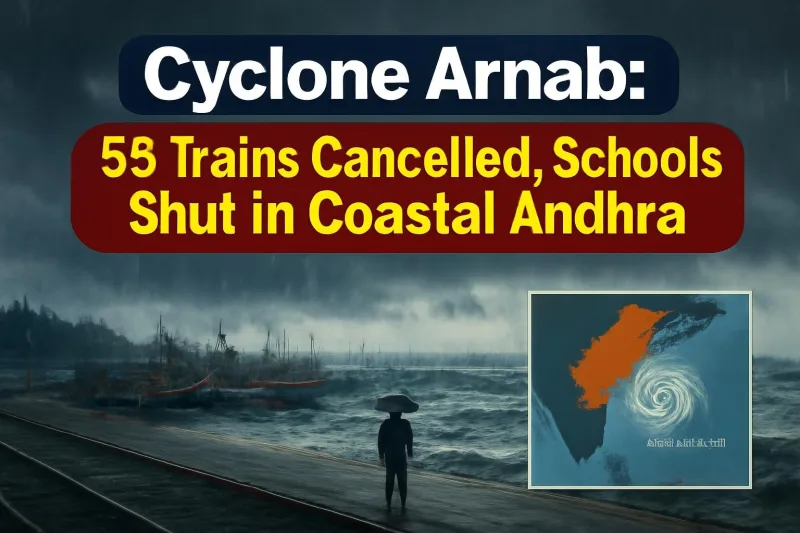
Rail and air travel took a heavy hit. South Coast Railway cancelled dozens of trains and set up a 24x7 war room, while South Central Railway cancelled several Visakhapatnam-bound expresses. At least 16 flights were cancelled at Visakhapatnam and 5 at Vijayawada on Tuesday, with 15 more Vijayawada flights cancelled for Wednesday. Schools in coastal Andhra stay shut on Wednesday, and several Odisha districts have also closed schools.
Beyond Andhra: Telangana and Odisha on alert
Even as it weakens, Arnab's rain bands are expected to travel inland. Telangana has a red alert for Khammam, Bhadradri Kothagudem, Mulugu and Mahabubabad districts for Wednesday. Odisha has kept police on high alert in seven southern districts and deployed 294 rescue teams. Advisories were also issued for West Bengal, Jharkhand and the Andaman and Nicobar Islands.
What it means for you
- Stay indoors until local authorities announce that the danger has passed; fallen trees and snapped power lines are the biggest risks after a cyclone.
- Check your train or flight on the official railway and airline channels before leaving home, as more cancellations and diversions are likely through Wednesday.
- Avoid low-lying roads near the Godavari mouth and the coast while surge water recedes.
- Use only official updates from the IMD, the state government and district collectors, and avoid forwarding unverified videos.
What happens next
The IMD expects Arnab to weaken rapidly over land, but heavy rain will continue over parts of coastal Andhra, Yanam and neighbouring Telangana through the day. Once the winds ease, the focus will shift to restoring power, clearing roads, and assessing damage to houses and standing paddy crops in the Godavari delta, one of Andhra's richest farming belts. We will update this story as official figures on damage and casualties come in.





Comments (0)