
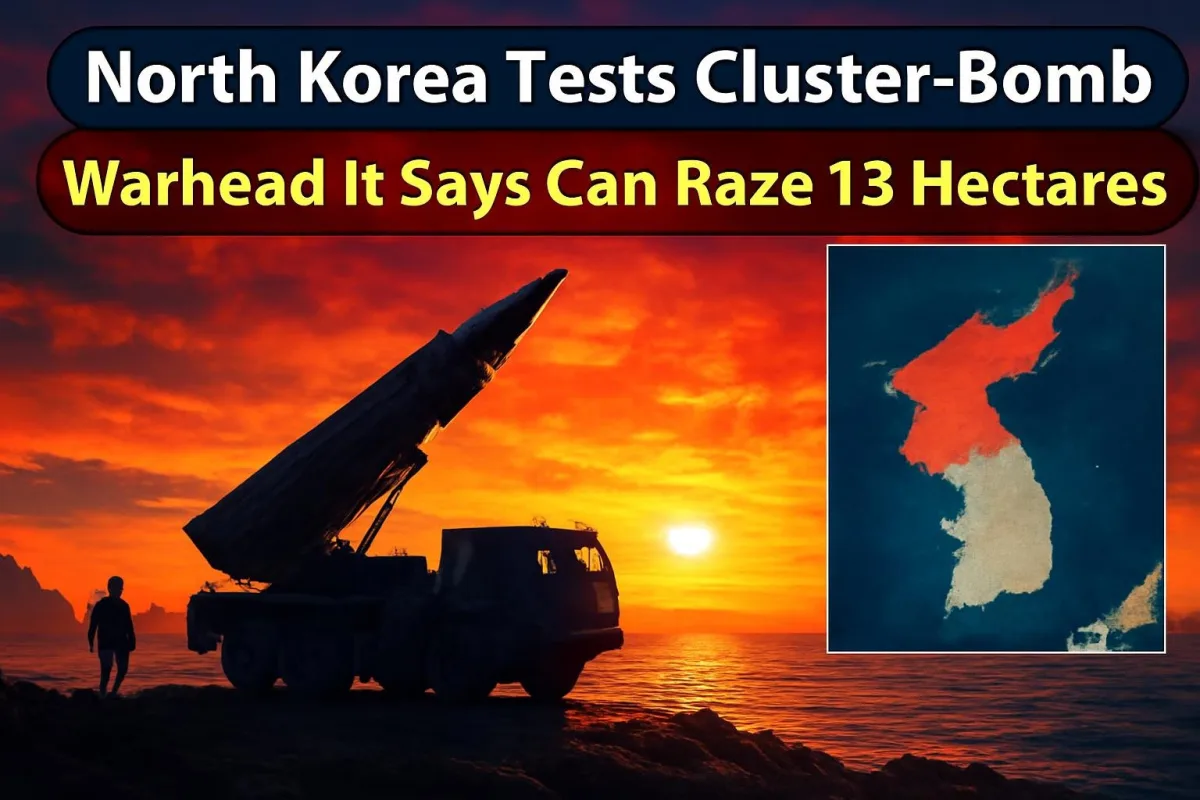
North Korea has tested a new cluster-bomb warhead designed for its tactical ballistic missiles, state media KCNA reported on Sunday, November 1. The missile was fired on Saturday, October 31, toward the Yellow Sea from near Chongju county in the country's northwest, and Pyongyang claims the warhead can reduce a target area of 12 to 13 hectares "to ash".
The launch is the latest in a run of weapons tests this year and comes just days after the United States, South Korea and Japan renewed their call for North Korea's complete denuclearisation.
What North Korea Says It Tested
According to KCNA, the country's Missile Administration carried out the test to assess the "combat adaptability and power" of a cluster-bomb warhead, which it called the "Standard Type 2". Research institutes involved said that at its highest-density setting the warhead could devastate an area of roughly 12 to 13 hectares.
State media photos showed a missile leaving a mobile launcher with an orange exhaust plume, and multiple bomblet impacts on an island target. KCNA said cluster warheads fall into four categories by purpose, and the general director of the Missile Administration said frontline units will be able to choose among all types within this year, depending on the mission and target.
Unlike an earlier cluster-warhead launch in April, which leader Kim Jong Un oversaw with his daughter Ju Ae, reports said Kim was not present at Saturday's test.
Which missile was used?
KCNA did not name the missile. Shin Jong-woo, secretary-general of the Korea Defense and Security Forum, told the Korea Herald the projectile appeared to be a variant of the Hwasong-11, a short-range missile family that resembles Russia's Iskander and is built for low, manoeuvrable flight.
Key Facts
| Test date | Saturday, October 31, 2026 |
| Reported by | KCNA, Sunday, November 1 |
| Launch area | Near Chongju county, northwest North Korea |
| Direction | Towards the Yellow Sea |
| Weapon | "Standard Type 2" cluster-bomb warhead for tactical ballistic missiles |
| Claimed destructive area | 12–13 hectares at highest density |
| April 2026 claim (earlier warhead) | 6.5–7 hectares |
| Kim Jong Un present? | No, according to reports |
How South Korea Responded
South Korea's Joint Chiefs of Staff said on Sunday that it had tracked activity ahead of the launch through close intelligence sharing with the United States and maintained a full readiness posture. Seoul did not immediately give flight details.
The test also follows a landmine blast on the heavily fortified inter-Korean border that wounded three South Korean soldiers. North Korea has denied responsibility for that incident and said it will fortify its border areas and resume loudspeaker broadcasts, adding to tensions along the frontier.
The Bigger Picture
The claimed blast area is roughly double the 6.5 to 7 hectares North Korea said its earlier cluster warhead could cover when it tested one in April. Pyongyang has also recently tested attack drones, a precision-guided torpedo system and an intermediate-range hypersonic missile, as Kim pushes to modernise his forces and deepen ties with Russia.
Diplomatically, the door is not fully shut. US Secretary of State Marco Rubio said on Saturday that President Donald Trump remains open to talks with Kim if Pyongyang is willing to address US and allied concerns, though no meeting has been scheduled. The launch came shortly after trilateral talks in Atlanta where the US, South Korean and Japanese foreign ministers restated their denuclearisation goal.
Why It Matters for India
India has no direct stake in the Korean Peninsula's military standoff, but it watches closely for three reasons. First, North Korea's missile and nuclear networks have historically been linked to proliferation in India's neighbourhood. Second, any flare-up in East Asia affects shipping lanes and supply chains for electronics and semiconductors that Indian industry depends on. Third, India has consistently backed the denuclearisation of the Korean Peninsula at international forums, and every new weapons test makes that goal look more distant.
What Happens Next
Analysts will watch whether North Korea follows up with further launches, especially around US-South Korea military drills, and whether its stated plan to field all four cluster-warhead types by the end of 2026 goes ahead. The situation along the border, after the landmine incident and the threat to resume loudspeaker broadcasts, is another flashpoint to watch in the coming weeks.





Comments (0)