
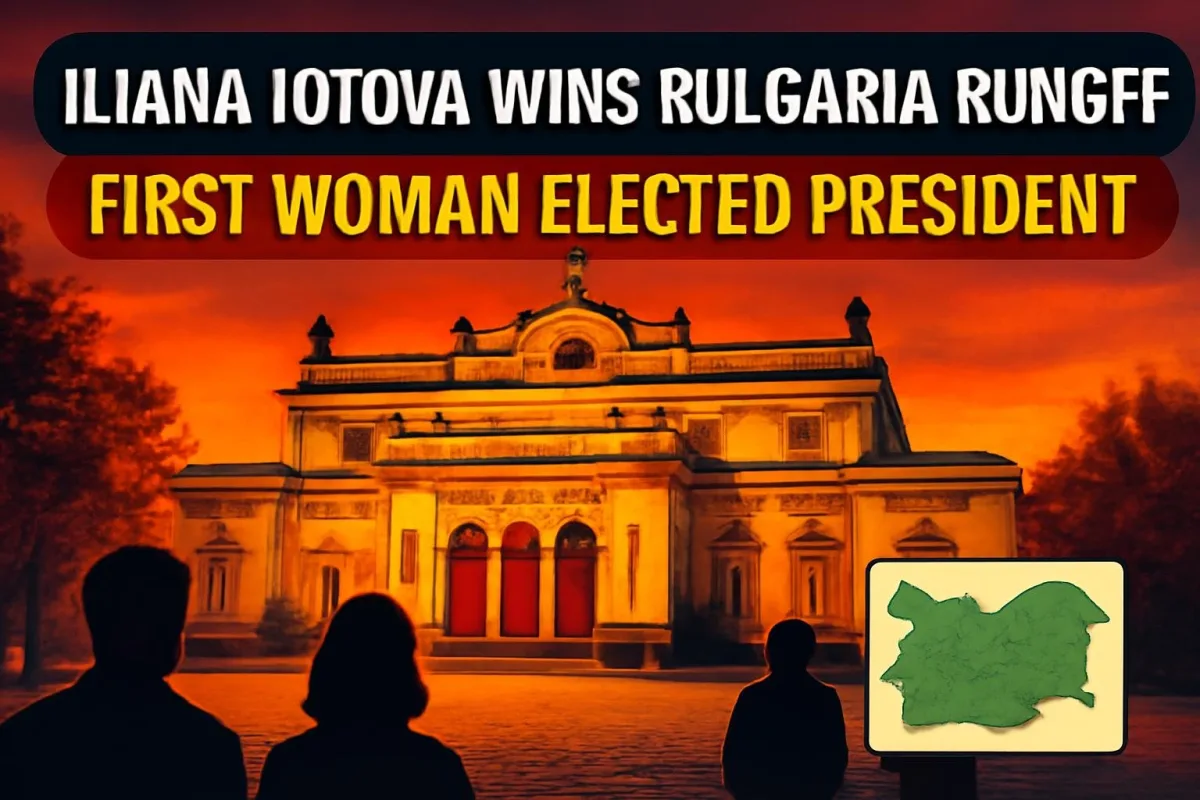
Bulgaria has elected a woman as its president for the first time. Acting president Iliana Iotova won Sunday's (November 1) runoff with 57.6% of the vote, defeating former caretaker prime minister Andrey Gyurov, who got 39.5% and conceded defeat, according to Bulgaria's Central Election Commission. The 62-year-old former television journalist will begin her five-year term on January 22.
How the vote went
Iotova received about 1.09 million votes against roughly 7.5 lakh for Gyurov. Turnout, however, was low at around 27%. In the first round on October 25, turnout was about 23%, a record low for a Bulgarian presidential election. Around 56,000 voters, nearly 3% of those who turned out in the runoff, picked the ballot option "I support none of the candidates".
| Key fact | Details |
|---|---|
| Runoff date | November 1, 2026 |
| Winner | Iliana Iotova, 57.6% |
| Runner-up | Andrey Gyurov, 39.5% |
| Runoff turnout | About 27% |
| First round | October 25, turnout about 23% |
| Vice president-elect | Kiril Valchev |
| Term begins | January 22, 2027 |
Who is Iliana Iotova?
Iotova started her career as a television journalist in the 1990s before moving into politics. She served in Bulgaria's National Assembly and then in the European Parliament for the Socialist Party, and was elected vice president twice, in 2016 and 2021, on Rumen Radev's ticket. She has been acting president since January, when Radev resigned to contest parliamentary elections.
That move paid off for Radev. His Progressive Bulgaria party won 131 of 240 seats in April's parliamentary vote, and he is now prime minister. With Iotova's win, the same political camp controls both the government and the presidency. Her running mate, Kiril Valchev, has headed the Bulgarian News Agency since 2021.
Her stand on Russia, Ukraine and the EU
Iotova campaigned as a "president of peace". She favours a diplomatic end to the war in Ukraine, opposes further military aid to Kyiv, and has called for renewed dialogue with Russia and the lifting of sanctions on Moscow. At the same time, she supports Bulgaria's membership of the European Union and NATO. Radev's government has already stopped transferring military equipment to Ukraine.
After voting, Iotova said she cast her ballot "for national consensus through dialogue" and promised to heal divisions in Bulgarian society. European Commission President Ursula von der Leyen congratulated her, writing, "For a strong Bulgaria in a strong Europe."
The losing side
Gyurov, a former central bank deputy governor, ran on a pro-European, pro-Ukraine platform backed by pro-Western opposition parties. As caretaker prime minister he had signed a security cooperation agreement with Kyiv. Former prime minister Boyko Borissov endorsed him late in the race, which Iotova's campaign used to paint him as part of the old establishment.
A low-turnout mandate
Iotova's margin is comfortable, but the turnout numbers tell another story. With only about a quarter of eligible voters taking part in the runoff, she was chosen by a relatively small share of the electorate. Still, a lead of roughly 18 percentage points over her rival is a clear verdict among those who did vote, and it gives her a firm footing as she takes over from her acting role.
What the president can and cannot do
Bulgaria is a parliamentary republic, so the president's powers are limited. The president is commander-in-chief of the armed forces, can return laws to parliament through a veto, and has a role in foreign policy. Day-to-day governing stays with the prime minister and cabinet. Analysts have warned that with one camp holding both offices, the usual checks between the presidency and government could weaken.
Why it matters beyond Bulgaria
Bulgaria sits on the Black Sea and on NATO's eastern edge, so its tilt matters for Europe's approach to the Russia-Ukraine war. Iotova's win adds another EU voice calling for talks over weapons. The timing is sensitive: drone attacks on commercial ships off Bulgaria's coast have killed at least 24 crew members in the past month, according to Reuters, and both candidates condemned the attacks without directly blaming Moscow.
For readers in India, the result is another sign of how Europe is divided on the war: some governments want more weapons for Kyiv, others want talks first. How Bulgaria votes inside the EU on sanctions and Ukraine aid in the months ahead will be closely watched in Brussels.


Comments (0)