
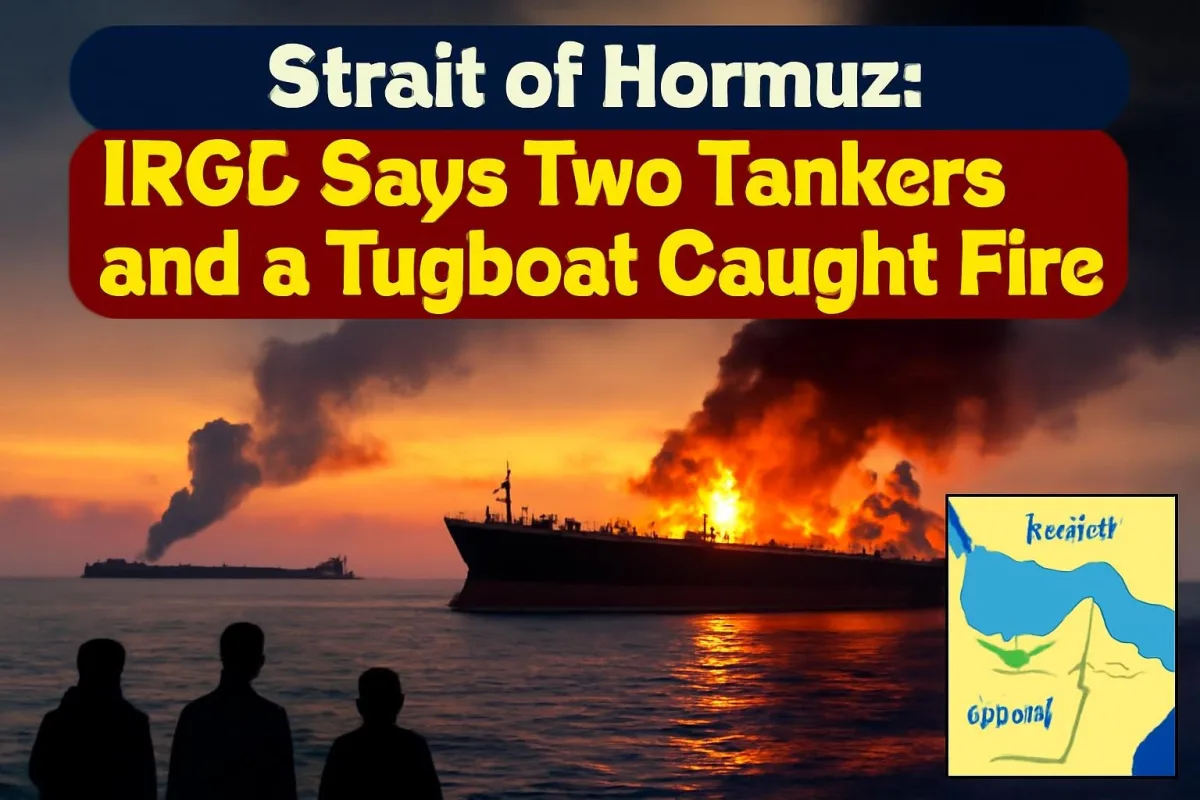
Tension in the world's most important oil chokepoint rose again on Thursday after Iran's Islamic Revolutionary Guard Corps (IRGC) said two oil tankers and a tugboat had caught fire in separate incidents in the Strait of Hormuz. According to the IRGC, the vessels ran into trouble after trying to use routes through the strait that Tehran has not authorised, and one of the tankers struck a mine.
The claims, carried by Iranian state media and reported by international news agencies, have not been independently confirmed. No ship names, flags or casualty figures had been made public by the time of writing.
What the IRGC said
As per the IRGC's account, the first incident took place on Wednesday night, when a large oil tanker attempting to cross a passage south of the strait struck a mine and came to a halt. In a second incident, a supertanker caught fire as it was leaving the route in the eastern part of the waterway. A tugboat that went to help put out that fire also caught fire.
The Guards also claimed that their navy's electronic warfare unit had taken control of two aircraft they described as intruding, and repeated that Iran remains in control of the strait. Neither claim could be verified independently.
| Location | Strait of Hormuz, between Iran and Oman |
| Vessels involved | Two oil tankers and one tugboat (IRGC claim) |
| Alleged cause | One tanker hit a mine; a supertanker and the tugboat caught fire |
| When | Wednesday night into Thursday, November 4-5, 2026 |
| Ship names and casualties | Not disclosed |
| Independent confirmation | None so far |
The bigger picture: a war and an election
The incidents come against the backdrop of the US-Iran war, which has hung over shipping in the Gulf for months, and only days after the Democrats won control of both the House and the Senate in the US midterm elections. Speaking at the White House, President Donald Trump said the war had been worth its political and economic costs, arguing that the US had no choice but to act to stop Iran from getting a nuclear weapon. He also agreed with Vice President JD Vance that the conflict had hurt Republicans at the polls by pushing up petrol prices.
In Tehran, Supreme Leader Mojtaba Khamenei said American hostility towards Iran would continue regardless of the midterm results, suggesting there is little immediate expectation of a thaw.
Oil prices had just started to cool
The timing is awkward for energy markets. Brent crude had slipped below $100 a barrel on Wednesday for the first time in a month, falling to about $98.70 after a third straight session of losses, as traders bet on a lower risk of escalation after the US election. Fresh trouble in Hormuz could test that optimism, especially if shipping companies begin rerouting or insurers raise war-risk premiums again.
Why it matters for India
India buys most of the crude oil it uses from abroad, and a large share of it, along with cooking gas cargoes, comes from Gulf producers whose tankers must pass through the Strait of Hormuz. That makes the narrow waterway directly relevant to Indian households. Any sustained disruption tends to show up in three ways:
- Fuel and import costs: higher crude prices widen India's import bill and put pressure on the rupee.
- Freight and insurance: tanker owners charge more to sail through a conflict zone, which raises the cost of every cargo.
- Crew safety: Indian seafarers make up a big part of the global merchant fleet, so incidents at sea are closely watched by families and the shipping ministry.
So far, there is no indication that Indian ships or crew were involved in Thursday's incidents.
What happens next
The key things to watch are whether shipping authorities or the owners of the vessels confirm the IRGC's account, whether the crews are safe, and how oil markets react when trading resumes. Any official advisory for ships in the region, including from India's Directorate General of Shipping, would be an important signal for Indian operators. We will update this story as verified details emerge.





Comments (0)