
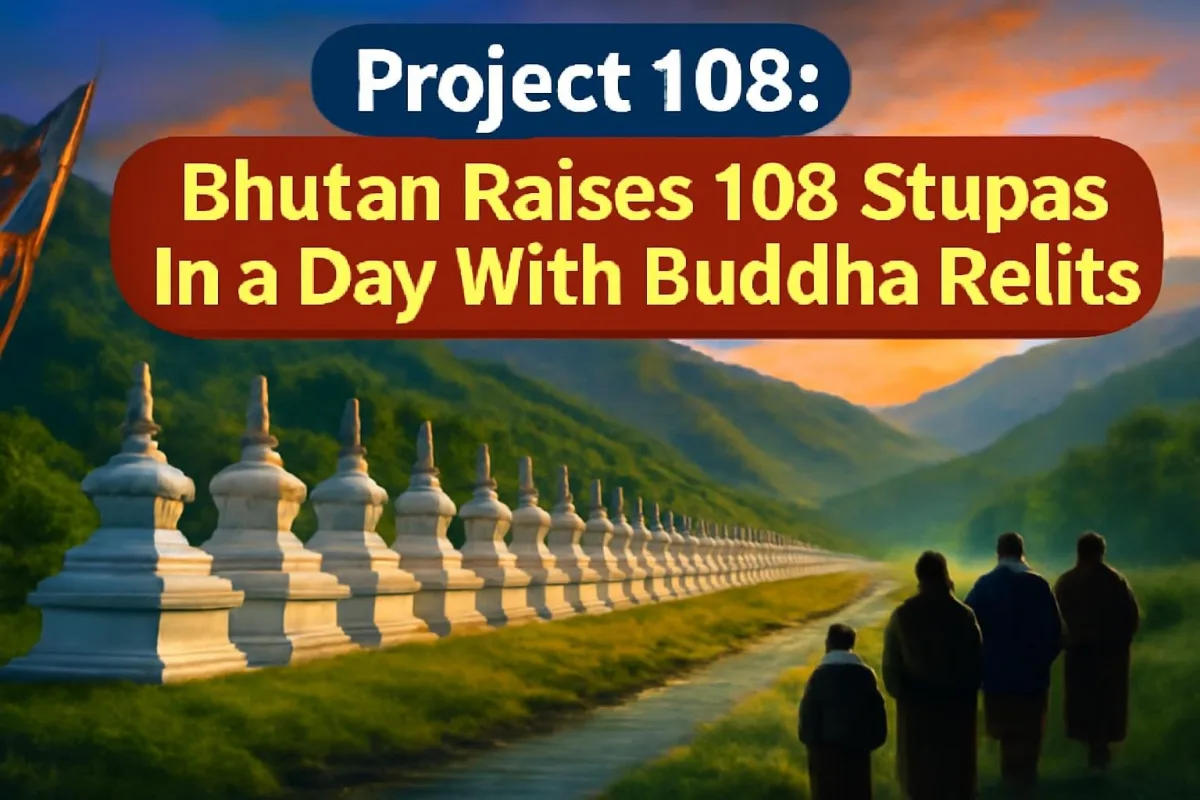
In a single morning, Bhutan raised 108 Buddhist stupas along a 12-km stretch of the Mau Chhu river in Gelephu, close to the Assam border. More than 40,000 volunteers worked from 3 AM to noon on November 1 to complete Project 108, a royal initiative that has drawn huge crowds, including an Indian delegation led by Union Minister Kiren Rijiju, and carries sacred Buddha relics from India inside the chortens.
The four-day celebrations, which began on November 1 and end today, November 4, include consecration prayers, offerings and circumambulation of the newly built chortens.
What is Project 108?
Project 108 is the brainchild of King Jigme Khesar Namgyel Wangchuck, who announced it on February 21, 2026. The idea was to build 108 Jangchub Chortens – "Stupas of Enlightenment" – in one day at the site of the upcoming Gelephu Mindfulness City (GMC), the special economic and spiritual hub that Bhutan is developing in its southern foothills.
The number 108 is deeply sacred in Buddhism. A prayer mala has 108 beads, and the Kangyur, the collection of the Buddha's translated teachings, has 108 volumes. Each chorten stands 15 metres tall and is placed exactly 108 metres from the next, forming a long spiritual corridor along the riverbank.
Project 108: key facts
| Date raised | November 1, 2026 |
| Location | Gelephu Mindfulness City, along the Mau Chhu river, Bhutan |
| Number of chortens | 108 |
| Height of each | 15 metres |
| Gap between chortens | 108 metres |
| Corridor length | About 12 km |
| Volunteers | More than 40,000 |
| Construction window | 3 AM to 12 noon |
| Estimated cost | About $21 million |
| India's representative | Union Minister Kiren Rijiju |
A day of faith and zhabto
Work at the sites began soon after midnight with traditional prayers and rituals. At 3 AM, the sound of 58 sets of dungchen – the long Buddhist horns – signalled the start of construction. Volunteers worked in teams of 20 to 24 people for each chorten, building them simultaneously at all 108 sites.
The volunteers came from every walk of life – students, farmers, doctors, monks and retirees – under the Bhutanese tradition of zhabto, or voluntary community service. The land had been cleared and foundations prepared in advance, so the final push could be completed in a single morning. Officials quoted by AFP estimated that around two lakh people gathered to watch.
"That is the Bhutanese spirit," the King said, praising the collective effort. "My prayer is this – that we never ever change."
Why the date matters
November 1 was chosen carefully. It coincided with Lhabab Düchen, the festival that marks the Buddha's descent from the heavenly realm, and also with the 18th anniversary of King Jigme Khesar's coronation. His Holiness the Je Khenpo, Bhutan's highest spiritual authority, led the religious observances in the presence of the Royal Family.
The India connection
India's link to Project 108 runs deep. Inside each chorten are zung – sacred relics, scriptures, statues and offerings that represent the Buddha's enlightened body, speech and mind. Among them are Buddha relics from India, along with contributions from Buddhist communities across Asia, including offerings from the 12th Tai Situpa.
India was officially represented at the ceremony by Kiren Rijiju, the Union Minister for Parliamentary Affairs and Minority Affairs. His presence reflects the close cultural and spiritual ties between the two neighbours, which share a long Buddhist heritage. India has often lent sacred relics for exhibitions and ceremonies in Buddhist countries as part of its cultural diplomacy.
Gelephu itself lies near the Assam border, and the Gelephu Mindfulness City project is closely watched in India. New Delhi has been working with Thimphu on cross-border connectivity, and the GMC is expected to become a major economic gateway between Bhutan and India's northeast.
What it means for Bhutan and the region
Gelephu Mindfulness City was set up through a royal charter in 2024. It is designed as an economic hub that combines investment, jobs and sustainable development with Buddhist values – an unusual mix that the King hopes will create opportunities for young Bhutanese, many of whom have been leaving the country for work abroad.
Project 108 gives the city a strong spiritual foundation before major construction begins. The 12-km corridor of stupas is also likely to become a major pilgrimage and tourism attraction, which could bring visitors from India, especially from the Northeast and Buddhist circuits in Sikkim, Ladakh and Bihar.
What happens next
- The four-day consecration celebrations conclude today, November 4.
- The chortens will remain open for prayers and circumambulation by pilgrims and visitors.
- Development of Gelephu Mindfulness City as an economic hub will continue around the spiritual corridor.





Comments (0)