
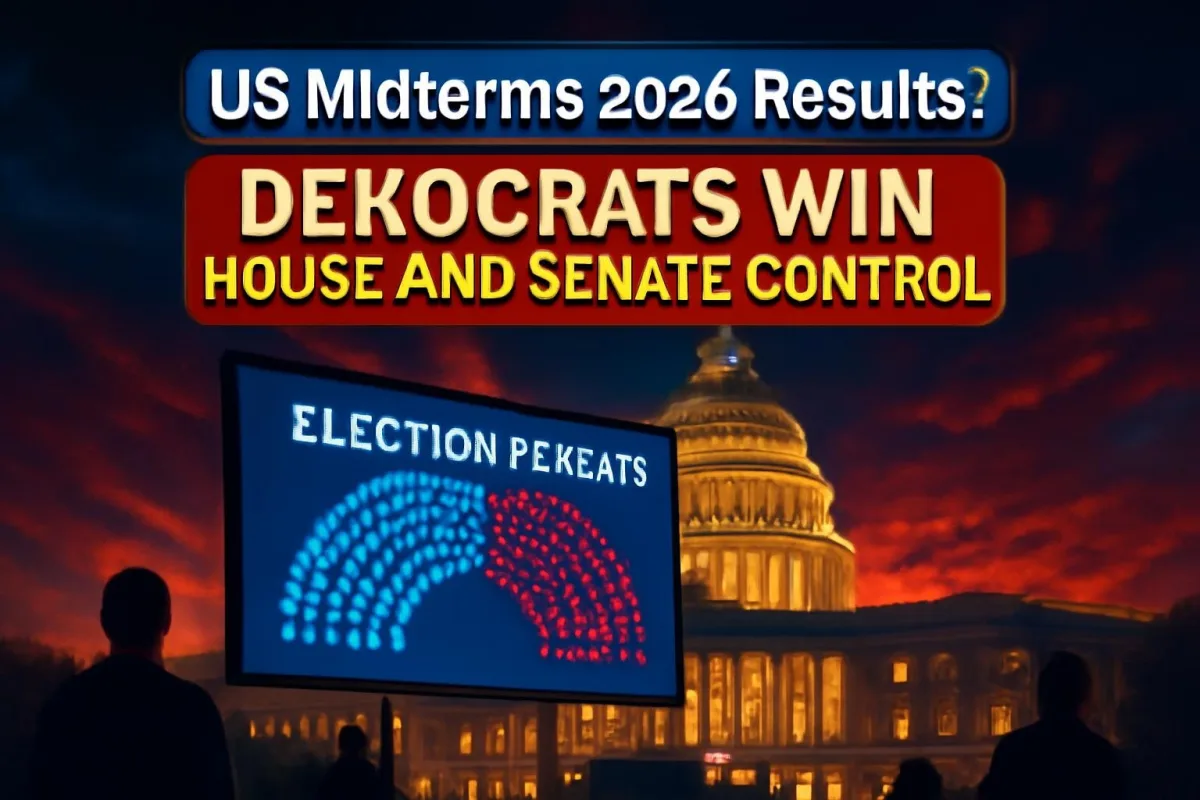
American voters have handed control of the US Congress to the Democratic Party. In the midterm elections held on Tuesday, November 3, Democrats won enough seats to take the House of Representatives and also flipped the Senate, according to projections by major US networks including CBS News. For President Donald Trump, who is only halfway through his second term, it is the biggest political blow since he returned to the White House.
Results started arriving on Wednesday morning India time and, by around noon IST, the picture was clear: from January, Mr Trump will face a Congress led by his opponents in both chambers.
How the night unfolded
The first big signal came from North Carolina, where former governor Roy Cooper defeated Republican Michael Whatley to win an open Senate seat earlier held by Republican Thom Tillis. It was the first Senate seat of the night to change hands. Democrats then held the seats they were defending in Georgia, where Jon Ossoff was re-elected, and in New Hampshire, where Chris Pappas beat former senator John E. Sununu.
The result that grabbed the most attention came from Texas. Democrat James Talarico, a 37-year-old state legislator and former school teacher, defeated Texas Attorney General Ken Paxton, who had the backing of Mr Trump. It is the first time Democrats have won a US Senate race in Texas since 1988, ending a Republican winning streak in statewide races that lasted more than three decades.
In Maine, Democrat Troy Jackson defeated long-serving Republican senator Susan Collins, CBS News reported. Democrats needed a net gain of four seats to take the Senate, and the projections show they crossed that line.
The House flips too
Before polling, Republicans held 218 seats in the 435-member House against 214 for Democrats, a razor-thin majority. Democrats needed a net gain of just a handful of seats, and they found them in places like Texas, Ohio and Wisconsin. CBS News reported that Democrats flipped two Texas districts, the 15th and the 23rd, while Republican representatives Max Miller in Ohio and Derrick Van Orden in Wisconsin lost their seats. Counting is still going on in several close races, so the final size of the new majority is not yet known.
"America is back," said House Democratic leader Hakeem Jeffries, who is now in line to become Speaker. Current Speaker Mike Johnson said Republicans "will not be deterred by the outcome of one election."
Key facts at a glance
| Election date | Tuesday, November 3, 2026 (results on November 4 IST) |
| Seats on the ballot | All 435 House seats, 35 Senate seats, 36 governor races |
| House before polls | Republicans 218, Democrats 214 |
| Senate before polls | Republicans 53, Democrats 45, plus 2 independents who side with Democrats |
| Result | Democrats projected to control both House and Senate |
| Headline Senate flips | North Carolina (Roy Cooper), Texas (James Talarico), Maine (Troy Jackson) |
| Early voting | More than 59 million early votes, above 2022 levels |
| New Congress takes office | January 2027 |
Why voters turned against the ruling party
The economy dominated the campaign. Consumer prices in the US rose 3.6% in September compared with a year earlier, and an AP survey of voters found about three-quarters described the economy as "not so good" or "poor". A similar share said they were angry or dissatisfied with the direction of the country. Mr Trump had urged supporters to vote as if he himself were on the ballot, and on election night he insisted the results would be "better than you think" for Republicans.
History was also against him. Since 1934, the president's party has gained House seats in a midterm only three times.
What it means for Trump's second half
With Democrats running both chambers, every big spending bill will now need their agreement, and House committees will gain the power to launch investigations into the administration. A Democratic Senate can also slow down or block Mr Trump's nominees, from cabinet posts to federal judges and any future Supreme Court vacancy. Expect more executive orders, more court battles and tougher budget fights over the next two years.
Why India should watch closely
For India, the shift matters on trade, tariffs and immigration. Congress has a say on trade deals, sanctions and visa laws, including the H-1B programme used heavily by Indian IT professionals. A divided government in Washington often means slower legislation, so big changes to work visas or trade terms could become harder to push through in either direction. Indian markets and the rupee also tend to react to US political uncertainty, especially when it affects the dollar and interest-rate expectations.
The Indian-American community, now one of the most politically active immigrant groups in the US, will also be watching how its representatives fare once all races are called.
What happens next
Officials will keep counting votes in close House races over the coming days, and some contests may head to recounts. The new Congress will be sworn in in January 2027, when Democrats formally take charge of both chambers. Until then, the current Republican-led Congress remains in office for a "lame duck" session.





Comments (0)