
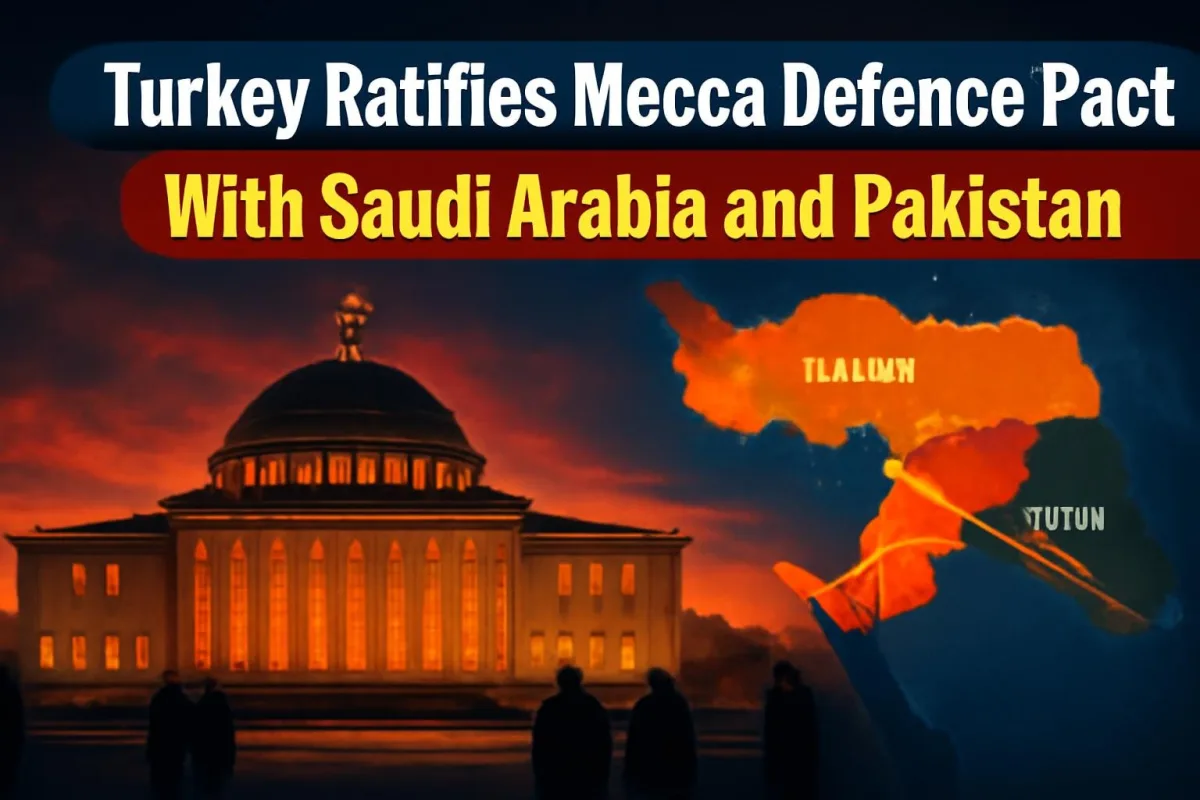
Turkey has formally signed up to a three-nation security bloc with Saudi Arabia and Pakistan. The Grand National Assembly of Turkey on Thursday, November 5, ratified the Mecca Joint Defence Agreement by 279 votes to 119, a pact under which an armed attack on any one of the three countries is to be treated as an attack on all of them.
The vote comes at a tense moment for the Gulf, with Saudi Arabia facing repeated attacks from Yemen's Iran-backed Houthi rebels, and it creates a new military alignment that India, with deep ties to Riyadh and a long rivalry with Islamabad, will be studying closely.
What Turkey's Parliament Approved
The bill passed by Turkish lawmakers is short, just three articles. The first approves the 16-article defence agreement itself. The second says the pact will take effect once it is published in Turkey's Official Gazette, and the third hands responsibility for carrying it out to the president.
The agreement was signed in Mecca on August 7, 2026, by the leaders of the three countries, and the Turkish government sent it to parliament for approval in October.
| Key Fact | Details |
|---|---|
| Agreement | Mecca (Makkah) Joint Defence Agreement |
| Members | Turkey, Saudi Arabia, Pakistan |
| Signed | August 7, 2026, in Mecca |
| Turkish parliament vote | 279 in favour, 119 against (November 5, 2026) |
| Size of agreement | 16 articles |
| Core clause | Armed attack on one member treated as an attack on all |
| Entry into force (Turkey) | On publication in the Official Gazette |
| Troop deployment | Needs separate approval from Turkish parliament |
The Mutual Defence Clause, Explained
The heart of the pact is its collective defence promise. If one signatory faces an armed attack, the other two are expected to treat it as an attack on themselves. That language will sound familiar to anyone who follows NATO, of which Turkey is already a member.
There is an important catch, though. According to details reported by China's Xinhua news agency, the clause does not automatically trigger military deployment. Any help would be decided through consultations between the three governments and according to each country's own constitutional procedures. In Turkey's case, sending troops abroad would still require a separate authorisation from parliament.
Beyond the headline clause, the agreement covers closer military cooperation, intelligence sharing, collective deterrence and cooperation between the defence industries of the three nations. Turkey and Pakistan already have strong defence-industry links, and Saudi Arabia has been looking to build up its own domestic arms production.
Why Now: Houthi Attacks on Saudi Arabia
The ratification clears the way for Ankara to send military support to Riyadh at a time when the kingdom is facing attacks by the Houthis from Yemen. A ruling party lawmaker had told Reuters last month that Turkey would submit a separate mandate to parliament for deploying military personnel to Saudi Arabia.
Just this week, Qatar, Kuwait, Bahrain and Jordan condemned a Houthi ballistic missile attack on Saudi Arabia's Madinah region, according to Turkey's Anadolu news agency. The wider region has also been on edge over tensions in the Strait of Hormuz, a key route for oil shipments to Asia, including India.
Anadolu also reported that AK Party lawmaker Ziya Altunyaldiz told parliament the pact is not directed against any third country.
What It Means for India
No official reaction from New Delhi has been reported so far, but the pact touches several of India's interests at once.
Pakistan gets a bigger security umbrella
Pakistan is now tied into a formal defence arrangement with both a major Gulf power and a NATO member. While the agreement does not automatically commit troops, any future India-Pakistan crisis will now play out against the backdrop of this three-way alliance, which strategists in Delhi will factor into their calculations.
India's own ties with Saudi Arabia
Saudi Arabia is one of India's most important partners for crude oil, investment and jobs. Millions of Indians live and work in the Gulf, and Riyadh has steadily deepened its relationship with New Delhi over the past decade. How the kingdom balances its new commitments with Pakistan and Turkey alongside its close economic partnership with India will be a key question in the months ahead.
Safety of Indians in the Gulf
With Houthi missile attacks continuing and Turkey preparing to send support to Saudi Arabia, the security situation in the region remains fluid. Indian families with members working in Saudi Arabia will be watching developments, and any escalation could also affect oil prices back home.
What Happens Next
The next step in Turkey is publication of the law in the Official Gazette, after which the pact becomes binding for Ankara. A separate motion seeking parliament's permission to deploy Turkish military personnel to Saudi Arabia is expected to follow. Observers will also watch whether other countries in the region show interest in joining or aligning with the bloc, and how Iran and the Houthis respond.
For India, the immediate impact is diplomatic rather than military, but the Mecca agreement marks a clear shift in how security is being organised in the Gulf and West Asia, a region that matters deeply to India's energy, trade and diaspora.


Comments (0)