
External Affairs Minister S Jaishankar has said the India-US trade deal is in its final stretch, but he is not ready to call it finished. Speaking at the NDTV World Summit in New Delhi on Thursday, October 22, he said, "Well, look, it's never done till it's done," adding that the "last mile or the penultimate miles do pose their challenges."
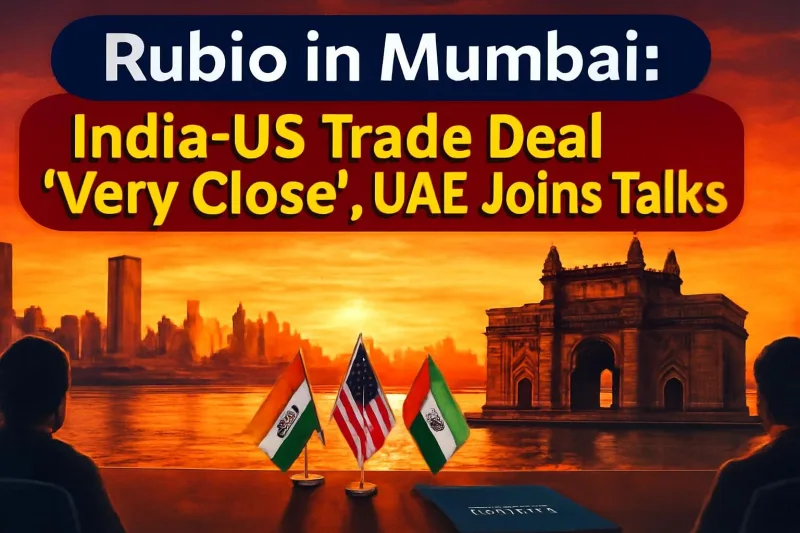
His careful words came two days after US President Donald Trump said the two countries were "pretty close" to an agreement, and soon after US Secretary of State Marco Rubio's visit to Mumbai, where he too described the pact as nearly ready.
What Jaishankar said
Jaishankar acknowledged that both Rubio and Commerce Minister Piyush Goyal had signalled the agreement was in its final phase. "We are moving towards it," he said. But he was clear that the closing stage of any trade negotiation tends to be the hardest. When asked what the remaining hurdles were, he declined to go into detail, saying that is "for the negotiators to sort out."
He also spoke about the wider picture, warning that countries "can no longer take stability in trade, energy, and geopolitics for granted." He argued against "overdependence on a single source" and said nations everywhere are rethinking where they get their energy from.
Trump and Rubio: 'pretty close'
On October 20, Trump told reporters at the White House that the countries were "pretty close" to a deal. He also said it would be "a much different kind of deal" than the trade pacts the US has signed before, though he did not explain what he meant.
Rubio, who met Jaishankar in Mumbai the same day, said only a small number of items remained after more than a year of talks. In an interview, he suggested the deal could be weeks rather than months away, and said both sides still need to agree on the final wording. During the visit, he also toured the Reliance-run Jamnagar refinery and described India as a petroleum-refining "superpower."
Key facts at a glance
| Item | Details |
| Talks began | February 2025 |
| First-phase framework announced | February 2026 |
| Trump's remark | "Pretty close" (October 20, 2026) |
| Jaishankar's remark | "It's never done till it's done" (October 22, 2026) |
| Main sticking points | Tariffs, market access, farm products, industrial goods, Russian oil purchases |
| Indian negotiator in charge | Commerce Minister Piyush Goyal |
| Status | No final deal announced yet |
Why it is taking so long
India and the US started working on a bilateral trade arrangement in February 2025 and announced a framework for the first phase in February this year. After that, changes in US tariff policy pushed both sides back to the table to rework the terms, especially how Indian exports will be treated.
The issues still being discussed are familiar ones. Washington wants wider access for American farm and industrial goods, while New Delhi has long protected sensitive sectors such as agriculture and dairy, which support millions of small farmers. Tariff levels on Indian goods entering the US are another big piece of the puzzle. India's purchases of Russian oil have also been a point of friction, although the US recently paused some proposed tariffs linked to Russian energy, which removed one complication.
Energy is now part of the conversation in a bigger way. Rubio has pitched more US energy exports as a way for India to diversify its supplies, a point that fits with Jaishankar's own message about not relying on any single source.
What it means for India
For Indian exporters, especially in textiles, gems and jewellery, engineering goods, pharmaceuticals and IT services, a deal could bring more predictable tariffs in their largest export market. Predictability matters as much as the actual duty rates, because businesses need to plan contracts months ahead.
For consumers, the effects are likely to be gradual. Lower duties on some American products, such as certain nuts, fruit or tech items, could make them cheaper over time, depending on what is finally agreed. Farmers' groups, on the other hand, will be watching closely to see whether any concessions touch sensitive crops or dairy.
There is also a political angle. The government has spoken about the deal as a sign of India's growing economic weight, while opposition parties have repeatedly asked for clarity on what India is giving up in return. A signed text will put those questions to rest one way or another.
What happens next
Officials on both sides are expected to keep working on the final details, including the legal wording of the agreement. If those talks close in the coming weeks, as Rubio suggested, the next step would be a formal announcement by the two leaders. Until then, Jaishankar's message is simple: progress is real, but nothing is final until both sides sign.
Comments (0)